 Semiahmoo Siding
 Birch Bay's Coastline Is Rougher on Siding Than It Looks
Birch Bay sits right on the water, and that changes what a house needs from its siding. Salt-laden air off the Strait rides in on the wind almost year-round, and it settles into anything porous or poorly sealed. Add Whatcom County's long, wet winters — months of driving rain broken up by only brief dry stretches — and you get siding that stays damp longer than it should, in conditions that never fully let it dry out before the next system rolls through.
That combination is exactly what breeds moss. Shaded walls, north-facing elevations, and anywhere wind-driven rain collects tend to grow a green film within a few seasons if the siding material and the installation details aren't built to shed water and dry fast. Moss isn't just cosmetic — it holds moisture against the wall, and moisture held against a wall long enough finds a way in, especially around seams, corners, and trim.
None of this means a house in Birch Bay is doomed to constant repairs. It means the siding material and the install both have to be chosen for this specific exposure, not for a catalog photo or a low bid.
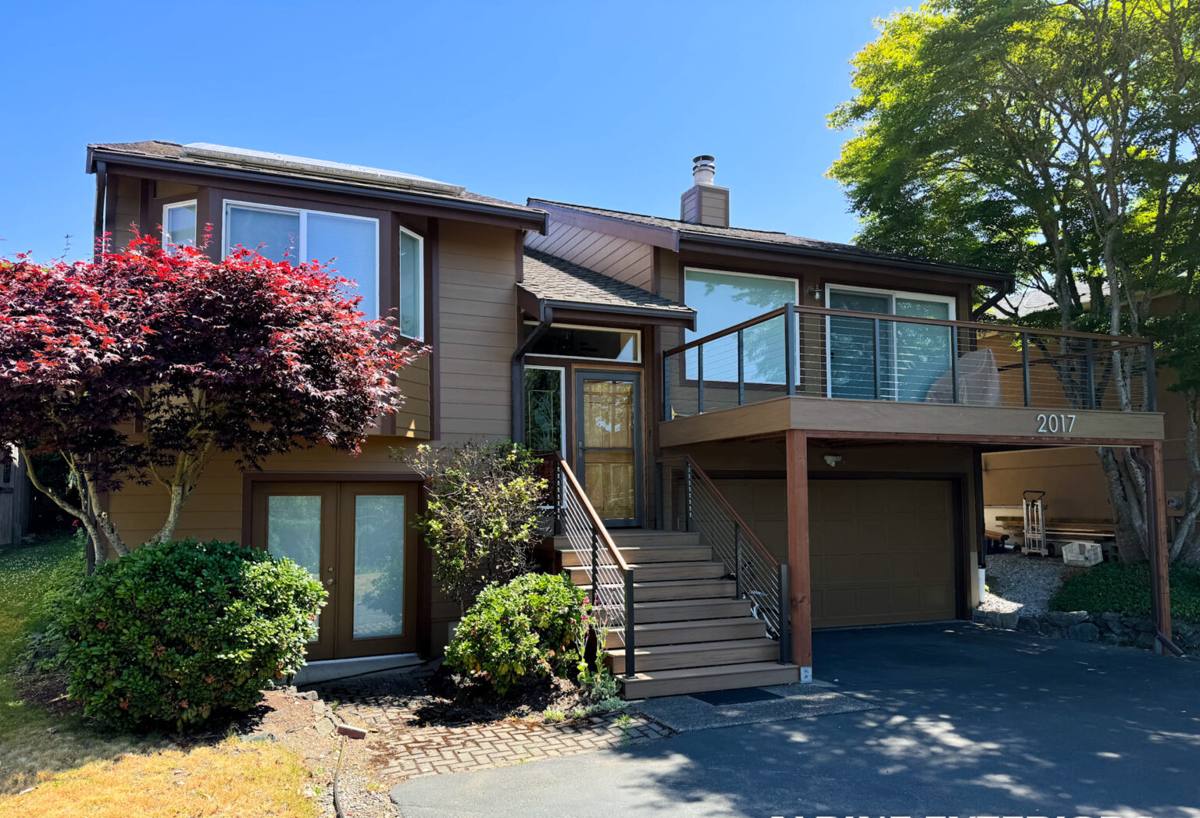
What "Correct" Siding Installation Actually Means Here
A siding job can look finished and still be wrong underneath. In a salt-air, high-rainfall environment, the parts nobody sees matter as much as the parts everyone does. Correct installation for a Birch Bay home includes:
- A drainage plane and weather-resistive barrier installed so water that gets behind the siding has somewhere to go — down and out, not trapped against the sheathing
- Rainscreen or furring strip gaps where the wall assembly calls for them, so both sides of the siding can actually dry
- Correct fastener type and spacing for fiber cement, not whatever nails happen to be in the gun
- Proper flashing at every window, door, and roofline intersection — the majority of siding failures start at a flashing detail, not the field of the wall
- Manufacturer-specified clearances at grade, decks, and roof lines so siding never sits in standing water or snow load
- Factory-finished panels handled and cut in a way that keeps the factory coating intact at every edge
Skip any one of these and the siding itself stops mattering — water will find the gap in the system, not the gap in the material.
Why We Install Only James Hardie Fiber Cement
We standardized on James Hardie fiber cement siding and don't install vinyl, LP SmartSide, cedar, primed spruce, or other fiber cement brands. That's a deliberate call based on what holds up in exactly this kind of exposure.
Fiber cement is non-combustible and dimensionally stable — it doesn't expand and contract with humidity swings the way wood-based products do, which matters when a wall is damp more often than it's dry. James Hardie's HZ5 product line is engineered specifically for wet, moderate coastal climates like ours, with a formulation built to resist moisture-related damage over the long haul. The factory-applied ColorPlus finish is baked on under controlled conditions, giving it better fade and moisture resistance at the surface than field-applied paint — which matters when salt air is already working against any coating.
We're not saying every other product is unusable everywhere. We're saying that after years of doing this work on this coastline, we've seen which materials need the least babying in salt air and long wet seasons, and we only want our name on the ones that hold up with reasonable maintenance.
| Factor | James Hardie Fiber Cement | Vinyl | Wood-Based (cedar, primed spruce, LP SmartSide) |
|---|---|---|---|
| Moisture behavior | Dimensionally stable, engineered HZ5 formulation for wet coastal climates | Doesn't absorb water, but can warp or crack in temperature swings | Absorbs moisture; prone to swelling, rot, or delamination if seals fail |
| Salt air exposure | Factory ColorPlus finish holds up well against airborne salt | Can chalk and become brittle over time in coastal UV/salt exposure | Coatings degrade faster; needs more frequent recoating near the water |
| Moss/algae resistance | Dense, low-porosity surface sheds and dries faster | Sheds moisture but seams and J-channels trap debris | More porous surface holds moisture, encouraging moss growth |
| Fire resistance | Non-combustible | Combustible, can melt or deform near heat sources | Combustible |
| Long-term maintenance | Occasional wash and repaint of trim; panel finish is durable | Low maintenance but limited repair options if damaged | Regular recoating/resealing needed to prevent moisture damage |
Our Installation Process for Birch Bay Homes
Assessment and Wall Condition Check
Before any siding goes up, we look at what's underneath. On a coastal home this is non-negotiable — we're checking sheathing for moisture damage, confirming the current weather barrier condition, and identifying trouble spots like north-facing walls or areas with heavy moss buildup that point to past drainage problems.
Weather Barrier and Drainage Plane
We install or verify a continuous weather-resistive barrier and, where the wall assembly calls for it, a rainscreen gap so both faces of the siding can dry. This step matters more here than almost anywhere else we work, given how long walls stay damp through a typical Whatcom County winter.
Flashing Details
Every penetration — windows, doors, hose bibs, light fixtures, roof-to-wall transitions — gets flashed correctly before siding closes it in. This is the step that determines whether a house stays dry for decades or develops hidden rot in five years.
Hardie Panel Installation
Panels, fasteners, and clearances are installed to James Hardie's published specifications for our climate zone — correct nail spacing, correct gaps at grade and roof lines, and factory-cut edges kept sealed and protected.
Final Detail Work
Trim, caulking at appropriate joints (not as a substitute for flashing), and a final walk-through where we point out anything the homeowner should keep an eye on going forward.
Cost Factors Homeowners in Birch Bay Should Know
Every home is different, so we won't quote a number without seeing the house, but the main variables that move the price are consistent:
- Whether existing siding needs to be removed and the sheathing repaired underneath (common on homes with past moisture intrusion)
- Total wall square footage and the complexity of the roofline (dormers, gables, and multiple stories add labor)
- James Hardie product line and profile selected (lap siding, panel, shingle-style)
- Trim scope — window and door trim, corner boards, and fascia work done alongside the siding
- Access — waterfront lots, steep grades, or tight setbacks common in Birch Bay can add staging or access time
We walk every home before quoting, because the condition of the wall behind the old siding — not just the siding itself — is often the biggest driver of cost on a coastal property.
Signs Your Current Siding Is Already Behind
Homeowners in Birch Bay usually notice one or more of these before calling: persistent moss or green staining that comes back within a season of cleaning, soft or spongy spots near the bottom of walls or under windows, visible warping or gaps at panel seams, paint or finish that's chalking and fading unevenly, or a musty smell in rooms along exterior walls. Any of these point to moisture getting past the siding system, and on a coastal home that problem rarely stays small.
Why Local Experience in Birch Bay Matters
A crew that mostly works inland doesn't think about rainscreen gaps, salt-air fastener corrosion, or moss-prone north walls the same way a crew that works this shoreline every week does. We size up a Birch Bay wall assembly the same way we'd want a homeowner here to think about it — assuming wind-driven rain, assuming salt air, and assuming the wall needs to dry out fast after every storm, because in this part of Whatcom County, it's going to get tested constantly.
That local familiarity also means we know what tends to go wrong first on homes in this area — usually flashing details and drainage, rarely the siding material itself when it's installed correctly. Fixing the right problem the first time is what keeps a siding job from becoming a recurring expense.
Maintenance After Installation
James Hardie siding installed to spec is low-maintenance, not no-maintenance. In a salt-air environment like Birch Bay, an occasional gentle wash to clear salt residue and any early moss growth goes a long way. Keeping gutters clear and vegetation trimmed back from walls helps airflow and cuts down on shaded, damp zones where moss tends to start. Beyond that, periodic visual checks at trim and flashing points — the same details we're careful about during installation — catch small issues before they become wall problems.
If you're weighing a siding replacement or want a second opinion on a wall that's showing moss, staining, or soft spots, we're happy to take a look. Reach out for a free, no-pressure estimate — we'll walk the house, tell you honestly what we see, and go from there.