 Semiahmoo Siding
 Siding Built for Laurel's Coastal Weather
Laurel sits close enough to Semiahmoo Bay and the Strait of Georgia that homes here deal with a specific combination of stresses most inland Whatcom County properties don't see as intensely: salt-laden air moving in off the water, long stretches of driving rain, and a moss and mildew season that can run from October well into spring. None of that is unusual for this corner of northwest Washington — but it does mean the exterior materials on a Laurel home are working harder, year-round, than the same materials would on a house fifty miles inland.
We're a local crew that works this area regularly, not a company that shows up once and disappears. That matters for siding, roofing, windows, and decks alike, because exterior work in a marine climate isn't just about the install day — it's about how the whole envelope behaves in month eighteen, and year eight, and year twenty.
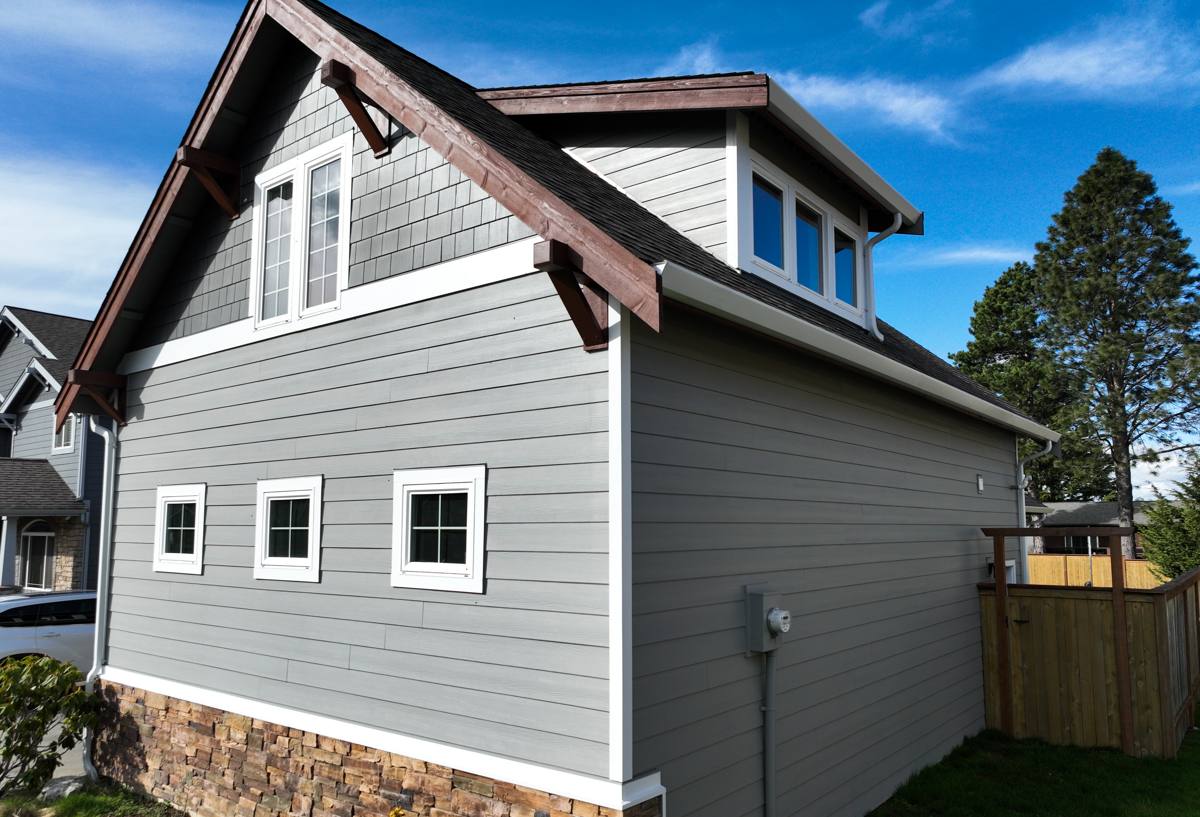
What the Local Climate Actually Does to a House
Salt Air and Corrosion
Airborne salt doesn't just affect houses right on the waterfront. It travels on wind and settles on siding, trim, fasteners, and flashing well inland from the shoreline. Over years, salt exposure accelerates corrosion on unprotected metal fasteners and can degrade coatings that weren't formulated to handle it. It also tends to hold moisture against a surface longer than plain rainwater would, which compounds the next problem.
Driving Rain and Wind-Driven Moisture
Storms coming off the water in this part of Whatcom County often bring rain sideways, not straight down. That means siding laps, window flashing, and deck ledger connections all take on more water intrusion risk than they would in a calmer inland setting. A siding system that's tolerant of standing moisture — and installed with the right flashing details — matters more here than it does in drier parts of the state.
Moss, Algae, and the Long Wet Season
Whatcom County's wet season is long, and shaded or north-facing walls in Laurel can stay damp for weeks at a time. Moss and algae growth on siding and roofing isn't just cosmetic — sustained organic growth holds moisture against the surface underneath it, and on materials that aren't dimensionally stable or moisture-resistant, that's a slow path to rot, delamination, or coating failure.
Why We Install Only James Hardie Fiber Cement Siding
We made a deliberate decision to install one siding system across every job we do: James Hardie fiber cement. We don't install vinyl, LP SmartSide, Cemplank, Allura, primed spruce, or cedar. That's not a marketing position — it's a practical one, built around what actually holds up in this climate over decades, not just through the warranty period.
- Non-combustible core: Fiber cement doesn't feed a fire the way wood-based or engineered-wood siding can, which matters for insurance conversations and long-term risk, not just aesthetics.
- Moisture and salt tolerance: Hardie's fiber cement composition doesn't swell, rot, or delaminate the way wood-based products can when they take on repeated moisture exposure — a real advantage in a salt-air, high-rainfall area like Laurel.
- Factory-applied ColorPlus finish: Baked-on in a controlled environment rather than field-applied, ColorPlus finishes are formulated to resist fading and hold up against UV and moisture cycling far longer than a job-site paint job.
- Climate-engineered product lines: Hardie makes region-specific HZ formulations, so the product going on a home here is engineered for Pacific Northwest moisture exposure rather than a one-size-fits-all national spec.
- Strong transferable warranty: A meaningful, transferable warranty adds real value at resale, which matters in a market where buyers increasingly ask what the exterior is made of.
We're not going to tell you every other siding product is worthless — vinyl, engineered wood, and others each have a legitimate place. But once you've seen what salt air and a wet Whatcom County winter do to lesser materials over ten or fifteen years, standardizing on one proven system stopped being a hard call for us.
How a Siding Project Works in Laurel
Inspection and Assessment
Every job starts with a real look at the existing siding, trim, and the wall assembly behind it — not just a visual pass from the street. We're checking for hidden moisture damage, failed flashing, and any spots where prior water intrusion has already started working on the sheathing. In a marine climate, what's happening behind the siding is often more important than what's visible on the surface.
Moisture Management Details
Given how much wind-driven rain this area sees, we pay particular attention to weather-resistive barrier installation, window and door flashing integration, and drainage plane detailing behind the new siding. Fiber cement performs best when the assembly behind it is also doing its job — a good product installed with sloppy flashing will still leak.
Installation to Manufacturer Spec
James Hardie siding has specific installation requirements around fastening, clearances, and joint treatment, and those requirements exist for a reason — they're what the warranty is actually based on. We install to spec, not to the fastest possible timeline.
Full Exterior Envelope: Siding, Roofing, Windows, Decks
Siding doesn't function in isolation, and homes in Laurel typically need the whole envelope working together against the same weather. We handle roofing, window replacement, and deck construction and repair alongside siding work, which lets us look at a house as one system rather than four separate problems.
- Roofing: The roof-to-wall transitions and flashing details are often where wind-driven rain finds its way in — worth checking whenever siding is being replaced.
- Windows: Old window flashing is a common hidden source of wall moisture; window replacement is a natural pairing with a siding project rather than a separate job later.
- Decks: Ledger board connections and deck-to-house flashing face the same rain and moisture exposure as siding, and deteriorate on the same timeline in this climate.
Why a Local Crew Matters Here
A crew that works Whatcom County regularly knows what Laurel's exposure actually looks like — which walls take the worst of the weather off the bay, what moss growth patterns tell you about a wall's drainage, and how local permitting and inspection processes work. That local knowledge shows up in the details: where extra flashing attention is warranted, which sides of a house need closer moisture inspection before new siding goes on, and how to sequence a project around this area's rainy stretches. We're also here after the job is done, for warranty questions or a follow-up look, rather than a name on an invoice from a company that worked the region once.
Comparing Siding Options Homeowners Consider
| Material | Moisture/Salt Behavior | Fire Resistance | Finish Durability | Maintenance Burden |
|---|---|---|---|---|
| James Hardie fiber cement | Highly tolerant, dimensionally stable | Non-combustible | Factory ColorPlus, long fade resistance | Low |
| Vinyl | Doesn't rot but can warp/crack in temperature swings | Combustible, can melt/deform in fire exposure | Color molded through, but fades and chalks over time | Low, but limited repair options |
| Engineered wood (LP SmartSide-type) | Vulnerable to moisture intrusion at cut edges and joints | Combustible | Field or factory finish, variable | Moderate to high in wet climates |
| Cedar / primed spruce | Natural material, absorbs moisture, needs consistent sealing | Combustible | Requires periodic refinishing | High |
What to Expect From an Estimate
Cost varies with home size, wall complexity, trim detail, and how much of the existing assembly needs repair before new siding goes on — we won't quote a number without actually looking at the house. What we can tell you upfront is what drives the range on most Laurel-area projects:
- Square footage of siding and complexity of the wall lines (dormers, gables, multiple stories)
- Condition of the existing sheathing and weather barrier once old siding comes off
- Amount of trim, corner detail, and custom work involved
- Whether roofing, window, or deck work is being bundled into the same project
- Color and product line selected within the Hardie system
A Practical Checklist for Homeowners Considering Siding
- Look for moss or algae concentrated on specific walls — it usually points to a drainage or sun-exposure pattern worth understanding before you re-side
- Check for soft spots, bubbling, or discoloration near window and door trim, which often signals flashing failure underneath
- Ask any contractor what specific product line and finish they're proposing, not just "fiber cement" or "siding"
- Confirm whether the quote includes flashing and weather-barrier work, not just panel installation
- Ask about warranty terms and whether they transfer to a future buyer
If you're weighing a siding, roofing, window, or deck project in Laurel, we're happy to come take a real look and walk you through what we're seeing and what it would take to fix it right. Estimates are free, and there's no pressure to move forward — just a straight answer from a crew that works this coastline regularly.