 Semiahmoo Siding
 Exterior Conditions Homeowners in Lynden Deal With
Lynden sits in Whatcom County, close enough to the Strait of Georgia and the Salish Sea that salt-laden air, wind-driven rain, and long stretches of damp, low-light weather all shape how a home's exterior ages. It's not one dramatic storm that causes problems out here — it's the accumulation. Months of overcast skies, persistent moisture in the air, and a moss season that can run from fall through spring wear on siding, trim, and roofing in ways that don't show up right away but eventually do.
Homes with south and west exposure tend to take the brunt of driving rain, while shaded north sides and anything tucked under trees deal with the worst of the moss and algae growth. Add in the salt air that rides inland on coastal wind, and you've got a combination that punishes any exterior material with weak points at seams, fasteners, or paint film.
Why This Matters for Siding Specifically
Siding is the first line of defense against all of this. If it absorbs water, holds moisture against the wall assembly, or lets finish coatings fail early, the problems move inward — rot in sheathing, mold behind the wall, and repair bills that dwarf what a better material would have cost up front. That's the lens we use when we talk to Lynden homeowners about their options.
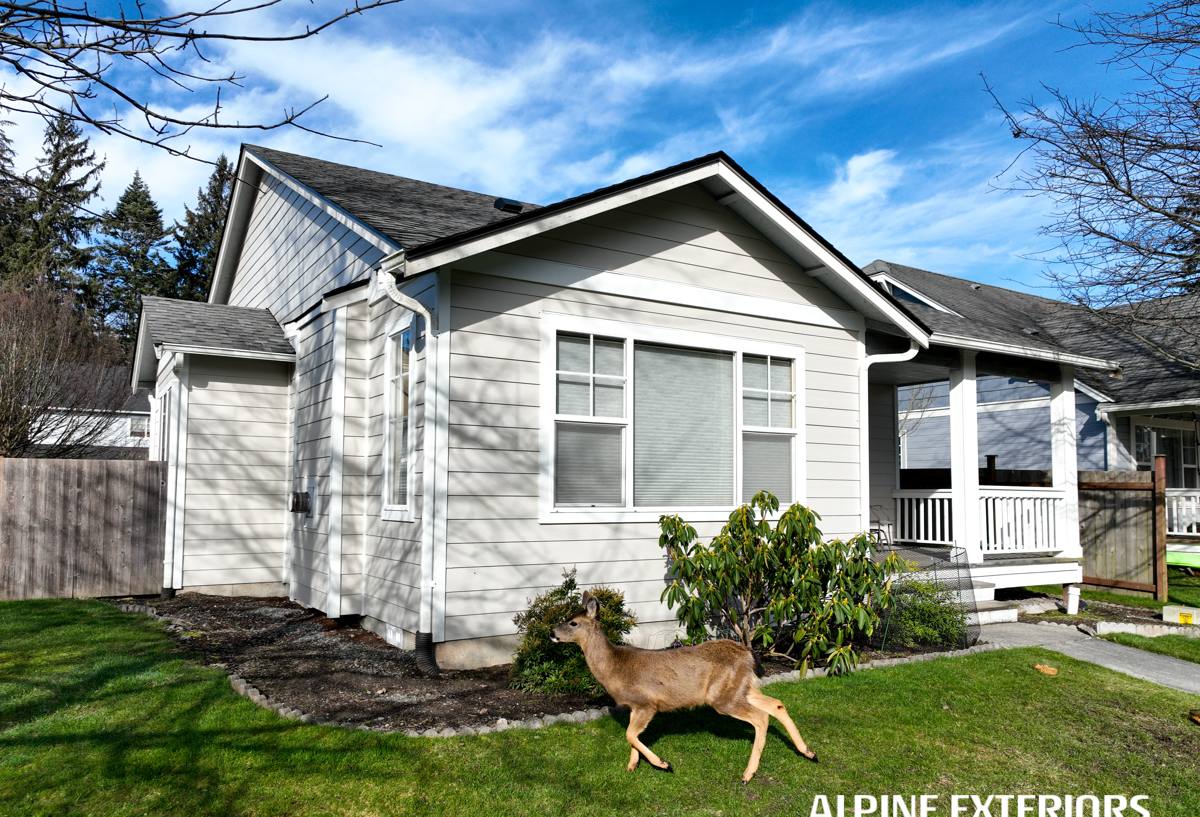
Why We Install Only James Hardie Fiber Cement
We made a decision as a company to install James Hardie fiber cement siding exclusively. We don't install vinyl, LP SmartSide, Cemplank, Allura, primed spruce, or cedar. That's not a marketing angle — it's a standard we hold because of what we've seen play out on real homes in this climate over years, not just at the time of installation.
Fiber cement is non-combustible, dimensionally stable, and doesn't absorb water the way engineered wood products can. James Hardie's ColorPlus finish is baked on in a factory-controlled process, which gives it a more consistent, durable topcoat than field-applied paint typically achieves. And Hardie engineers specific product lines (HZ5, HZ10) for different climate zones, which matters in a region that cycles through wet winters and drier summers.
What This Looks Like in Practice
- Panels and lap siding that hold their shape and don't swell or delaminate at cut edges when properly sealed
- A factory finish designed to resist fading and cracking longer than most field-applied paint systems
- A material that doesn't feed mold or fungal growth the way wood-based products can
- A transferable limited warranty that adds real value if the home is sold within the coverage period
Why We Don't Install Vinyl, LP SmartSide, or Comparable Products
We want to be straightforward about this rather than just saying "we don't do it." Each of these products has legitimate uses and reasons homeowners choose them — usually cost.
Vinyl Siding
Vinyl is inexpensive and low-maintenance in mild climates, and it has a place in the market. But it's a thin plastic product that expands and contracts significantly with temperature swings, can crack in impacts, and fades over time with no way to refinish it short of replacement. In a region with persistent wind and driving rain, vinyl's seams and J-channels are also common points where water finds its way behind the cladding.
LP SmartSide and Other Engineered Wood
Engineered wood siding has improved a lot over the decades, but it's still a wood-strand product with a resin binder, which means it's more sensitive to sustained moisture exposure than fiber cement. In a climate with a long wet season and heavy moss growth, any breach in the finish or a poorly sealed cut edge gives water an entry point that wood-based cores don't handle as gracefully as fiber cement.
Cemplank, Allura, Primed Spruce, and Cedar
Cemplank and Allura are also fiber cement products, and they're reasonable materials on paper. Our decision to standardize on Hardie specifically comes down to manufacturing consistency, the ColorPlus finish process, and the warranty and support structure behind the product in our market. Primed spruce and cedar are beautiful, traditional choices, but they require an ongoing maintenance commitment — refinishing, caulking, moisture monitoring — that most homeowners underestimate until they're several years in, especially in a climate that doesn't give painted wood much of a break to dry out.
Comparing Siding Materials for This Climate
| Material | Moisture Resistance | Maintenance | Typical Lifespan Here |
|---|---|---|---|
| James Hardie Fiber Cement | Strong; doesn't absorb water like wood-based products | Low; occasional wash, repaint only if desired | 30+ years with correct install |
| Vinyl | Moderate; seams are vulnerable | Low but non-repairable finish | 15–25 years, shorter with impact damage |
| LP SmartSide / Engineered Wood | Moderate; sensitive at cut edges and breaches | Moderate; finish and caulking upkeep | 20–30 years if well maintained |
| Cedar / Primed Spruce | Weak without diligent upkeep | High; regular refinishing and sealing | Highly variable, often 15–25 years |
These are general ranges, not guarantees — actual performance always depends on installation quality, exposure, and upkeep, regardless of material.
How Correct Installation Matters as Much as the Product
Even the best siding material fails early if it's installed wrong. In a climate defined by driving rain and long wet stretches, the details most homeowners never see are the ones that determine whether siding lasts 10 years or 40.
What Correct Hardie Installation Involves
- Proper water-resistive barrier and flashing behind the siding, not just at obvious points like windows but at every penetration
- Correct fastener placement and spacing per manufacturer specification, not shortcuts that void warranty coverage
- Minimum clearance between siding and grade, decks, roofing, and other surfaces so water has somewhere to go
- Sealed and primed cut edges, since an unsealed factory edge is one of the few weak points in the material itself
- Proper caulking and joint treatment at seams, corners, and trim transitions
This is the part of the job that doesn't show up in photos but is the actual difference between a siding job that performs for decades and one that causes problems in five years.
Our Process for Lynden Homeowners
We start with a walk-around of the home to look at exposure, existing damage, moss and moisture patterns, trim condition, and anything the current siding or roofing is telling us about how water has been moving around the structure. From there we talk through product lines, colors, and where the budget makes sense to spend more or less.
Because we handle siding, roofing, windows, and decks as one company, we can also flag related issues while we're there — a roof edge that's feeding water behind the wall, a window flashing detail that needs correcting before new siding goes over it, or deck ledger connections that are contributing to rot nearby. Homeowners in this region often end up needing more than one of these addressed at once, since moisture problems rarely stay contained to a single system.
What to Expect During the Job
| Stage | What Happens |
|---|---|
| Assessment | Walk-around, moisture and exposure check, product and color discussion |
| Prep | Removal of old siding or trim, inspection of sheathing, repair of any hidden damage found |
| Weather barrier | Water-resistive barrier and flashing installed at all penetrations and transitions |
| Installation | Hardie panels or lap siding installed to manufacturer spec, including fastener and clearance requirements |
| Finish detail | Trim, caulking, and touch-up work at seams and corners |
Beyond Siding: Roofing, Windows, and Decks
Siding doesn't work in isolation. A roof that's shedding water incorrectly, windows with failed flashing, or a deck ledger tied into the wall assembly can all undermine even a well-installed siding job. Because our crew handles all four of these trades, we look at a home's exterior as one connected system rather than four separate projects that happen to touch the same house.
This matters especially in a climate where moss, algae, and sustained moisture don't respect the boundary between "roofer's problem" and "siding contractor's problem." A gutter or roof edge issue that's pushing water behind the siding won't get fixed by replacing the siding alone.
Maintenance Homeowners Should Actually Do
Fiber cement is low-maintenance, not no-maintenance. A little attention goes a long way in this climate.
- Rinse siding periodically to remove dirt, salt residue, and organic buildup, especially on shaded or north-facing walls
- Keep gutters clear so water isn't overflowing onto siding below
- Trim back vegetation and tree cover that keeps siding damp and shaded, which encourages moss and algae
- Check caulking at trim and seams every year or two and have gaps resealed before they become water paths
- Address moss on nearby roofing promptly, since runoff from a mossy roof accelerates growth on siding below
Why a Local Crew Matters
Working on homes throughout this part of Whatcom County day in and day out means we're not guessing at how salt air, driving rain, and moss season actually behave here — we see it on job after job. That translates into decisions on flashing details, clearance heights, and product selection that come from local experience, not a generic install checklist written for a different climate.
It also means we're reachable after the job is done. If a homeowner in Lynden notices something a year or two later, they're calling a crew that already knows the house, not starting over with someone new.
If you're weighing siding, roofing, window, or deck work on a home in the Lynden area, we're happy to walk the property with you, point out what we see, and put together a straightforward estimate — no pressure, no upsell script. Reach out through the form below to get started.