 Semiahmoo Siding
 Blaine and Semiahmoo: A Different Kind of Exterior Environment
Blaine sits about as far northwest as you can get in Washington State without crossing into Canada, and that location matters more than most homeowners realize. You're on Semiahmoo Bay, close to the Strait of Georgia, with the Semiahmoo Spit and the surrounding shoreline putting homes directly in the path of marine air moving off the water. That's a very different exposure than a house fifteen miles inland in Whatcom County. Salt-laden air, near-constant humidity, and long stretches of gray, wet weather all act on exterior building materials in ways that don't show up in a brochure photo — they show up five, ten, fifteen years down the road, on the siding, trim, and roofline of the house.
We work on homes throughout Blaine and the Semiahmoo area, and the pattern we see is consistent: houses that were sided, roofed, or trimmed with materials chosen for upfront cost rather than climate fit tend to show their age early. Houses built or re-clad with materials suited to this specific coastal environment tend to hold up the way homeowners expected when they paid for the work.
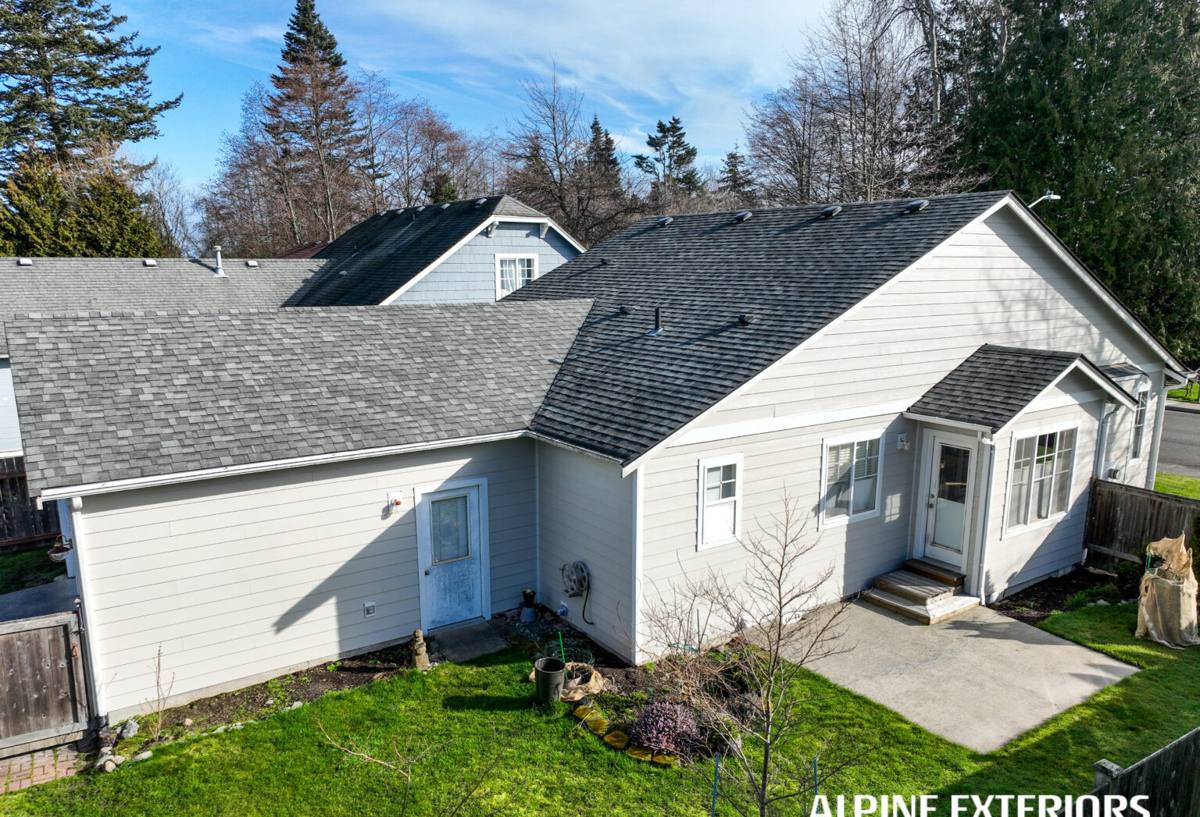
What This Climate Actually Does to a House
Salt Air
Proximity to Semiahmoo Bay and the Strait means airborne salt is a real factor here, not a coastal cliché. Salt accelerates corrosion on fasteners, flashing, and any metal components on the exterior. It also interacts with paint and coatings over time, contributing to earlier fading and chalking on lower-quality finishes. Materials and hardware that aren't rated for coastal exposure age faster in Blaine than they would in, say, Bellingham proper or further inland.
Driving Rain
Whatcom County gets a lot of rain overall, but what matters more for siding performance is wind-driven rain — rain pushed sideways into wall assemblies during storms coming off the water. Driving rain finds every gap, every under-caulked seam, and every place where water management wasn't done correctly. A siding product's water resistance rating and a crew's attention to flashing and water-shedding details both matter enormously in a spot like this.
Moss and Sustained Moisture
Long, mild, wet seasons in this part of the state create ideal conditions for moss and algae growth on north-facing walls, shaded siding, and anywhere air doesn't circulate well. Moss holds moisture against the surface of siding and trim for extended periods, which is a slow but steady stress on any material that isn't dimensionally stable or that absorbs water.
Temperature Swings and Humidity Cycling
Even without extreme heat or cold, the region's humidity swings between damp winters and drier summer stretches put materials through repeated expansion and contraction. Products that swell, shrink, or delaminate under that cycling develop problems — cracked caulk lines, warped boards, lifted paint — well before a homeowner expects to be dealing with exterior repairs.
Why We Install Only James Hardie Fiber Cement Siding
We made a deliberate decision as a company to install James Hardie fiber cement exclusively — we don't install vinyl, LP SmartSide, Cemplank, Allura, primed spruce, or cedar. That's not a marketing angle; it's a standard built around what actually holds up in Pacific Northwest coastal conditions like Blaine's.
Fiber cement is fundamentally different from wood-based or wood-fiber composite siding in how it handles moisture. It's not organic material, so it doesn't feed rot, and it doesn't swell and delaminate the way engineered wood products can when moisture gets past the finish. James Hardie backs its ColorPlus factory-applied finish with a real, transferable warranty, and the company engineers specific product lines (their HZ5 line, for example) for climate zones like ours. That's a meaningful difference from a generic siding product sold the same way in Arizona and Alaska.
We're not going to tell homeowners that every other product is worthless — vinyl, LP, and cedar all have legitimate use cases and loyal customers elsewhere. But for a Semiahmoo Bay exposure with salt air, driving rain, and long moss seasons, we've found that fiber cement's moisture stability, non-combustibility, and factory-cured finish consistently outperform the alternatives over the 20-30 year window homeowners actually care about.
How James Hardie Compares to the Alternatives Homeowners Often Consider
| Factor | James Hardie Fiber Cement | Vinyl | Cedar / Primed Spruce |
|---|---|---|---|
| Moisture behavior | Dimensionally stable, doesn't rot or delaminate | Doesn't absorb water, but can warp and gap | Absorbs moisture; prone to rot without diligent upkeep |
| Salt air resistance | Engineered finish holds up well | Can chalk and fade faster in coastal exposure | Finish breaks down faster; needs frequent recoating |
| Fire resistance | Non-combustible | Combustible, can melt/deform near heat | Combustible |
| Maintenance | Periodic caulk/paint touch-up over a long cycle | Low, but limited repair options if damaged | Regular refinishing, sealing, and moss/rot monitoring |
| Warranty structure | Strong, transferable manufacturer warranty | Varies widely by brand and thickness | Typically no manufacturer warranty on the material itself |
Siding, Roofing, Windows, and Decks Working Together
Siding doesn't perform in isolation. On a coastal property like the ones we work on around Blaine and Semiahmoo, the roof, windows, siding, and any exterior decking all interact as one water-management system. A well-installed Hardie siding job can still fail early if flashing at window and door openings isn't done correctly, or if a roof is shedding water onto a wall in a way it wasn't designed for.
That's part of why we handle siding, roofing, windows, and decks rather than specializing narrowly. When one crew understands how all four systems tie together on a specific house, water management decisions get made holistically instead of in silos. A window replacement gets flashed with the siding plan in mind. A re-roof accounts for how water will run off onto walls below. A deck ledger connection doesn't become a hidden rot point behind new siding.
What a Local Crew Actually Changes
- Familiarity with how wind-driven rain moves across specific lot orientations near the bay and spit
- Understanding of which sides of a house in this area tend to develop moss and need extra attention to ventilation and drainage planes
- Knowledge of local permitting and inspection processes in Whatcom County and the City of Blaine
- Ability to sequence siding, roofing, window, and deck work so systems are coordinated, not patched together by separate unrelated crews
- Direct accountability — the same company that quoted the job is the one standing behind it later
What a Proper Installation Looks Like Here
Fiber cement siding is only as good as its installation. In a climate like this one, a few details matter more than they would in a drier region:
Water-Resistive Barrier and Drainage Plane
A correctly installed weather-resistive barrier behind the siding, combined with a drainage gap that lets any incidental moisture escape rather than sit against the back of the boards, is essential. In a high-rain, high-humidity environment, skipping or shortcutting this step is one of the most common causes of premature siding failure — regardless of what siding material is used.
Flashing at Every Penetration
Windows, doors, hose bibs, vents, and any other penetration through the wall plane need proper flashing that directs water outward and downward, never behind the siding. Driving rain off the bay will find any shortcut here eventually.
Correct Fastening and Clearances
James Hardie specifies fastener types, spacing, and minimum clearances from grade, roof lines, and decks. These aren't arbitrary — they're calibrated to how the product expands, contracts, and sheds water. Following them (rather than treating them as optional) is part of what keeps the manufacturer's warranty valid and the wall assembly performing as designed.
Caulking and Joint Treatment
Butt joints, corners, and trim transitions need the right sealant applied correctly. In a marine climate, the wrong caulk — or the right caulk applied poorly — becomes a moisture entry point within a few seasons.
Signs Your Current Siding Is Struggling With This Climate
Homeowners in Blaine and around Semiahmoo often reach out to us after noticing one or more of these signs. None of them mean immediate disaster, but they're worth addressing before they compound:
- Persistent moss or algae growth that returns quickly after cleaning, especially on north- or shade-facing walls
- Soft spots, bubbling, or visible swelling in the siding material, particularly near the bottom courses or around windows
- Paint that's chalking, peeling, or fading unevenly, often faster on sides exposed to prevailing wind off the water
- Visible gaps at seams, corners, or trim where caulking has shrunk or failed
- Rust staining running down from fasteners or metal flashing
- A noticeably musty smell near exterior walls, which can indicate moisture intrusion behind the siding
Cost Factors Homeowners Should Understand
We won't quote pricing without seeing the specific house, but a few factors consistently drive cost on siding projects in this area, and it's worth understanding them before you start collecting estimates:
| Factor | Why It Matters |
|---|---|
| Existing wall condition | Rot or moisture damage found once old siding comes off adds repair scope beyond the original estimate |
| House size and complexity | More corners, gables, and trim details mean more labor and material per square foot |
| Siding profile and finish choice | James Hardie offers lap, shingle, and panel profiles in a range of ColorPlus finishes, which affects material cost |
| Access and site conditions | Steep lots, limited driveway access, or tight setbacks near the water can affect staging and labor time |
| Scope beyond siding | Bundling roofing, window, or trim work into the same project can improve efficiency but changes total project cost |
Working With Us in Blaine and Semiahmoo
We approach every property in this area with the coastal exposure in mind from the first walkthrough — not as an afterthought once problems show up. That means looking closely at how water currently moves around the house, where moss has already taken hold, what the existing wall assembly looks like once we can see behind the old siding, and how the roof, windows, and any decking interact with the walls.
Because we only install James Hardie fiber cement, homeowners working with us aren't choosing between five different siding brands with five different quality tiers — they're getting one product system we've standardized on because it holds up in exactly this kind of environment, backed by a warranty that means something and an installation process we control from start to finish.
If you're weighing a siding, roofing, window, or deck project on a home in Blaine or Semiahmoo, we're happy to take a look and talk through what your specific house needs. There's no pressure and no cost to get an honest assessment — just a straightforward look at your home's exterior and what it would take to get it holding up the way it should against this coastline's weather.