 Semiahmoo Siding
 Birch Bay's Climate Is Harder on Siding Than Most Homeowners Realize
Birch Bay sits right where the Strait of Georgia meets the Salish Sea shoreline, and that location shapes everything about how a house ages here. Homes closer to the water take on salt-laden air almost daily, while the broader Whatcom County weather pattern adds long stretches of driving rain, persistent overcast humidity, and a moss and algae season that can run most of the year. None of that is unique to any one street or subdivision in Birch Bay — it's the baseline condition for exterior building materials anywhere along this stretch of coastline. Siding, trim, and fascia here don't fail because of one bad storm. They fail slowly, from repeated cycles of moisture intrusion, salt exposure, and biological growth that most siding products simply weren't engineered to handle indefinitely.
Salt Air and Coastal Corrosion
Airborne salt doesn't just affect boats and metal railings. It settles on siding surfaces, works into seams and fastener heads, and accelerates the breakdown of paint films and adhesives over time. Wood-based products and some engineered wood sidings are especially vulnerable because salt exposure combined with moisture speeds up swelling, delamination, and edge deterioration at a rate you wouldn't see on an inland property twenty miles east.
Driving Rain and Wind-Driven Moisture
Rain in Birch Bay rarely falls straight down. Wind off the water pushes it sideways, driving moisture into laps, corners, and butt joints that a calmer climate would never stress. Siding systems that rely on tight seams and minimal drainage detailing are more likely to trap water behind the cladding rather than shed it, which is where hidden rot and sheathing damage usually start.
The Long Moss and Mildew Season
Shaded north- and west-facing walls in this area can stay damp for weeks at a time, especially under tree cover or where landscaping sits close to the house. That's ideal growing conditions for moss, algae, and mildew, all of which hold moisture against the siding surface and, on porous materials, can contribute to gradual surface breakdown if left unaddressed.
Why Siding Choice Matters More Here Than Inland
Every siding material handles coastal exposure differently. Some of that difference is cosmetic — fading, staining, chalking. Some of it is structural, affecting how long the product lasts before it needs replacement rather than just cleaning or repainting. The table below reflects general, honest trade-offs we see across siding materials in wet, salt-exposed coastal environments like Birch Bay — not brand-specific claims, just how each category of material tends to perform.
| Material | Moisture Behavior | Salt Air Exposure | Typical Maintenance Burden |
|---|---|---|---|
| Vinyl siding | Sheds surface water but seams and J-channels can allow moisture behind panels | Can become brittle and discolored over time in coastal UV and salt conditions | Low routine upkeep, but panels are hard to repair invisibly once damaged |
| Cedar or primed wood | Absorbs moisture readily; needs consistent sealing to resist swelling and rot | Salt accelerates finish breakdown, requiring more frequent recoating | High — regular painting/staining and rot inspection |
| OSB-based engineered wood (e.g., LP SmartSide) | Engineered to resist moisture better than raw wood, but edge and seam sealing is critical | Coastal humidity and salt make proper caulking and edge maintenance non-negotiable | Moderate to high — depends heavily on installation quality and upkeep |
| James Hardie fiber cement | Non-combustible and dimensionally stable; resists moisture-driven swelling | Factory-applied ColorPlus finish is engineered to hold up under UV and coastal exposure | Low — periodic rinsing, no routine repainting on ColorPlus finishes |
Why We Only Install James Hardie Fiber Cement
Semiahmoo Siding Co. made a deliberate decision to install James Hardie fiber cement exclusively, and Birch Bay's climate is a big part of why. We don't install vinyl, LP SmartSide, Cemplank, Allura, primed spruce, or cedar — not because those products can't be installed correctly, but because we've chosen to build our business around one system we can stand behind fully, in the specific conditions this coastline creates.
Built for Climate, Not Just Sold for It
Hardie's HZ product lines are engineered for specific climate zones, including the wetter, more humid conditions typical of the Pacific Northwest. Fiber cement is inherently resistant to moisture-driven swelling and won't support rot the way wood-based products can, which matters directly in a place where walls stay damp for extended stretches during the fall and winter.
The ColorPlus Finish Advantage
Standard field-applied paint breaks down faster under UV and salt exposure than a factory-baked finish. Hardie's ColorPlus finish is applied and cured in a controlled facility, which gives it stronger adhesion and color retention than most site-applied paint jobs, and it typically doesn't require repainting on the same schedule wood siding does.
Non-Combustible Construction
Fiber cement is non-combustible, which is a meaningful consideration anywhere in Washington given wildfire smoke and ember exposure concerns in recent years. It's not the primary reason we chose Hardie, but it's a real advantage over wood-based and some engineered wood alternatives.
A Warranty That Actually Transfers
Hardie backs its siding with a strong, transferable limited warranty, and ColorPlus finishes carry their own separate finish warranty. For homeowners planning to sell within the warranty period, that transferability adds real value that not every siding manufacturer offers in the same way.
What a Birch Bay Siding Project Actually Involves
Inspection and Moisture Assessment First
Before we talk products or pricing, we look at what's actually happening behind the existing siding — sheathing condition, evidence of past water intrusion, and how the current cladding has held up to wind and rain exposure on that specific elevation. A house facing open water gets a different read than one tucked behind a windbreak of trees.
Installation Details That Matter More Here
Correct installation is what makes any siding system perform, and in a driving-rain climate the details are non-negotiable: proper flashing at windows, doors, and penetrations; adequate rain screen gap for drainage and drying; correct fastener spacing and type for fiber cement; and sealed, weather-appropriate joints. Fiber cement performs exactly as well as it's installed — cutting corners on flashing or gapping undermines even the best material.
Beyond Siding: Roofing, Windows, and Decks in Birch Bay
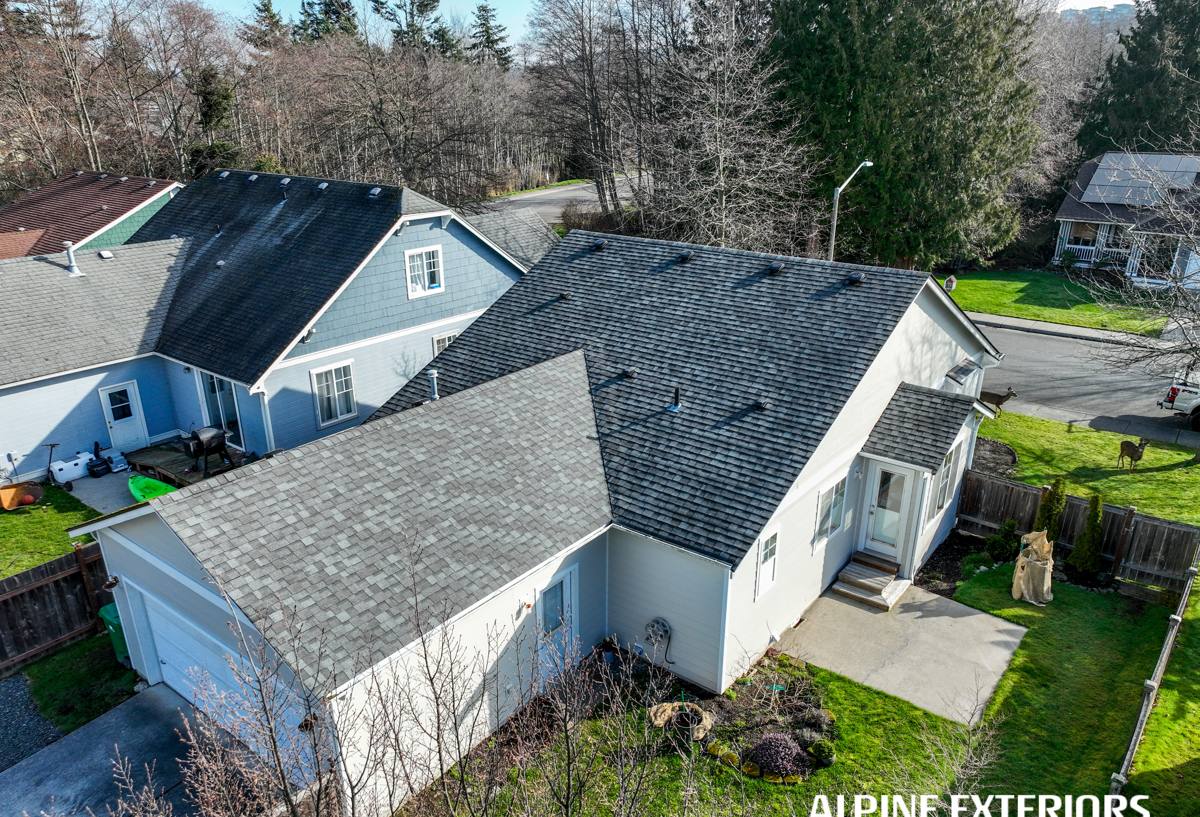
Siding doesn't work in isolation. It's one piece of a building envelope that also includes the roof, windows, and any exterior structures like decks that tie into the wall assembly. We handle roofing, window replacement, and decks alongside siding because a leak at a poorly flashed roofline or an aging window can undermine even a well-installed siding job. Addressing the whole envelope, rather than treating siding as a standalone cosmetic project, is generally the more durable approach for coastal homes.
Signs Your Birch Bay Home May Need Attention
Coastal wear is often gradual, so it helps to know what to watch for before small issues become expensive ones.
- Soft, spongy, or discolored spots on wood or engineered wood siding, especially near the bottom courses
- Persistent moss or algae growth on north- or west-facing walls that returns quickly after cleaning
- Peeling, chalking, or fading paint that's noticeably worse than surrounding homes of similar age
- Visible gaps, warping, or separation at seams, corners, and trim joints
- Staining or streaking below window sills or roof-to-wall intersections, which often points to flashing issues
- A musty smell near exterior walls, which can indicate trapped moisture behind the cladding
Working With a Local Crew
A crew that works this stretch of Whatcom County regularly understands how Birch Bay's exposure differs from Bellingham a few miles inland, or from a more sheltered lot versus one facing open water. That local knowledge shapes practical decisions — how much rain screen gap to plan for, which elevations need extra attention to flashing, and realistic timelines around this area's weather windows. It also means we're familiar with local permitting expectations and can plan a project around Whatcom County's typical wet-season scheduling rather than working against it.
Maintenance Tips for Coastal Homes
Even durable siding benefits from basic upkeep in a salt-air environment. A periodic rinse to remove salt residue and organic buildup goes a long way, particularly on walls facing the water or shaded from direct sun. Keep gutters and downspouts clear so water isn't overflowing onto siding below, and trim back vegetation that keeps walls shaded and damp. Check caulking around windows, doors, and trim annually, since seal failure is often where moisture problems begin regardless of the siding material underneath.
If you're noticing wear on your Birch Bay home's exterior, or you're planning ahead for a siding, roofing, window, or deck project, we're happy to take a look and talk through what we're seeing, with no pressure to commit. Use the form below to request a free estimate.