 Semiahmoo Siding
 Building on a Spit: Why Semiahmoo Resort Is a Different Kind of Job
Semiahmoo Resort sits about as close to the water as a home in Whatcom County can get. That's the appeal of living there, and it's also exactly what makes the exterior of a house work harder than almost anywhere else in the region. A home a mile inland deals with rain and the occasional cold snap. A home on or near the Semiahmoo spit deals with rain, wind coming straight off Semiahmoo Bay and the Strait of Georgia, and salt-laden air that never really stops moving across the siding, trim, and window frames. Add in the marine layer that keeps things damp for long stretches of the year, and you've got a building envelope that's under more or less constant low-grade stress.
None of that means a house at Semiahmoo Resort is doomed to problems. It means the exterior has to be chosen and installed with that environment in mind, not treated like any other build in Whatcom County. That's the difference between siding that looks good for five years and siding that's still doing its job in twenty-five.
What the Climate Actually Does to a House Here
Salt Air
Airborne salt is corrosive to a lot of building materials, especially exposed metal fasteners, flashing, and hardware. Over years, it accelerates rust and pitting in anything not rated for coastal exposure. It also settles on painted and coated surfaces, which is part of why paint film breaks down faster near open water than it does a few miles inland.
Driving Rain and Wind-Driven Moisture
Semiahmoo Resort gets weather off open water, and that means rain doesn't just fall straight down — it comes in sideways, pushed by wind. Wind-driven rain finds every gap in flashing, every poorly sealed penetration, and every seam that wasn't lapped correctly. This is a water-intrusion problem more than a rainfall-volume problem, and it's the single biggest reason siding fails early in coastal Whatcom County: not because it got wet, but because water got behind it and had nowhere to go.
Moss and Prolonged Dampness
Western Washington's long wet season is well known, but a shaded, moisture-holding property near the water can grow moss and algae on siding, trim, and roofing for a good chunk of the year. Moss itself doesn't destroy fiber cement or properly finished trim, but it holds moisture against the surface longer than it would otherwise sit, which matters most where a coating or caulk joint is already compromised.
Temperature Swings
Coastal exposure moderates extreme heat but also means siding and trim go through more frequent wet-dry and freeze-adjacent cycles than a drier inland site. Materials that expand, contract, or absorb moisture unevenly are the ones that show gaps, cupping, and cracked paint first.
Why We Install Only James Hardie Fiber Cement
We get asked, especially by homeowners who've priced out vinyl or LP SmartSide, why we don't offer those options. The honest answer is that we've made a standard for our company based on what holds up in exactly the conditions Semiahmoo Resort throws at a house, and fiber cement is what we're willing to put our name behind.
Vinyl siding is affordable and low-maintenance in a general sense, but it's a poor match for high-wind coastal exposure — it can flex, rattle, or pull away from fastening points in sustained wind, and it doesn't hold up structurally to wind-driven debris the way a rigid fiber cement panel does. LP SmartSide is a wood-strand product with an engineered resin coating; it performs well in a lot of climates, but any wood-based substrate is more sensitive to sustained moisture exposure at cut edges and joints than fiber cement is, which matters a great deal on a site where wind-driven rain finds every seam. James Hardie's fiber cement is non-combustible, dimensionally stable in wet-dry cycling, and doesn't rot, feed pests, or delaminate the way wood-based products can if a joint fails.
That's not a knock on every other product on the market in every situation. It's that we don't think it's honest to sell a homeowner at Semiahmoo Resort a product we know is working against the site conditions instead of with them.
James Hardie Product Lines for This Environment
| Product Line | What It's Built For | Fit for Semiahmoo Resort |
|---|---|---|
| HardiePlank HZ10 | Engineered for Pacific Northwest wind, rain, and moisture cycling | Primary siding choice — the HZ10 climate zone formulation is built for exactly this kind of coastal, high-moisture exposure |
| HardiePanel | Vertical panel siding, often paired with board-and-batten trim | Good for modern or craftsman coastal exteriors, strong wind and moisture performance |
| HardieTrim | Fascia, corner boards, window and door trim | Resists the swelling and rot that wood trim shows first near salt air |
| ColorPlus Technology | Factory-applied, baked-on finish | Holds color and resists fading and moisture intrusion better than field-applied paint, which matters where UV and salt both attack a finish |
ColorPlus is worth calling out specifically for a property like this. A factory-cured finish is more uniform and more resistant to the early chalking and fading that field-applied paint shows in coastal exposure, and it comes with its own finish warranty separate from the substrate warranty on the siding itself.
How We Approach Installation Here
Fiber cement is only as good as the install behind it, and that's doubly true in a wind-driven-rain environment. A few things we hold to on every Semiahmoo Resort job:
- Correct manufacturer-specified fastener spacing and embedment — under-driven or over-driven fasteners are one of the most common causes of early siding failure
- Proper water-resistive barrier and flashing integration at every window, door, and penetration, lapped to shed water downward and outward
- Rigid, corrosion-resistant fasteners and flashing hardware suited to coastal salt exposure
- Correct joint and butt-seam treatment, caulked or flashed per Hardie's specification rather than left to rely on caulk alone
- Adequate clearance between siding and grade, decks, and roof lines so water has somewhere to go and siding isn't sitting in standing moisture
- Ventilation behind the cladding where the assembly calls for it, so moisture that does get in can dry out instead of being trapped
Every one of those is a place where a rushed or unfamiliar install can undercut a good product. This is where a crew that actually works this coastline regularly earns its keep — we've seen what wind-driven rain does to a poorly flashed window on this stretch of coast, and we build accordingly.
Roofing, Windows, and Decks Face the Same Conditions
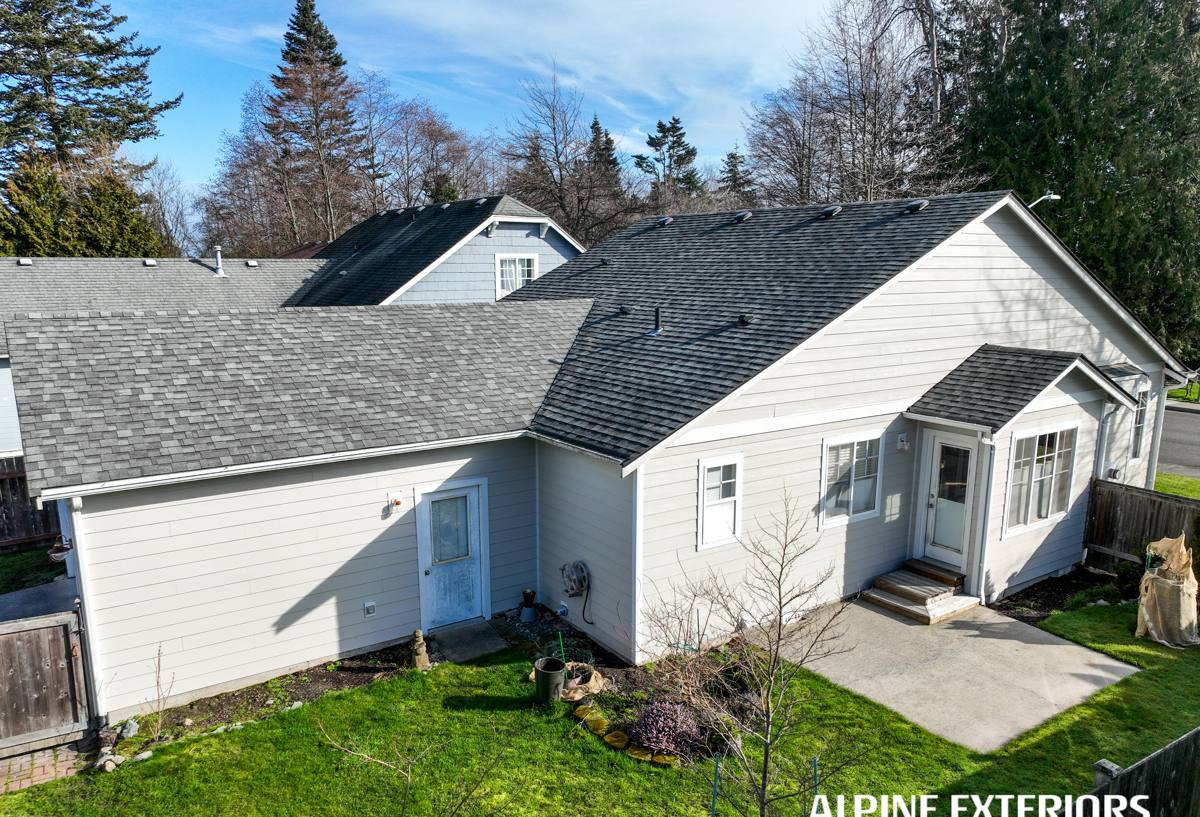
Siding isn't the only part of a Semiahmoo Resort home under coastal stress. Roofing takes wind-driven rain and salt exposure directly, and flashing details around chimneys, vents, and valleys need the same attention we give siding flashing. Windows near open water benefit from coastal-rated hardware and careful flashing integration with the siding plane — a window that's improperly flashed is one of the most common paths for water intrusion in this kind of setting. Decks exposed to salt air and standing moisture need materials and fasteners chosen with corrosion resistance in mind, and proper drainage so wood or composite decking isn't sitting wet for days after a storm. We handle all four — siding, roofing, windows, and decks — because on a coastal property they're really one connected system, not four separate projects.
Signs a Semiahmoo-Area Home Needs an Exterior Evaluation
- Visible moss or algae buildup that returns quickly after cleaning
- Paint that's chalking, peeling, or fading faster than expected, especially on the ocean-facing side
- Soft spots, staining, or discoloration around window and door trim
- Rust streaking from fasteners or flashing
- Gaps or separation at siding joints and corner boards
- Musty smell or visible moisture inside exterior walls
Any one of these on its own isn't necessarily an emergency, but on a coastal property they tend to compound faster than inland, so it's worth having them looked at sooner rather than later.
What Replacement Typically Involves
Every home is different, but a fiber cement siding replacement at Semiahmoo Resort generally follows the same sequence: removal of existing siding and inspection of the sheathing and water-resistive barrier underneath (this is often where hidden moisture damage from a previous install shows up), repair of any damaged sheathing, installation of a correctly lapped water-resistive barrier and flashing system, and then the HardiePlank or HardiePanel installation itself with proper fastening and joint treatment. Trim, corner boards, and any window or door flashing integration happen alongside the siding, not as an afterthought.
Cost Factors Worth Understanding
| Factor | Why It Matters Here |
|---|---|
| Sheathing condition underneath old siding | Coastal moisture exposure means hidden rot or water damage is found more often than inland, which can add repair scope once the old siding is off |
| House complexity (corners, dormers, trim detail) | More flashing points and joints mean more labor to do correctly, especially in a wind-driven-rain zone |
| Product line and finish | HZ10 panels and ColorPlus finishes cost more than base product but are built for this exact climate |
| Access and site conditions | Waterfront and resort-area lots can have access constraints that affect scheduling and equipment |
Why a Local Crew Matters Here
A crew that mostly works drier, inland Whatcom County jobs can still install siding correctly on paper and still miss the details that matter on a coastal spit — how far to hold siding off a deck ledger that gets salt spray, which flashing details actually stop wind-driven rain instead of just shedding straight-down rain, how much clearance to leave near grade on a lot with poor drainage. We work this coastline regularly, which means we're not guessing at how Semiahmoo Bay's weather behaves on a given exterior — we've seen it, and we build for it.
If you're weighing a siding, roofing, window, or deck project on a Semiahmoo Resort home, we're happy to come take a look, walk the exterior with you, and give you a straight read on condition and options — no pressure, no hard sell. A free estimate is a good first step whether you're dealing with visible damage now or just planning ahead.