 Semiahmoo Siding
 A Familiar Sight Around Semiahmoo
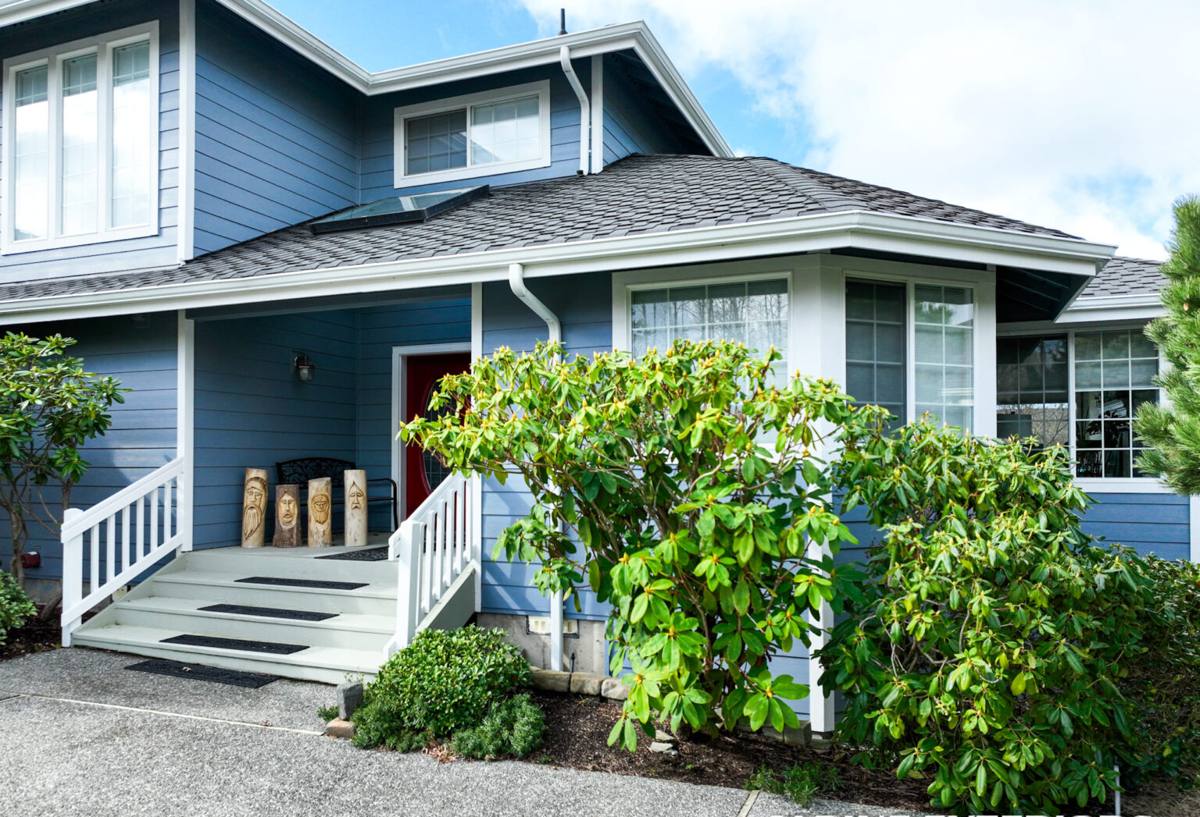
Drive through the older neighborhoods near Semiahmoo Spit or inland toward Blaine and you'll still spot it: wide-lap wood siding, usually primed spruce or fir, painted over year after year. For decades it was the default choice for Pacific Northwest homes, and there's a reason it stuck around this long — it's real wood, it takes paint well when it's fresh, and it has a warmth that manufactured products spend a lot of marketing budget trying to imitate. We're not going to pretend otherwise.
But we don't install it. Not because it's a bad piece of wood the day it goes up, but because of what happens to it over the following ten, fifteen, twenty years in this specific climate — salt-laden air off the Strait of Georgia, driving winter rain, and a moss season that in Whatcom County can run nine months out of twelve. This page explains the trade-offs as plainly as we can, so you understand our standard rather than just being told "we don't do that."
What Primed Spruce Siding Actually Is
Primed spruce (sometimes fir, sometimes a mix depending on the mill run) is solid-sawn or finger-jointed lumber, milled into lap boards or panels, and coated with a factory primer before it reaches the job site. The primer is meant to seal the wood and give the finish paint something stable to bond to. It is not a finished product — it still needs a full field-applied paint system, and it still needs someone to maintain that paint system for the life of the siding.
Where It Genuinely Performs
- Real wood grain and texture that vinyl and fiber cement can only approximate
- Easy to cut, shape, and repair with standard carpentry tools
- Lower material cost per board foot than most factory-finished alternatives
- Can be field-painted any custom color at any time, without waiting on a manufacturer's color line
If a home is in a dry, sheltered climate and gets repainted on schedule without fail, primed spruce can hold up reasonably well. That's just not the environment most of our clients live in.
The Moisture Problem in a Marine Climate
Spruce is a softwood. It's more absorbent than cedar and far more absorbent than fiber cement. Whatcom County sits right on the water, which means fog, mist, and horizontal rain off the Strait are a regular part of the weather pattern, not an occasional event. Water gets driven into lap joints, butt seams, and end grain — the same places primer coverage is thinnest to begin with, because factory priming is done on the flat faces of the board, not the cut ends made on site.
Once moisture gets past the paint film and into the wood fiber, spruce doesn't dry out quickly, especially on north- and west-facing walls that don't get much direct sun. That trapped moisture is what leads to the problems homeowners actually call us about: swelling at the seams, paint that blisters and peels from the inside out, and soft spots that show up first at the bottom edge of each board.
Salt Air's Role
Being this close to the water adds a second layer to the problem. Salt-laden air accelerates the breakdown of paint film faster than an inland location would see, and it also promotes the growth of moss and algae on any surface that stays damp — which, on a wood lap board in a shaded exposure, is most of the year. Homeowners in Semiahmoo, Blaine, and along Drayton Harbor deal with this more directly than most, since the salt exposure here is about as constant as it gets in Western Washington.
Paint Maintenance Isn't Optional — It's the Whole System
This is the part that gets underestimated most often. Primed spruce siding is not "install and forget." The primer coat is a base layer, not a finish, and the finish paint is the only thing standing between the wood and the weather. When that paint film starts to fail — chalking, hairline cracking, loss of adhesion — the clock starts running on the wood underneath it.
| Maintenance Task | Typical Interval in This Climate | Consequence of Skipping |
|---|---|---|
| Full repaint / recoat | Every 5-8 years, often sooner on sun/salt-exposed walls | Paint film fails, water intrusion begins |
| Caulk joints and seams | Every 2-4 years | Open seams become direct water entry points |
| Moss and algae wash-down | Annually, more on shaded elevations | Trapped moisture accelerates wood decay |
| Spot repair of damaged boards | As needed, ideally caught early | Localized rot spreads to adjacent boards |
Multiply that maintenance schedule over 20-30 years and the total cost of ownership on primed spruce often lands well above what homeowners expect when they compare the up-front material price to a factory-finished product.
Why We Won't Put Our Name on It
We're not a paint contractor, and we don't want to be the crew that installs a product and then hopes the homeowner keeps up a maintenance schedule for the next three decades. When we install siding, we want to stand behind it — and that means putting up something whose long-term performance doesn't depend entirely on someone else's follow-through years after we're gone.
We've also seen what happens on the repair and replacement side of this business: spruce siding that looks fine from the street but has soft, punky wood at the bottom courses and around window trim once you get a probe into it. That's not a defect in the product — it's the predictable result of solid wood siding meeting a wet, salty coastline climate over enough years. We'd rather not install something we already know needs that level of ongoing attention to survive here.
What We Install Instead: James Hardie Fiber Cement
Our standard is James Hardie fiber cement siding, and the reasoning ties directly back to the problems above.
How It Addresses the Same Issues
- Non-combustible and dimensionally stable — fiber cement doesn't swell, cup, or split the way solid wood can when it takes on moisture
- ColorPlus factory finish — a baked-on finish applied and cured under controlled conditions, not a job-site paint job dependent on weather during installation
- HZ5 / HZ10 engineered product lines — Hardie manufactures specific formulations for wet, humid, marine-exposed climates, which is exactly the Whatcom County profile
- Resists moss and algae growth far better than bare or painted wood fiber, which matters given how long this region stays damp
- Strong transferable warranty that isn't contingent on a strict repaint schedule the way wood siding effectively is
It costs more up front than primed spruce. We tell every homeowner that plainly. But the maintenance burden and repaint cycle are dramatically lower, and that's the trade-off that actually matters once you're ten or fifteen years into ownership rather than looking at a bid sheet.
A Fair Way to Think About the Choice
If you love the idea of solid wood siding and are committed to staying ahead of the paint and caulk schedule indefinitely, primed spruce isn't an unreasonable product on its own merits — it's a legitimate, traditional building material. Our position is narrower than "wood is bad": it's that installing it as a contractor means either signing up to maintain it for our clients indefinitely, or handing over a product we know will start showing problems in a climate this wet and salty if maintenance slips even a little. We'd rather install something engineered for exactly these conditions from the start.
Quick Comparison Checklist
- Want the lowest up-front material cost and don't mind a strict repaint schedule: primed spruce may suit you, though it's not what we install
- Want a factory-cured finish that doesn't depend on job-site paint conditions: fiber cement
- Live on or near the water with regular salt exposure: fiber cement's engineered moisture resistance matters more here than almost anywhere else in the county
- Want the lowest total cost of ownership over 20+ years, not just the lowest bid: fiber cement
Let's Talk About Your Home Specifically
Every house on this stretch of coastline has its own exposure — sun, shade, wind direction, how close it sits to the water. If you're weighing siding options for a home in Semiahmoo, Blaine, or anywhere else in Whatcom County, we're happy to walk the exterior with you, point out what your specific exposure is dealing with, and give you a straight answer about what we'd recommend and why. Reach out for a free, no-pressure estimate — there's no obligation, just an honest look at your home.