 Semiahmoo Siding
 The Marine Climate Problem: Salt Air, Driving Rain, and Moss
Drayton Harbor sits close enough to saltwater that it changes how windows age. Salt-laden air corrodes hardware, pits aluminum components, and breaks down cheap weatherstripping years before it would fail in a drier inland climate. Add in the wind-driven rain that comes off the water during winter storms, and you've got moisture that doesn't just fall straight down — it gets pushed sideways into every gap, seam, and undersized flashing detail. Then there's the long moss and mildew season that Whatcom County is known for, which keeps humidity elevated around window openings for months at a stretch, even when it isn't actively raining.
None of this means windows here need to be exotic or overbuilt. It means the glass, the frame, and — just as important — the installation itself need to be matched to a marine environment instead of a generic climate zone. A window that performs fine in a catalog spec sheet can still underperform badly on a Drayton Harbor home if it's installed without accounting for how water actually moves around this property type.
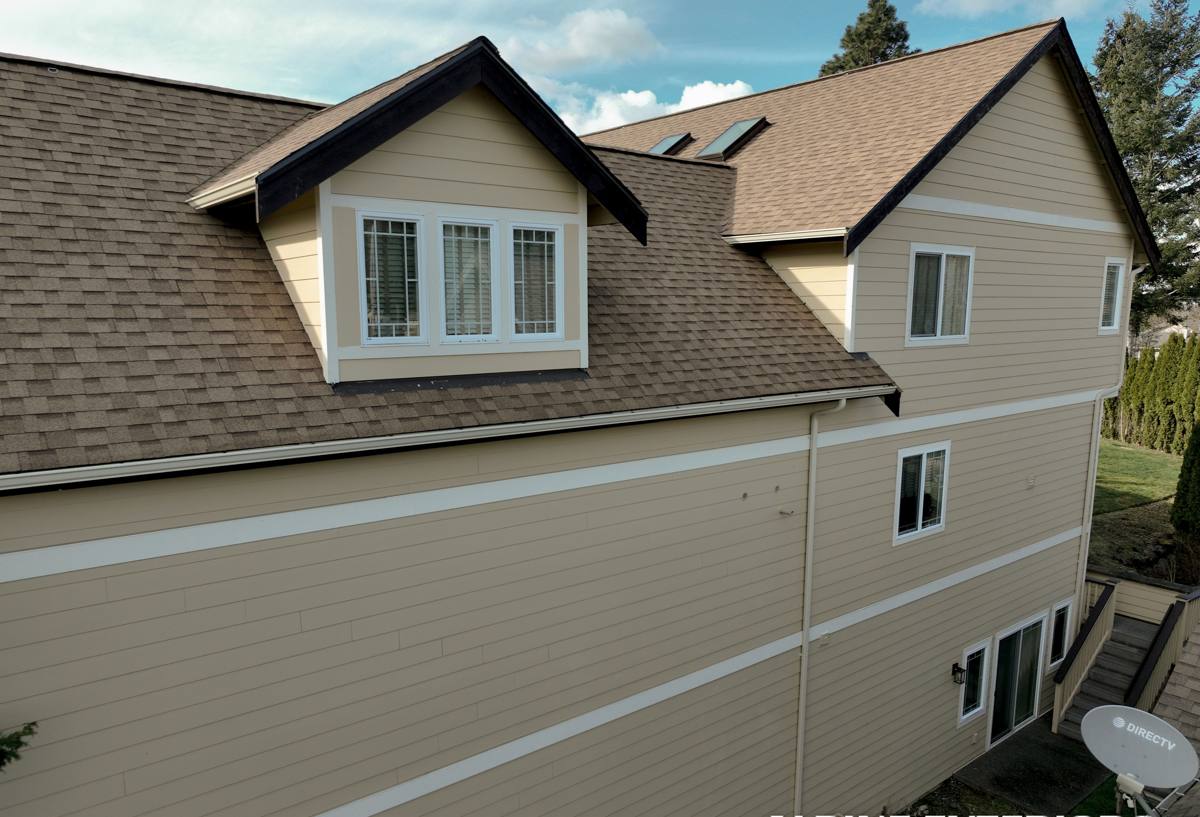
Signs Your Current Windows Are Costing You
Most homeowners don't replace windows because of one dramatic failure — they replace them because a handful of smaller problems add up. Before we ever talk about new windows, it's worth checking whether your existing ones are actually the issue, or whether the real problem is trim, siding, or flashing around them.
- Visible condensation or fogging between the panes of a double-pane unit (a sign the seal has failed)
- Cold drafts you can feel near the frame even when the window is fully latched
- Wood frames that are soft, discolored, or show black staining at the corners
- Hardware — locks, cranks, hinges — that's stiff, rusted, or has stopped closing tightly
- Noticeably higher heating bills in winter without a clear other cause
- Moss or persistent green staining building up on the sill or the siding directly below the window
- Difficulty opening or closing that's gotten worse over the past year or two
If you're seeing two or more of these, it's usually time for a real evaluation rather than another round of caulk and weatherstripping.
What Actually Makes a Window Energy-Efficient
"Energy-efficient" gets used loosely in this industry, so it's worth being specific about what actually drives performance. It comes down to three things working together: the glass package, the frame material, and the spacer/gas fill between the panes. Any one of these done well and the others ignored still leaves you with a window that underperforms.
| Component | What It Does | Why It Matters Here |
|---|---|---|
| Low-E glass coating | Reflects heat back into the room in winter, blocks solar heat gain in summer | Cuts heat loss during our long, wet, gray winters without sacrificing daylight |
| Argon or krypton gas fill | Sits between panes, insulates better than plain air | Reduces interior condensation risk during humid, moss-season months |
| Warm-edge spacer | Separates panes at the edge, resists heat transfer at the glass perimeter | Prevents the cold-edge effect that shows up as fogging and drafts along the glass edge |
| Frame material | Determines thermal performance, water resistance, and long-term durability | Has to handle salt exposure and driving rain without warping or corroding |
A window with all four of these done properly will noticeably outperform one that's just marketed as "double-pane" with no other detail given.
Frame Material Trade-Offs for a Waterfront-Adjacent Home
There's no single "best" frame material — there's a best material for your specific home, budget, and exposure to weather. Here's how the common options actually compare in a Drayton Harbor setting.
| Material | Strengths | Trade-Offs in This Climate |
|---|---|---|
| Vinyl | Good insulation, low maintenance, competitive cost | Can expand/contract with temperature swings; quality varies a lot between manufacturers |
| Fiberglass | Very stable dimensionally, strong resistance to moisture and corrosion | Higher upfront cost than vinyl |
| Wood | Classic appearance, good insulator | Needs ongoing maintenance to resist rot in a wet, salt-air climate |
| Wood-clad (wood interior, metal or vinyl exterior) | Interior warmth of wood, exterior protection from the elements | Clad seams and joints need careful installation to stay watertight long-term |
| Aluminum | Slim sightlines, strong | Poor insulator on its own and prone to corrosion in salt air unless properly finished |
For most Drayton Harbor homes, we steer clients toward vinyl or fiberglass because they hold up to salt exposure and driving rain with the least long-term maintenance. We're honest about the trade-offs of each option rather than pushing whatever has the best margin — the right call depends on your home's exposure, your budget, and how much upkeep you actually want to do.
What We Avoid Recommending, and Why
We're cautious about bare aluminum frames near the water and about painted wood that isn't already committed to a real maintenance schedule. Neither is a bad product in the right setting — they're just a poor match for a home taking direct salt air and wind-driven rain, where the maintenance burden and moisture risk go up faster than most homeowners expect.
Installation Details That Determine Whether It Actually Performs
The window unit itself is maybe half the equation. The other half is installation, and this is where most performance problems actually originate — even with a good window.
- Flashing integration: The window's flashing has to tie into the house wrap and siding correctly, layered so water sheds outward and downward, never trapped behind the cladding.
- Sill pan protection: A proper sill pan under the window gives any water that does get past the exterior seal somewhere to drain, instead of soaking into the framing.
- Air sealing at the rough opening: Gaps between the window frame and the rough opening need to be sealed with the right materials — not just foam sprayed in and forgotten.
- Fastening and shimming: Windows installed out of square or under-shimmed will bind, leak, or fail prematurely regardless of how good the unit is.
- Exterior trim and caulking: The final seal at the trim line is what stands between the wall assembly and driving rain for the next 15-20 years.
This is also where being a siding company matters. Because we work on the whole exterior envelope, we treat the window opening as part of the wall system — not an isolated hole to patch — which is exactly how it needs to be handled in a climate that pushes rain sideways.
Our Process, Start to Finish
Estimate and Assessment
We look at the existing windows, the surrounding trim and siding condition, and how the home is oriented relative to prevailing wind and rain. That tells us whether it's a straightforward window swap or whether trim and flashing repair need to happen at the same time.
Removal and Prep
Old units come out carefully to avoid unnecessary damage to surrounding siding and trim. We check the rough opening for hidden moisture damage before anything new goes in — this is often where problems from years of driving rain get discovered.
Installation
New sill pan, correctly layered flashing, proper shimming and fastening, and air sealing at the rough opening. Every step is done in sequence, not shortcut, because skipping one undoes the benefit of the others.
Final Seal and Cleanup
Exterior trim goes back on (or gets replaced if it wasn't sound), final caulking is applied, and the work area is cleaned up. We walk the finished windows with you before we consider the job done.
Permits, Timing, and Working Around Local Weather
Window replacement in Whatcom County typically requires a permit, and we handle that as part of the job rather than leaving it to the homeowner. On timing: we plan installs around weather windows rather than a fixed calendar date, since a rushed install during a driving rain event is exactly the scenario that leads to water intrusion later. Most jobs move quickly once weather cooperates, but we'd rather wait a day for a dry window than compromise the seal.
Why Hire a Crew That Already Works Drayton Harbor
A lot of window problems in this area aren't really window problems — they're installation problems from a crew that installed the same way they would in a dry inland climate. Working regularly in Drayton Harbor and the surrounding Semiahmoo area means we're used to sizing flashing, sill pans, and sealing details for salt air and wind-driven rain, not guessing at it. We're also the same crew that handles siding and trim, so if a window job uncovers moisture damage in the surrounding wall, we can address it directly instead of pointing you to another contractor.
If your windows are drafty, fogged, or just older than they should be for the job they're doing, we're happy to take a look and give you a straightforward assessment — no pressure, no inflated urgency. Reach out for a free estimate using the form below, and we'll walk your home's windows with you in person.