 Semiahmoo Siding
 Why Sumas Homes Go Through Siding Faster Than the National Average
Homes in and around Sumas sit inside one of the more demanding climates on the West Coast for exterior materials. It isn't one single event that wears siding out here — it's the combination. Salt-laden air moves through the region and slowly attacks fasteners, trim, and any exposed wood edge. Driving rain, often pushed sideways by wind rather than falling straight down, finds every gap in flashing and caulk that a calmer climate would never test. And because temperatures stay mild and damp for long stretches of the year, moss and algae get a foothold on siding, roofs, and trim that they simply wouldn't get in a drier state.
None of that is unusual for Whatcom County. It's just the trade-off of living somewhere green year-round. But it means the siding on a Sumas home is doing more work than siding on the same house built in Spokane or Denver, and it needs to be selected and installed with that reality in mind — not treated like a generic exterior product.
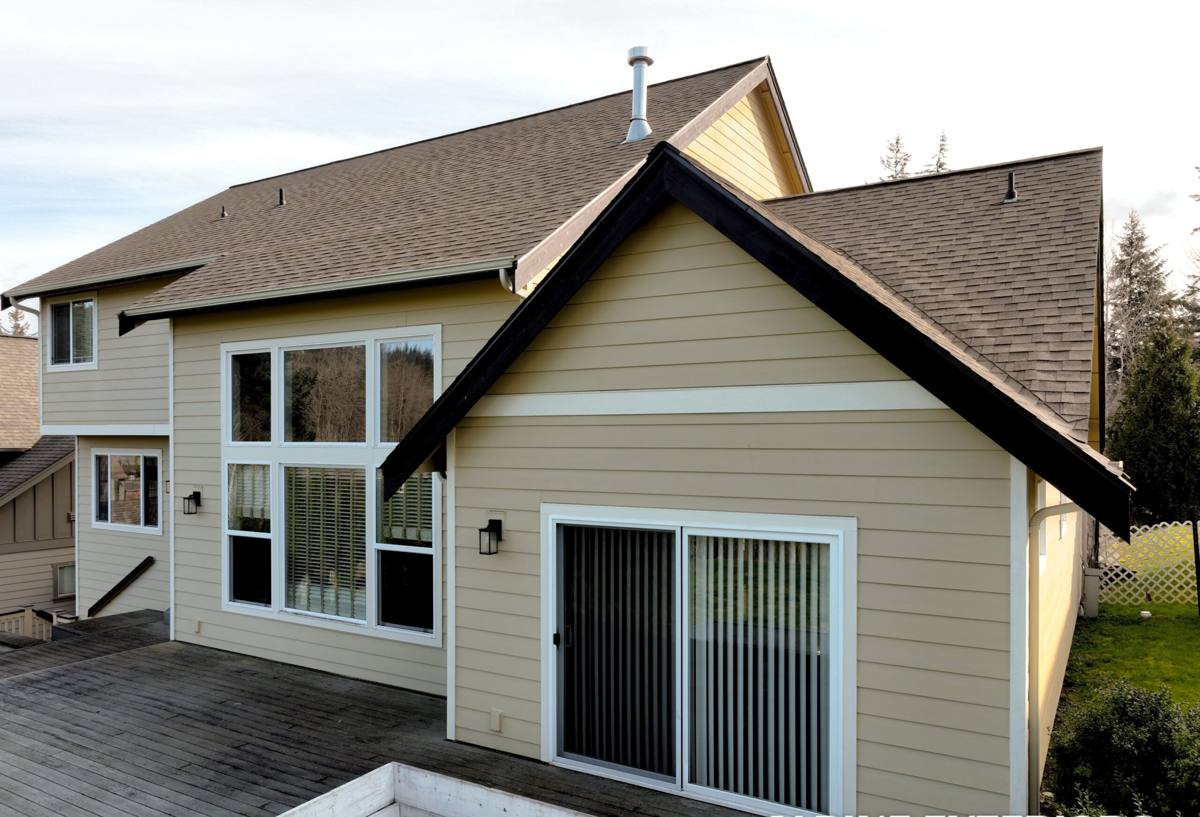
What "Siding Replacement" Actually Means (and When It's the Right Call)
Siding replacement isn't the same project as a repair, a recoat, or a patch job, and it's worth being clear about the difference before you invite bids.
- Spot repair — replacing a few damaged boards or a section behind a downspout while leaving the rest in place.
- Repaint or recoat — refreshing the finish on siding that's still structurally sound.
- Full replacement — removing the existing siding down to the sheathing, correcting whatever moisture or ventilation problems are hiding underneath, and installing a new weather-resistive barrier and cladding system.
Full replacement is the right call when the siding itself has failed — not just cosmetically, but structurally — or when there's evidence of moisture getting behind it. In a climate like this one, siding failure is rarely just about looks. By the time boards are visibly cracked, delaminating, or holding moss in their grain, there's a good chance the sheathing or framing behind them has been absorbing water for a while too.
Signs a Sumas Home Needs Replacement, Not a Patch
- Soft or spongy spots when you press on siding, especially near the bottom courses
- Persistent moss or algae growth that comes back within a season of cleaning
- Visible gaps, warping, or cupping in wood-based siding
- Paint that won't hold — bubbling, peeling, or needing repainting more than once every several years
- Rot or discoloration around window and door trim
- Fastener heads showing rust streaks or pulling loose from the substrate
- A musty smell or visible staining on interior walls that back up to exterior siding
If you're seeing two or more of these, it's worth getting a full assessment rather than assuming a repair will hold.
Why We Install Only James Hardie Fiber Cement
We made a decision a long time ago to install one siding system, not a menu of options. We don't install vinyl, LP SmartSide, Cemplank, Allura, primed spruce, or raw cedar. That's not a marketing position — it's a standard we hold because of what we've seen these products do, and not do, in a climate like this one over the long run.
Vinyl siding is affordable and low-maintenance in dry climates, but it expands and contracts significantly with temperature swings, and driving rain can push moisture behind panels at seams and corners if installation isn't precise. Wood-based products — primed spruce, cedar, LP SmartSide's engineered wood — all share a common vulnerability: they're organic material, and organic material in a wet, mild climate is exactly what moss, algae, and rot are built to exploit. Even with good primer and careful caulking, wood-based siding asks for more upkeep here than most homeowners want to commit to.
James Hardie fiber cement is a different category of material. It's cement, sand, and cellulose fiber — non-combustible, dimensionally stable, and engineered specifically for climate exposure. Hardie makes region-specific product lines (their HZ5 and HZ10 formulations) built around moisture and freeze-thaw behavior in different parts of the country, and the Pacific Northwest falls squarely into the range those products are designed for. The factory-applied ColorPlus finish is baked on under controlled conditions, which gives it more consistent adhesion and UV resistance than field-applied paint, and it comes with a real transferable warranty backing that finish and the substrate separately.
None of this means fiber cement is maintenance-free — nothing exposed to this climate is. But it means the material itself isn't the weak link, and that lets us focus our attention on the part that actually determines how a siding job performs over twenty-plus years: the installation.
What Correct Installation Involves
Fiber cement siding is only as good as the water management system behind it. Hardie's own installation instructions are detailed for a reason — skipping steps is the single biggest cause of siding failures we get called out to diagnose, and it's almost never the board's fault.
Water Management Comes First
Before a single piece of siding goes up, the wall needs a correctly lapped weather-resistive barrier, properly integrated flashing at every window, door, and penetration, and a drainage plane that lets any moisture that does get behind the cladding find its way back out. In a climate with sustained driving rain, this layer matters more than the siding itself — it's the difference between water that sheds and water that sits.
Fastening and Clearance
Fasteners need to hit framing at the correct spacing and depth — overdriven or underdriven nails are a common source of long-term problems. Siding also needs proper clearance from grade, roof lines, decks, and other horizontal surfaces so it isn't sitting in standing water or trapped moisture. Caulking joints need the right product and the right technique, not just a bead run down every seam.
Cuts, Corners, and Sealed Edges
Every cut edge on fiber cement siding needs to be sealed before installation — a factory edge is engineered, a field cut isn't, until it's treated. Corners, whether trim-based or mitered, need consistent detailing so they don't become the first point of failure.
Get any one of these wrong and even the best siding material on the market will underperform. Get them right, and a correctly installed Hardie system is built to handle exactly the conditions this region throws at it.
Our Process, Start to Finish
1. Assessment and Estimate
We look at the existing siding, the sheathing condition where we can access it, and the specific exposure of the home — which walls take the most weather, where moss has been an ongoing problem, where past repairs may be masking bigger issues. That informs the estimate and the scope, not just a square-footage number.
2. Tear-Off and Substrate Check
Old siding comes off completely. This is the point where hidden moisture damage, if any exists, gets found and dealt with — not covered over. Any compromised sheathing gets repaired before anything new goes up.
3. Weather Barrier and Flashing
New house wrap or weather-resistive barrier goes on, integrated with flashing at every opening and penetration, following a lapped, shingle-style sequence so water is always directed outward and down.
4. Installation
James Hardie boards or panels go up to spec — correct fastener pattern, correct clearances, sealed cut edges, and properly detailed corners and trim.
5. Final Walkthrough
We go through the finished job with the homeowner, check caulking and trim details, and make sure everything matches what was scoped at the estimate.
What Drives the Cost of a Siding Replacement
Every home is different, so we don't quote from a flat rate card — but these are the factors that most often move a project up or down in price.
| Factor | Why It Matters |
|---|---|
| Extent of substrate repair | Rot or moisture damage found during tear-off adds carpentry work beyond the siding itself |
| Home size and wall complexity | More corners, dormers, and cutouts around windows mean more labor per square foot |
| Siding profile chosen | Lap siding, shingle-style panels, and board-and-batten all install differently and price differently |
| Trim and accessory scope | Full trim replacement alongside siding costs more than reusing sound existing trim |
| Access and site conditions | Multi-story walls, tight lot lines, and limited staging area affect labor time |
| Color and finish selection | Standard ColorPlus colors versus custom field-painted finishes affect material and labor cost |
The honest way to get a real number is a walk-through of the actual house, not a phone estimate — too many of these factors only show up once someone's looking at the walls in person.
Why It Matters to Hire a Crew That Already Works This Area
Siding installation isn't identical everywhere. A crew that mostly works dry-climate jobs may not think twice about a detail that's critical here — clearance at grade, flashing sequence around a deck ledger, how much lap to leave at a butt joint given how hard rain can drive sideways off the water. A crew that works Whatcom County regularly has already seen what happens when those details get skipped, because we've been the ones called back out to diagnose it on someone else's installation.
There's also a practical side: local crews know the permitting expectations in the jurisdictions we work in, they're not learning the region's weather patterns on your project, and they're not disappearing to another state once the job wraps if a warranty question comes up down the road.
Living With Fiber Cement Siding After Installation
Correctly installed James Hardie siding is genuinely low-maintenance, but "low" isn't "zero" in a climate that grows moss on roofs and driveways. A simple periodic rinse — not pressure-washing directly into seams — keeps moss and algae from establishing. Keep gutters clear so water isn't sheeting down the wall face, keep an eye on caulking at trim joints over the years, and touch up any incidental scuffs or scratches to the finish before they become an entry point for moisture. That's a fraction of the upkeep wood siding demands in this climate, and it's part of why we standardized on this system in the first place.
If your Sumas-area home is showing signs of siding fatigue — or you're just tired of fighting moss and touch-up paint every year — we're happy to walk the exterior with you and give you a straight, no-pressure assessment of what it actually needs. The estimate is free, and there's no obligation attached to it.