 Semiahmoo Siding
 Roofs Around Drayton Harbor Face a Tougher Job Than Most
A roof over a home near Drayton Harbor works harder than a roof fifty miles inland. The salt-laden air coming off the water accelerates corrosion on fasteners, flashing, and any exposed metal. Winter storms bring driving rain that comes in sideways off the harbor, testing every seam and lap in the roofing system rather than just falling straight down. And Whatcom County's long, wet, mild winters give moss months at a time to take hold on shaded and north-facing slopes. None of this means a roof here is doomed — it means the repair work has to account for conditions a roofer working a dry inland subdivision never has to think about.
Storm damage in this area rarely shows up as one clean, obvious problem. It's usually a combination: a gust that lifted a few shingles, rain that got up under the lift before anyone noticed, and moss that had already been holding moisture against the deck in that spot for a season or two. A repair that only addresses the visible wind damage and ignores the moisture and moss context underneath tends to fail again at the next storm.
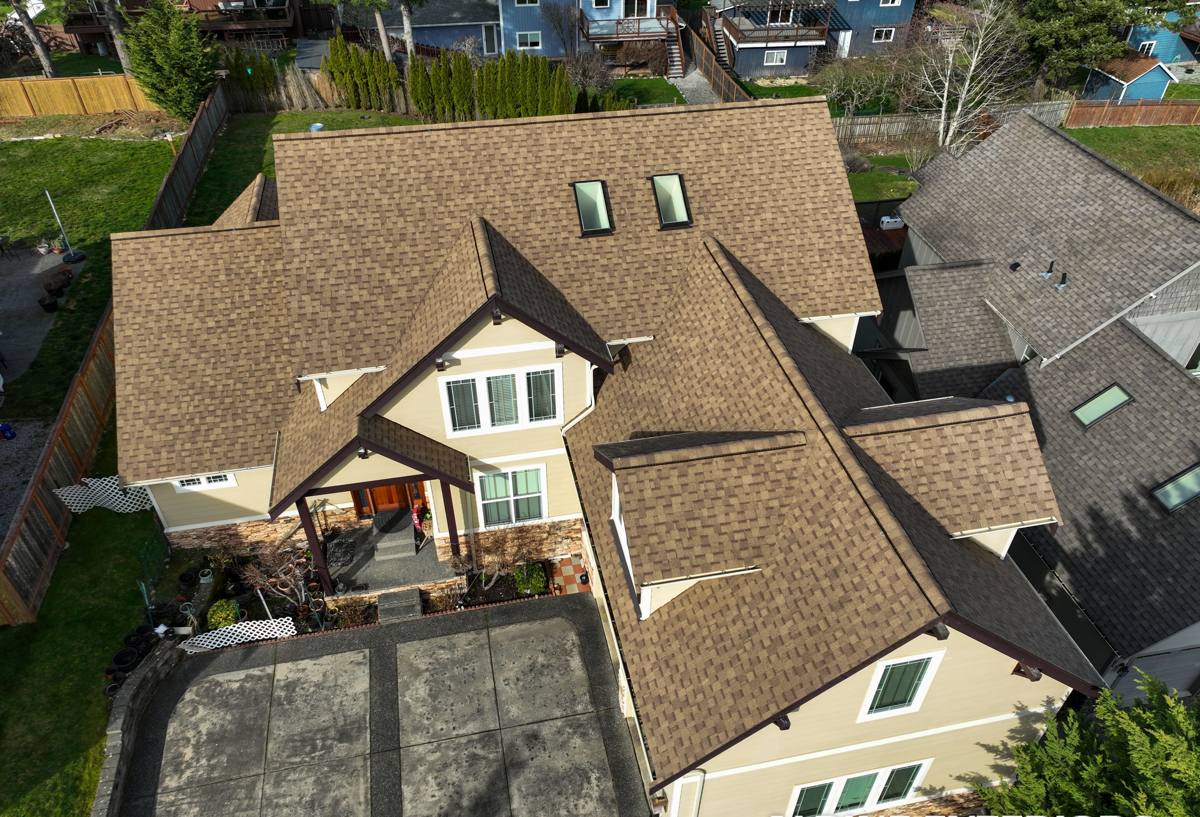
What Storm Damage Actually Looks Like on a Local Roof
Wind Damage
Wind off Drayton Harbor and the Strait doesn't always tear a roof apart dramatically. More often it's a handful of shingles or shakes lifted at the tab, a ridge cap loosened, or a section of flashing bent or pulled slightly away from a chimney or wall. These small openings are exactly what lets the next round of driving rain get underneath the roofing material.
Wind-Driven Rain Intrusion
Because our storms bring rain at an angle instead of straight down, water can be pushed up and under laps and flashings that would keep out a vertical rain just fine. Homeowners often notice this weeks after the actual storm, as a ceiling stain or musty smell in an attic space, long after the wind has died down.
Moss and Debris Damage
Moss isn't weather damage by itself, but it changes how a roof responds to weather. A mat of moss holds water against shingles and decking, keeps that area from drying out between storms, and can physically lever shingles up at the edges over time. When a storm hits a roof that already has moss establishing itself, the damage is usually worse than it would be on a clean roof, and it's often hiding underneath the moss where it isn't visible from the ground.
Signs Worth a Closer Look
- Shingles or shakes that look lifted, curled, or missing after a windstorm
- Granules collecting in gutters or at downspout outlets
- Ceiling stains, especially near exterior walls, chimneys, or skylights
- Soft or spongy decking felt when walking the attic (if accessible safely)
- Visible moss growth, particularly on shaded north- or east-facing slopes
- Flashing that looks bent, separated, or rusted at chimneys, vents, or wall intersections
What a Correct Storm Damage Repair Involves
A proper storm repair is not just replacing the shingles that are obviously missing. It starts with pulling back the surrounding roofing far enough to check the condition of the underlayment and decking underneath — because if wind-driven rain got in, that area may already be damp or starting to soften, even if it looks fine from a distance. Skipping that step and just nailing new shingles over a compromised deck is the single most common shortcut that leads to a repeat repair a year or two later.
A correct repair also matches materials as closely as possible — not just the shingle type, but the exposure and color run when it's available — and pays close attention to flashing details at any chimney, vent, or wall the damage touched. Flashing is where the majority of hidden leaks originate, and re-bending or reusing damaged flashing to save time is a false economy in a climate this wet. Fasteners and any exposed metal should be corrosion-resistant given the salt air near the harbor, not just whatever standard-grade material is cheapest.
Finally, if moss contributed to the damage, the repair should include removing the moss from the affected area and the surrounding roof, not just patching around it. Repairing a section of roof while leaving established moss mats a few feet away just relocates the next problem.
Our Storm Damage Roof Repair Process
We keep this process straightforward because homeowners dealing with storm damage usually have enough else going on. Here's how a typical repair moves from first call to finished roof:
- Inspection. We walk the roof (and the attic, when accessible) to identify not just the obvious damage but any secondary issues — soft decking, damaged flashing, or moss that likely contributed.
- Documentation. We photograph and describe the damage clearly, in a form that's useful whether you're paying out of pocket or filing an insurance claim.
- Temporary protection. If there's active exposure to weather, we get it covered or tarped before we leave, so a second storm can't make the damage worse while a full repair is scheduled.
- Scope and estimate. We give you a clear, written scope of what needs to be done and why, including anything we found beyond the original visible damage.
- Repair. We complete the work to match your existing roofing as closely as possible, with attention to flashing, ventilation, and any moss removal the area needs.
- Cleanup and walk-through. We clear debris, check gutters and downspouts near the repair, and walk you through what was done.
Repair or Replace? How We Help You Decide
Not every storm-damaged roof needs to be replaced, and not every roof that looks fine after a storm should just be patched and left alone. The right call depends on a handful of factors we walk through with you honestly before recommending either direction.
| Factor | Leans Toward Repair | Leans Toward Full Replacement |
|---|---|---|
| Age of existing roof | Under roughly half its expected lifespan | Nearing or past its expected lifespan |
| Extent of damage | Isolated to one or two areas | Spread across multiple slopes |
| Decking condition | Solid, dry decking around the damage | Soft, rotted, or repeatedly wet decking |
| Moss history | Minor, recently treated or removed | Long-established, widespread growth |
| Material availability | Matching material still available | Discontinued or badly mismatched material |
We'd rather do an honest repair on a roof that has years of service left than push a replacement that isn't needed yet — and we'll say so plainly if that's what the roof tells us.
Working With Your Homeowners Insurance
Many storm-related roof repairs in this area get filed as insurance claims, and the documentation from our inspection is written with that in mind — clear photos, a plain description of the damage, and a scope that separates storm damage from pre-existing wear like general moss growth or age-related deterioration. We're glad to meet an adjuster at the property and walk the roof with them if that's helpful. Our goal is an accurate, defensible scope of work, not an inflated one — overstating damage to a carrier tends to create problems for the homeowner later, and we won't put you in that position.
Why Local Experience Matters for This Kind of Repair
A crew that already works roofs around Semiahmoo and Drayton Harbor has seen how wind off the water actually behaves on a roof, which slopes hold moss longest, and how quickly a small lifted shingle turns into a real leak in a marine climate. That's different knowledge than a crew that mostly works dry, inland roofs and treats every storm repair the same way. Local experience also means faster response after a storm — knowing the area, knowing what temporary protection actually holds up in harbor-front wind, and not having to learn Whatcom County's climate on your roof.
After the Repair: Protecting Your Roof Through the Next Storm Season
A good repair is only half the picture. A little regular attention keeps the next storm from undoing the work, especially in a climate that gives moss and moisture so much time to work.
- Clear gutters and downspouts at least twice a year, more often under overhanging trees
- Have moss growth treated or removed before it establishes on shaded slopes
- Trim back branches that overhang the roof to reduce debris and shade
- Do a visual check of flashing and roof edges after any major windstorm
- Keep attic ventilation clear so moisture doesn't build up underneath the roofing
- Schedule a roof check-up before the wet season starts each fall
If a recent storm has left your roof near Drayton Harbor with lifted shingles, a leak, or damage you're not sure how to interpret, we're happy to take a look and give you a straight answer. Reach out for a free, no-pressure estimate using the form below.