 Semiahmoo Siding
 Why Siding Fails Faster in Marietta Than Just a Few Miles Inland
Marietta sits close to the water, in the same salt-air belt as the rest of the Semiahmoo and Drayton Harbor shoreline. That proximity matters more than most homeowners realize until they're standing in front of siding that's failing years ahead of schedule. Airborne salt settles on exterior surfaces daily, working into seams, fastener heads, and any spot where a coating has thinned. Add Whatcom County's long, wet winters — driving rain that comes in sideways off the water, months of low sun angle, and a moss season that can run from October into May — and you have a climate that punishes any siding material with a weak point.
None of this means Marietta homes need exotic materials or constant upkeep. It means repairs have to be done correctly the first time, with the right materials and the right technique for a marine climate, or the same failure shows up again in a season or two. That's the standard we hold every Marietta repair to.
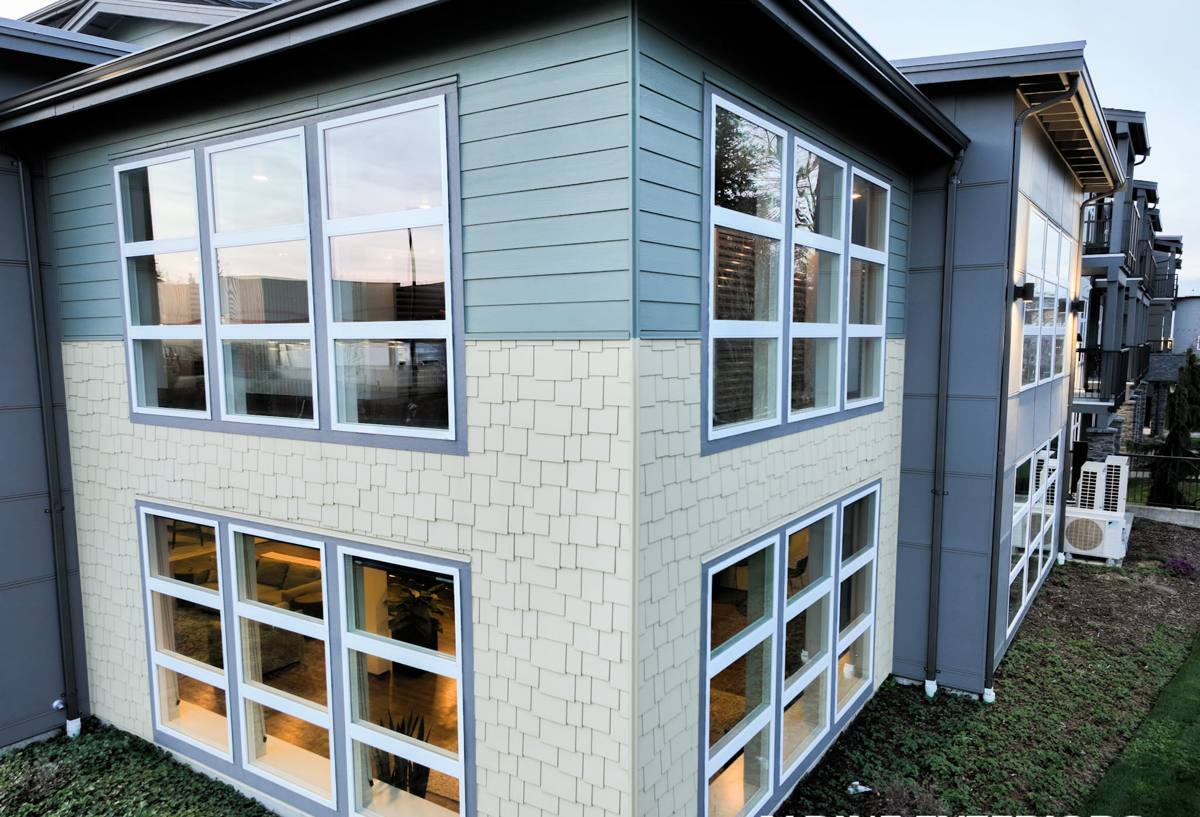
How Salt Air, Rain, and Moss Actually Damage Siding
Salt air
Salt is hygroscopic — it pulls moisture out of the air and holds it against the siding surface longer than plain rainwater would. On painted wood or engineered wood products, that constant low-grade moisture accelerates paint failure and edge swelling. On metal fasteners and trim, it accelerates corrosion, which shows up as rust streaking below nail heads and screws.
Driving rain
Wind off the water doesn't just wet the siding face — it drives water sideways and upward under laps, around window and door trim, and into any gap in caulking or flashing. Siding systems that depend on perfect, unbroken caulk lines to stay watertight are the ones that struggle most in this kind of weather, because caulk is the first thing to crack and shrink.
Moss and organic growth
Whatcom County's damp, shaded conditions are ideal for moss, algae, and mildew on north-facing walls and anywhere siding stays shaded and slow to dry. Beyond the cosmetic issue, moss holds moisture against the siding surface and can work its way into seams and butt joints, which keeps that section of wall wet far longer than it should be.
Signs Your Marietta Home May Need Siding Repair
- Soft, spongy, or crumbling spots when you press on the siding, especially near the bottom courses or below windows
- Paint that's bubbling, peeling, or flaking in patches rather than evenly across the wall
- Visible gaps, cracks, or separation at butt joints, corners, or trim boundaries
- Dark streaking, rust trails below fasteners, or persistent black or green staining that won't wash off
- Moss or algae buildup that keeps returning within weeks of cleaning
- Warping, buckling, or boards that no longer lie flat against the wall
- Interior signs — a musty smell, peeling interior paint, or a soft spot on an exterior wall — that point to moisture getting behind the siding
- Siding that's noticeably more damaged on the water-facing or wind-exposed side of the house than the sheltered side
Any one of these on its own might be minor. Several together, especially on the exposed side of the house, usually mean water has been getting behind the siding for a while — and that's a different, more involved repair than patching the surface.
What a Correct Siding Repair Actually Involves
A repair that just replaces the damaged board and re-caulks the edges treats the symptom, not the cause. In a marine climate like Marietta's, that approach tends to fail again within a year or two. A repair done right starts with figuring out how water got in, not just where it shows up.
Diagnose before you patch
Damaged siding is often a downstream symptom — a failed flashing detail above a window, a gap where trim meets siding, or a butt joint that was never properly sealed or backed. We pull back enough siding to see the sheathing and house wrap underneath before deciding what actually needs to be replaced.
Check what's underneath
If water has been getting behind the siding, the house wrap, flashing, and sometimes the sheathing itself need attention too. Replacing siding over compromised sheathing just hides the problem for another season.
Match materials and installation method
Repairs need to tie into the existing siding correctly — same reveal, same fastening pattern, factory-finished edges sealed the way the manufacturer specifies. A mismatched patch is often visible and can create a new water entry point at the seam.
Rebuild the water management, not just the surface
Correct flashing above windows and doors, proper caulking only where the manufacturer calls for it (not as a substitute for good flashing), and adequate clearance at the bottom of the wall all matter more in a wind-driven-rain climate than they would somewhere drier.
Common Repair Scenarios We See in Marietta
| What We Find | Typical Cause | What the Repair Involves |
|---|---|---|
| Soft or delaminating boards near the bottom of the wall | Splashback, poor ground clearance, or a failed weep path | Remove and replace affected boards, restore proper clearance, re-flash bottom edge |
| Staining and swelling below windows | Missing or undersized head flashing letting water run behind the siding | Pull siding back, install correct flashing, replace damaged boards |
| Cracked or open butt joints | Caulk shrinkage and thermal movement over time, common on wind-exposed walls | Reseal or rebuild the joint per manufacturer spec, sometimes with a backer |
| Persistent moss on shaded walls | Slow drying, low sun exposure, organic buildup holding moisture | Clean surface, inspect seams for water intrusion, address any hidden damage |
| Rust streaking at fasteners | Corrosion from prolonged salt-air exposure on standard fasteners | Replace with corrosion-resistant fasteners, touch up finish |
Repair or Replace? What Actually Drives That Decision
Not every problem area means the whole wall — or the whole house — needs new siding. But there's a point where patch-and-repeat repairs cost more over time than doing the job once, correctly.
| Factor | Repair Usually Makes Sense | Replacement Usually Makes Sense |
|---|---|---|
| Extent of damage | Isolated to one wall, one section, or a handful of boards | Recurring across multiple walls or showing up in new spots each season |
| Underlying material | Sheathing and house wrap underneath are sound | Water has compromised sheathing over a wide area |
| Age and material | Siding is relatively young and the product is still performing well overall | Siding is aging out, discontinued, or was never well suited to this climate |
| Repair history | First real repair the home has needed | Same areas have already been repaired more than once |
| Cosmetic match | Repaired sections can blend in with the existing siding and color | Existing product is faded, discontinued, or won't match a spot repair |
We'll give you a straight answer on which side of that line your home falls on — we don't have a reason to push a full replacement when a targeted repair will genuinely hold up.
Why We Repair With, and Recommend, James Hardie Fiber Cement
When a repair calls for replacement boards, or when repeated repairs point toward a bigger conversation, we install James Hardie fiber cement — and it's the only siding product we install, on repairs or full jobs. That's a deliberate standard, not a brand preference. Fiber cement doesn't absorb water and swell the way wood-based products can, it's non-combustible, and Hardie's factory-applied ColorPlus finish is baked on under controlled conditions rather than field-painted, which matters in a climate where field-applied coatings take a beating from rain and salt air before they've fully cured.
Hardie also builds region-specific HZ formulations engineered for different climate zones, which is relevant here — a product engineered for a hot, dry climate doesn't perform the same way through a wet Pacific Northwest winter. We standardized on Hardie because, installed correctly, it holds up to exactly the conditions Marietta throws at siding year after year, and it carries a strong transferable warranty that backs that up.
We don't install LP SmartSide, vinyl, Cemplank, Allura, primed spruce, or cedar. Each of those has situations where it's a reasonable choice for somebody — but we've made the call that for the marine climate we work in, fiber cement done to spec is what we're willing to put our name behind.
Our Repair Process
- On-site inspection. We look at the visible damage and check the areas around it — corners, trim, windows, and the wall below — for signs the problem extends further than what's obvious from the ground.
- Diagnosis, not just a quote. We tell you what we think caused the damage, not just what it'll cost to cover it up. If it's a flashing or water-management issue, we say so.
- Honest repair-vs-replace recommendation. We'll tell you plainly if a section can be repaired or if you're better off putting the money toward replacing that wall.
- The repair itself. Damaged material comes out, the substrate underneath gets checked and corrected if needed, and new material goes in matched to the existing reveal and finish, fastened and flashed to spec.
- Walkthrough. We show you what was done and why, so you know what to keep an eye on going forward.
Why a Crew That Already Works Marietta Matters
Marine-climate siding repair isn't the same trade skill as siding repair fifty miles inland. A crew that regularly works Marietta and the surrounding Semiahmoo shoreline has already seen how salt air affects fastener choice, how wind-driven rain finds the weak points in trim details, and which walls in this kind of setting take the brunt of the weather versus which stay relatively sheltered. That experience shows up in fewer surprises once the siding comes off and in repairs that are built for the specific conditions of your wall, not a generic fix.
It also means we're a known, reachable crew if a question comes up after the work is done — not a company that did one job in the area and moved on.
Keeping Repaired Siding Performing Long-Term
- Rinse siding periodically, especially shaded or north-facing walls where moss and algae build up fastest
- Keep gutters clear so overflow isn't running down and pooling against the siding
- Trim back vegetation that keeps a wall shaded and slow to dry
- Check caulking at trim and butt joints once a year — catching a small crack early is a lot cheaper than the repair it prevents
- After any wind event, do a quick visual check for lifted or displaced boards before the next rain
If you're seeing damage, staining, or recurring moss on your Marietta home's siding, we're happy to take a look and give you a straight assessment — no pressure, no upsell, just an honest read on what your siding actually needs. Use the form below to request a free estimate.