 Semiahmoo Siding
 Why Cherry Point Siding Takes a Different Kind of Beating
Cherry Point sits on open water at the edge of the Salish Sea, and that location shapes everything about how siding ages there. Homes here don't just deal with rain — they deal with rain pushed sideways by wind, salt-laden air drifting off the water, and a long, damp shoulder season where moss and algae get a real foothold on north- and west-facing walls. A siding repair in this part of Whatcom County has to account for all three, not just patch the visible damage and move on.
We've worked enough homes along this stretch of coastline to know that siding problems here rarely show up where you'd expect. Water finds its way in at trim joints, under window flashing, and behind loose caulk lines, then travels before it ever stains the surface. A repair that only addresses what's visible from the ground can leave the actual entry point untouched — which is why diagnosis matters as much as the fix itself.
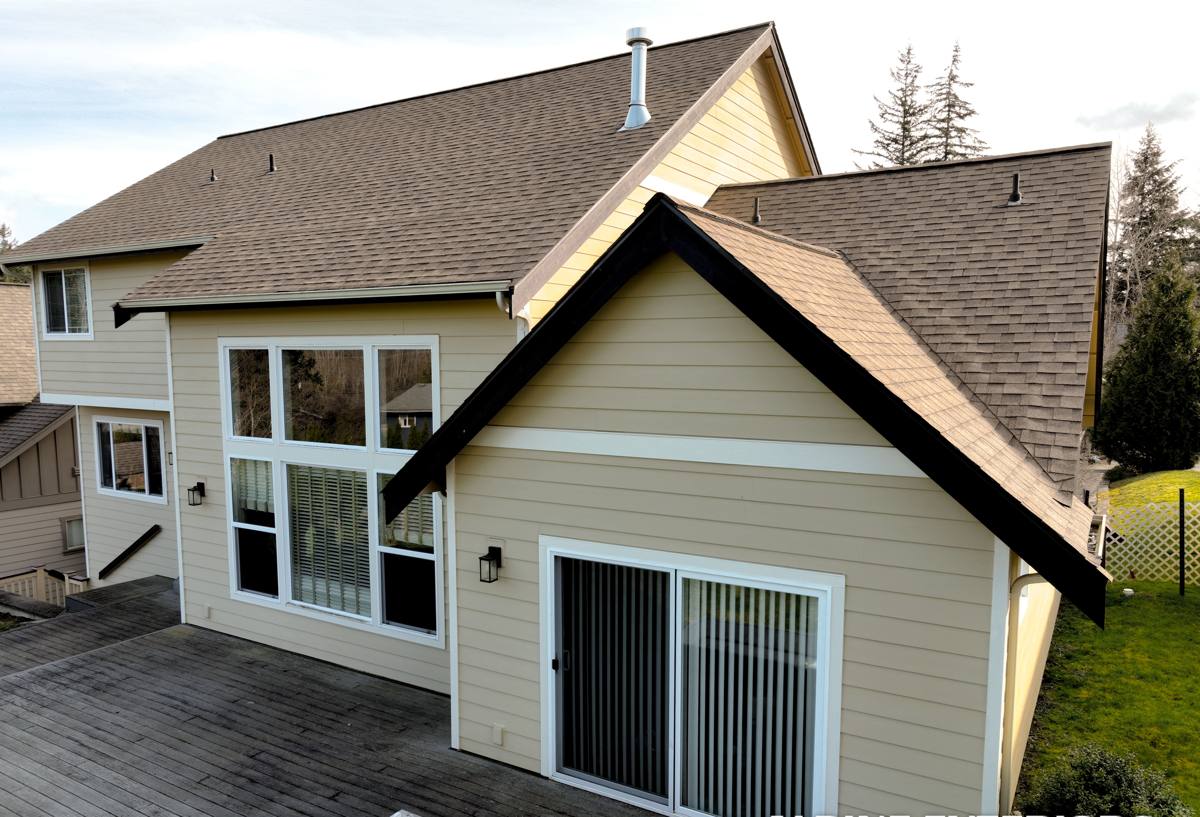
What Marine Exposure Actually Does to Siding
Salt Air and Fasteners
Airborne salt accelerates corrosion on exposed nail heads, screws, and metal trim pieces faster than it does further inland. Once a fastener starts to corrode, it can weep rust streaks down the face of the siding and eventually lose its grip, letting panels or boards work loose in wind.
Driving Rain and Joint Failure
Wind-driven rain doesn't fall straight down — it gets forced sideways and upward into laps, seams, and butt joints that were never designed to shed water from that angle. Caulk that looked fine five years ago can be the exact spot where water is now getting behind the siding.
Moss, Algae, and Trapped Moisture
Cherry Point's damp, shaded microclimates give moss and algae a long growing season. Beyond the cosmetic staining, moss holds moisture directly against the siding surface for extended periods, which is a bigger problem for moisture-sensitive materials than for fiber cement, but it still needs to be addressed correctly rather than pressure-washed aggressively, which can drive water into seams.
Signs Your Siding Needs Repair — Not Just a Paint Job
- Soft or spongy spots when you press on the siding near the bottom edge or around windows
- Visible gaps, cracks, or separation at butt joints and corner trim
- Rust streaking below nail heads or metal flashing
- Bubbling, peeling, or discolored paint concentrated in one area rather than spread evenly
- Persistent moss or dark staining that returns quickly after cleaning
- Warping or bowing panels, especially on the side of the house that faces prevailing wind
- Caulk that has cracked, shrunk, or pulled away from the joint it was sealing
Any one of these can be a simple, contained repair. Several of them together, especially if they're spreading, usually point to a moisture problem working its way along the wall — and that changes the scope of the job.
What a Correct Repair Actually Involves
Diagnosis Before Demolition
The first step isn't pulling boards — it's figuring out where water is actually getting in. That means checking flashing above windows and doors, inspecting caulk joints, and in some cases removing a small section of siding to look at the weather-resistive barrier and sheathing underneath. Repairing the surface without finding the source just buys a few years before the same spot fails again.
Matching Material and Profile
Replacing a damaged section means matching not just the color but the plank width, reveal, and texture of the existing siding. On older homes, especially ones with mismatched past repairs, this can take some hunting. It's also part of why we standardized on one product line — it makes accurate matching far more consistent from job to job.
Flashing and Water Management
Any competent repair includes correcting the flashing detail that let water in, not just replacing the damaged board and leaving the same vulnerability in place. This is often the difference between a repair that lasts and one that fails again within a couple of seasons.
Sealing and Finish Work
Fresh caulk at the right joints, touch-up or factory-matched finish on new material, and a final check that the repaired section sheds water the same way the surrounding wall does.
Common Repair Scenarios We See Near Cherry Point
| Issue | Likely Cause | Typical Fix |
|---|---|---|
| Soft siding near the base of the wall | Splash-back moisture, poor grade slope, or failed caulk at the bottom trim | Remove and replace affected boards, correct drainage path, reseal properly |
| Cracking at window and door trim | Wind-driven rain forcing past aging caulk or flashing | Re-flash the opening, replace trim as needed, reseal with appropriate sealant |
| Rust streaks below fasteners | Corroding fastener heads exposed to salt air | Replace with corrosion-resistant fasteners, patch or replace stained boards |
| Recurring moss or algae staining | Shaded, damp wall with limited airflow | Clean surface correctly, address any moisture retention, monitor |
| Impact damage from storms or debris | Wind-driven branches or debris during coastal storms | Cut out and replace the damaged section with matched material |
Repair or Full Replacement? How We Help You Decide
Not every problem needs a full re-side, and we're not going to sell you one if a targeted repair solves the issue. But there's a point where patching stops making financial sense. As a general guide:
- Repair usually makes sense when damage is isolated to one or two wall sections, the underlying sheathing is dry and sound, and the rest of the siding is in reasonably good condition.
- Replacement starts to make more sense when moisture damage has spread across multiple walls, the siding is old enough that matching material is no longer practical, or repeated repairs haven't resolved a recurring leak point.
We'll tell you honestly which category your home falls into, including when the answer is "this is a $400 fix, not a full project."
Why We Only Repair and Install James Hardie Fiber Cement
We don't install vinyl, LP SmartSide, or other fiber cement brands, and that standard applies to repair work too. In a marine environment like Cherry Point, the material matters as much as the workmanship. James Hardie's HZ5 product line is engineered for exactly this kind of climate — freeze-thaw cycling, sustained moisture, and coastal exposure — and it's non-combustible, which matters given the region's dry summer wildfire risk in surrounding areas.
From a repair standpoint specifically, Hardie's ColorPlus factory finish gives us a consistent, traceable color system, which makes matching a repaired section to existing siding far more reliable than trying to color-match a faded, field-painted product. And because we work almost exclusively in this material, we carry a working knowledge of profiles, reveals, and installation details that speeds up diagnosis and keeps repairs looking correct rather than patched.
Our Repair Process
- On-site inspection — we look at the damaged area and the surrounding wall, not just the spot you called about.
- Moisture check — where warranted, we check underlying sheathing condition before quoting the scope of work.
- Honest scope and estimate — you get a clear explanation of what's actually wrong and what it will take to fix it correctly.
- Matched material sourcing — profile, reveal, and finish matched as closely as the existing siding allows.
- Correct execution — flashing, fastening, and sealing done to spec, not just cosmetic patching.
- Final walkthrough — we show you what was done and why, and flag anything else worth keeping an eye on.
Why Local Experience Matters for This Kind of Work
A crew that regularly works the Semiahmoo and Cherry Point area already knows how prevailing wind and salt exposure tend to hit these homes — which walls fail first, where flashing details typically get missed on older construction, and how the local moss season behaves compared to more sheltered inland parts of Whatcom County. That familiarity shortens the diagnostic process and reduces the chance of treating a symptom instead of the actual cause.
It also matters for logistics. Coastal properties can have tighter access, exposure considerations during a repair, and weather windows that inland jobs don't have to plan around. A contractor who already knows the area schedules around that reality instead of learning it on your job.
A Quick Self-Check Before You Call
- Walk the exterior and press gently on siding near ground level and below windows — note any soft spots
- Look at trim corners and joints for visible gaps or cracked caulk
- Check for rust streaking below any exposed fasteners or metal flashing
- Note which walls have the heaviest moss or algae buildup and whether it returns quickly after cleaning
- Look inside near affected exterior walls for any signs of staining, musty odor, or soft drywall
If you notice any of these, it's worth getting a professional look before the damp season sets in further — small problems on coastal siding tend to grow faster than homeowners expect.
If you're seeing any of these signs on your Cherry Point home, we're glad to take a look and give you a straight answer — whether that's a small repair, a bigger fix, or just peace of mind that things are fine. Reach out for a free, no-pressure estimate using the form below.