 Semiahmoo Siding
 Why Marietta Decks Take More Punishment Than People Expect
Marietta sits close enough to Semiahmoo Bay and Drayton Harbor that salt-laden air is a daily fact of life, not an occasional weather event. Add Whatcom County's long stretch of driving rain each fall and winter, plus a moss season that can run from October well into spring on shaded or tree-covered lots, and you have a set of conditions that will find every weak point in a deck within a few years. Fasteners corrode faster here. Wood fibers stay damp longer between dry spells. Algae and moss get a head start on any surface that doesn't drain or dry quickly.
None of that means a deck in Marietta has to be high-maintenance or short-lived. It means the material choice and the build details have to match the actual climate the deck will sit in, not a generic install done the same way it would be done in a drier part of the state.
Salt Air and Metal Fasteners
Salt air accelerates corrosion on anything less than marine-grade or stainless hardware. On a lot of decks we're called out to repair, the boards themselves are still fine — it's the fasteners, joist hangers, and structural screws that failed first, working themselves loose or rusting through years ahead of schedule. That's a framing and hardware decision as much as a decking decision.
Moss and Shade
Many properties around Marietta have mature trees or sit close enough to neighboring structures that parts of the deck rarely see direct sun. Moss and algae thrive in that combination of shade and moisture. The board's surface texture, the gap spacing between boards, and how well air moves underneath the deck all affect how fast growth takes hold and how easy it is to clean off.
Why Composite Makes Sense for This Climate
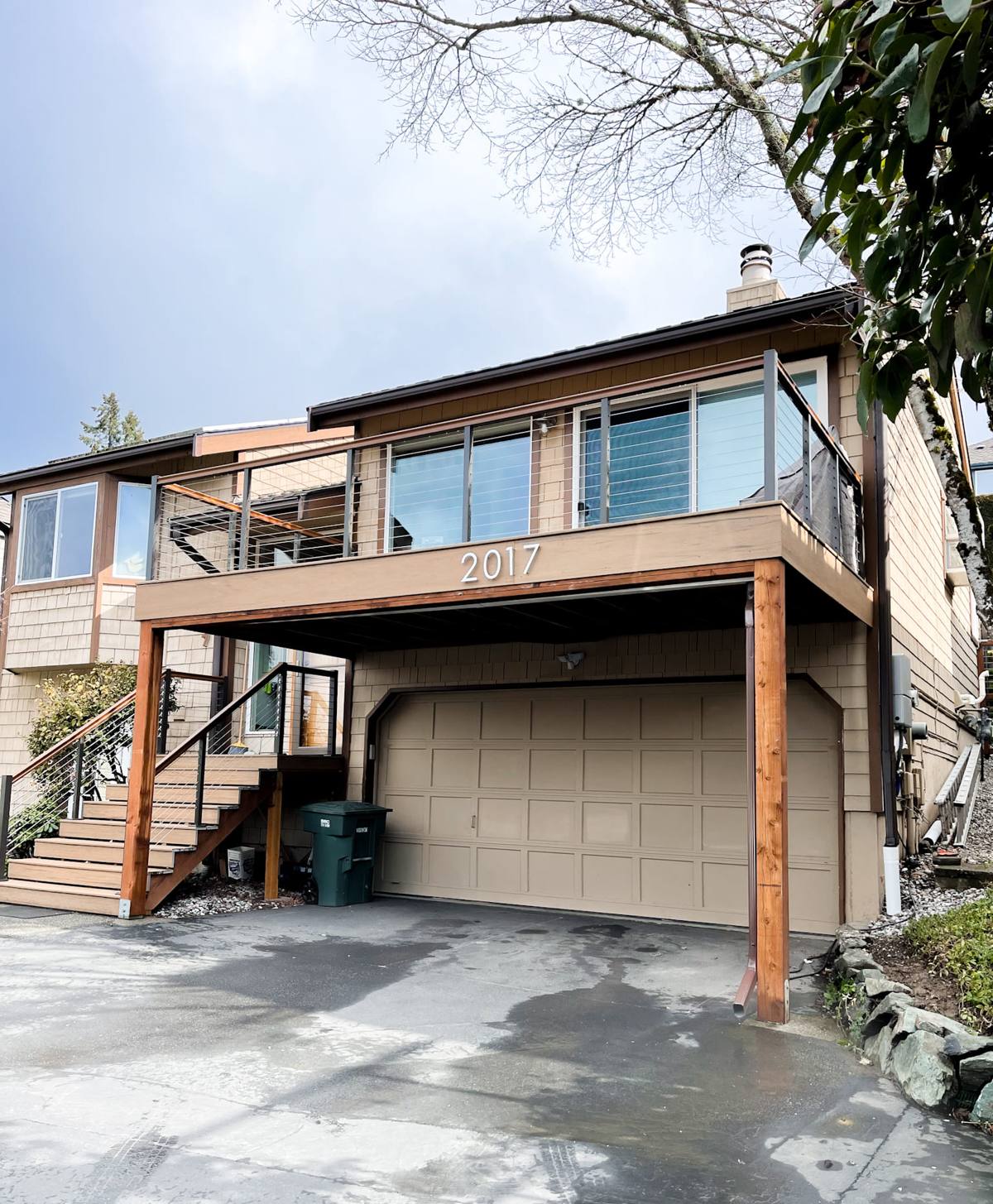
Composite decking — a blend of wood fiber and recycled plastic, usually with a protective cap layer — doesn't absorb water the way solid wood does, doesn't need annual staining or sealing, and resists rot outright since there's no exposed wood fiber to feed decay fungus. In a climate where a deck spends a good chunk of the year wet, that's a real advantage over traditional lumber, which needs consistent maintenance to keep moisture out and will eventually cup, split, or rot regardless of how well it's cared for.
That said, composite isn't maintenance-free — it's lower-maintenance. It still needs periodic cleaning to keep moss and surface grime from building up in the board's grain texture, and the quality of the install underneath the boards matters just as much as the boards themselves.
Capped vs. Uncapped Composite
Capped composite has a solid polymer shell wrapped around the wood-plastic core, which is what actually blocks moisture absorption and resists staining. Uncapped composite (or capped-on-one-side boards installed the wrong way up) is more vulnerable to moisture wicking in at the edges, especially in a wet climate like ours. We install fully capped composite specifically because of the amount of rain Whatcom County sees — it's the detail that protects the investment over the long run.
What a Correct Composite Deck Install Actually Involves
The decking boards get most of the attention, but they're the last thing installed, not the most important thing. A composite deck that fails early almost always fails underneath the boards — at the ledger connection, the joists, or the fasteners — not in the decking material itself.
- Ledger board properly flashed and sealed against the house to stop water intrusion at the rim joist — the single most common failure point on older deck-to-house connections
- Joist tape applied over every joist top to keep standing water from wicking into the wood framing underneath the composite
- Stainless steel or coated structural screws and hardware sized for coastal exposure, not standard interior-grade fasteners
- Hidden fastener clips or color-matched face screws installed to manufacturer spacing, not "close enough"
- Board gapping set to allow for drainage and airflow, adjusted for our wet season rather than a dry-climate default
- Proper ventilation and clearance underneath the deck so moisture doesn't sit trapped against the framing
| Factor | Pressure-Treated Wood | Composite | PVC |
|---|---|---|---|
| Moisture absorption | High — needs sealing | Low, especially capped | Very low |
| Moss/algae resistance | Poor in shade | Good, needs periodic cleaning | Good |
| Annual maintenance | Stain/seal, inspect for rot | Occasional wash | Occasional wash |
| Typical lifespan | 10-15 years with upkeep | 25-30+ years | 25-30+ years |
| Upfront cost | Lowest | Mid-range | Highest |
| Coastal/salt air fit | Fair with strict maintenance | Good | Good |
Framing and Substructure Considerations for This Area
Whatcom County soils and site conditions vary a lot within a short distance — some Marietta lots are wooded and hold moisture in the ground longer, others are more open and exposed to wind off the bay. Both situations affect the substructure. Footings need to be set to the correct depth for our frost line and inspected for existing settling or rot before any new decking goes down. On tear-off jobs where we're replacing old wood decking, we routinely find framing that looks sound from the top but has soft or corroded connections underneath — that's exactly the kind of thing that gets fixed during the build, not discovered five years later as a sag or a bounce underfoot.
If your existing deck substructure is solid, we can often install new composite decking over the existing frame after inspection and any needed repairs. If the frame shows rot, undersized joists, or fastener corrosion, we address that first — installing new decking over a compromised frame just moves the problem down the road.
Railings, Stairs, and Code Requirements
Any deck over a certain height off grade needs guard rails at code-required height, with baluster spacing tight enough to meet current safety code. Stairs need proper stringer support and consistent rise and run — inconsistent steps are one of the most common code violations and safety hazards on older decks we're asked to replace. Composite decking pairs with a range of railing systems, from matching composite rail to aluminum or cable rail, and the right choice depends on the view you're trying to keep open and the level of upkeep you want long-term.
Whatcom County permitting applies to most new decks and many substantial deck replacements, particularly when height, size, or structural work is involved. We handle that process as part of the job rather than leaving it for the homeowner to sort out.
Our Process for a Marietta Composite Deck
- On-site assessment of the existing deck or build site, including a look at framing condition, drainage, and sun/shade exposure
- Honest recommendation on repair-and-resurface versus full tear-off and rebuild, based on what we actually find underneath
- Written estimate covering materials, framing work, railing, and any permit needs
- Framing repair or replacement first, with joist tape, flashing, and coastal-grade hardware installed before any decking goes down
- Composite board installation to manufacturer spec, with attention to gapping and drainage for our wet season
- Final walkthrough so you know what maintenance the deck actually needs going forward
Maintaining a Composite Deck in This Climate
Composite decking cuts down on maintenance, but "low-maintenance" isn't "no-maintenance" here. The moss and rain we get make a basic seasonal cleaning routine worthwhile even on capped composite boards.
- Rinse and sweep debris off the deck regularly, especially in fall when leaf litter and organic material build up fast
- Scrub with a soft-bristle brush and mild soap or a composite-safe cleaner a couple of times a year, more often in heavily shaded areas
- Keep gutters and downspouts near the deck clear so runoff isn't dumping directly onto the decking or framing
- Trim back overhanging branches where possible to reduce shade and speed up drying time after rain
- Check railing connections and fasteners annually for any early signs of corrosion or loosening
What Affects the Cost of a Composite Deck Here
| Cost Factor | Why It Matters Locally |
|---|---|
| Framing condition | Rot or corrosion from prior moisture exposure often needs repair before decking goes on |
| Deck size and layout | Complex shapes, multiple levels, or stairs add labor and material |
| Railing type | Composite, aluminum, and cable rail systems vary widely in material cost |
| Fastener and hardware grade | Coastal-grade stainless hardware costs more upfront but avoids early corrosion |
| Permit and inspection | Required for most new builds and larger replacements in Whatcom County |
| Site access | Waterfront or sloped lots can add setup and material handling time |
Composite decking generally costs more upfront than pressure-treated wood, but the maintenance savings and longer service life often even that out over the life of the deck — particularly in a climate that's hard on untreated or under-maintained wood.
Why a Crew That Already Works in Marietta Matters
A contractor who works this specific stretch of Whatcom County knows what to expect before they even pull up: which lots hold moisture longest, which framing details tend to fail first near the water, and how much moss cleanup a shaded deck realistically needs each year. That's the difference between a deck that's built to the letter of a spec sheet and one that's actually built for where it sits. We've seen what salt air and a long wet season do to decks that weren't detailed for it, and we build accordingly from the framing up.
If you're considering a new composite deck or replacing an aging one in Marietta, we're happy to take a look and give you a straightforward, no-pressure estimate — just fill out the form below.