 Semiahmoo Siding
 Custer's Climate Is Harder on a Roof Than Most Homeowners Realize
Custer sits close enough to the water and the Canadian border that its roofs deal with a combination most inland Washington towns never see: salt-laden air blowing in off the Semiahmoo shoreline, long stretches of driving rain that come in sideways during winter storms, and shaded, moisture-heavy lots that turn into moss farms if a roof isn't built and maintained correctly. None of these problems are dramatic on their own. Together, over years, they're what separates a shingle roof that makes it to 25-plus years from one that starts showing granule loss, soft spots, and moss colonies by year twelve.
Asphalt shingles remain the right choice for the large majority of homes in Whatcom County — they're durable, repairable, and reasonably priced compared to metal or specialty materials. But "asphalt shingles" is a broad category, and how they're installed matters more here than in a dry inland climate. A roof that would hold up fine in Spokane can fail early in Custer if the underlayment, ventilation, and flashing details aren't matched to what this specific coastline throws at it.
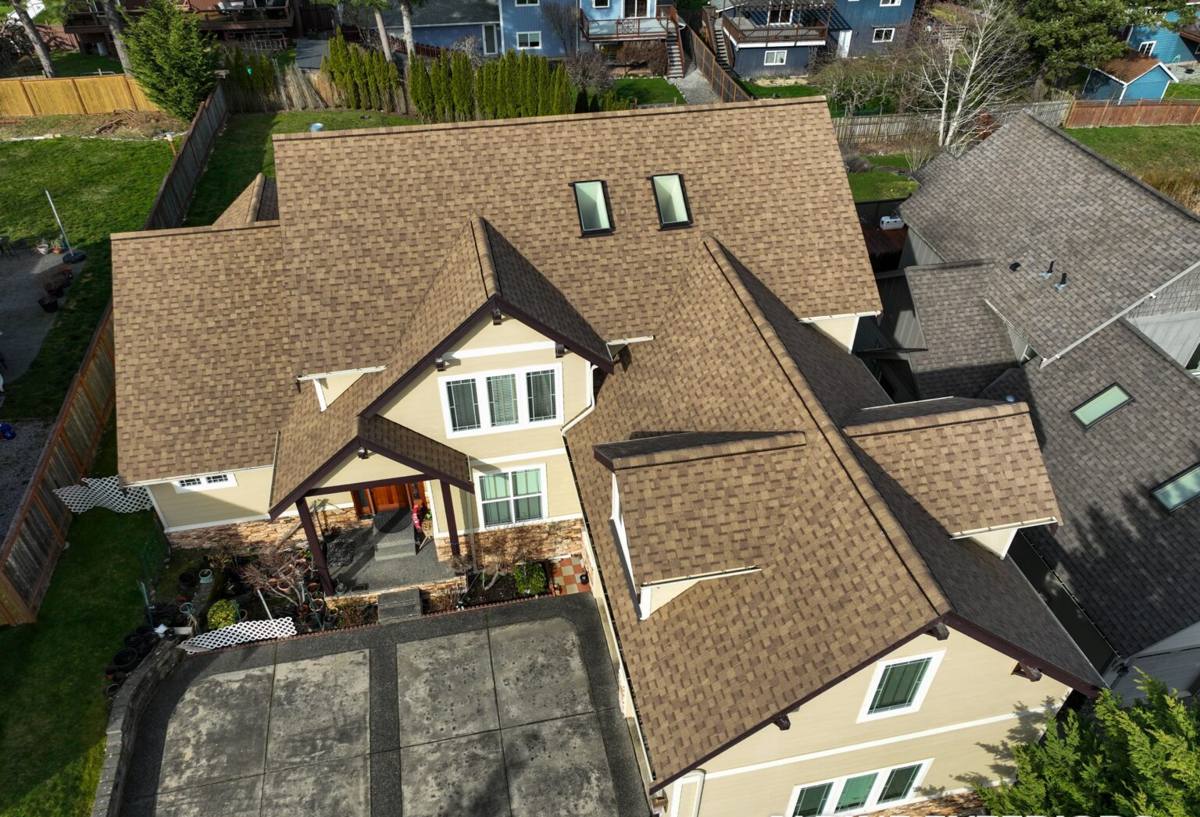
What Salt Air, Rain, and Moss Actually Do to a Roof
It helps to understand the mechanisms, not just the symptoms:
- Salt air accelerates corrosion on exposed metal — nail heads, flashing, vent stacks, and gutter fasteners age faster near the shoreline than they do even a few miles inland.
- Driving rain doesn't just fall straight down. Wind-driven rain gets pushed sideways and upward under shingle edges, around chimneys, and into valleys, which is why flashing and underlayment quality matters more here than shingle brand.
- Moss and moisture take hold on roof sections that stay shaded and damp for long stretches — north-facing slopes, areas under overhanging trees, and roofs with poor airflow underneath. Moss holds water against the shingle surface, which shortens the life of the mat underneath even before you see visible damage.
A correctly built roof in Custer accounts for all three from the start, rather than trying to fix them after the fact with more frequent moss treatments or patch repairs.
What a Correctly Installed Roof Needs in This Climate
Underlayment and Ice-and-Water Barrier
Standard felt underlayment is thinner and dries out faster than a synthetic underlayment, and in a climate with this much sustained moisture, that difference shows up over time. We use synthetic underlayment as our standard, with self-adhered ice-and-water barrier at eaves, valleys, and around every roof penetration — the spots where wind-driven rain is most likely to find a way in. This isn't an upgrade we upsell; it's the baseline for a roof that's supposed to hold up here.
Ventilation That Actually Moves Air
Moss and premature shingle aging are often a ventilation problem more than a shingle problem. If an attic can't breathe, warm moist air condenses against the roof deck from underneath, and the shingles above stay damp longer than they should after every rain. Balanced intake (soffit vents) and exhaust (ridge vents) keep air moving so the underside of the roof dries out between storms instead of staying saturated all winter.
Flashing Details
Chimneys, skylights, dormers, and roof-to-wall transitions are where the large majority of roof leaks actually start — not in the open field of shingles. Step flashing, counter-flashing, and properly lapped valley metal (not just caulk) are what keep wind-driven rain out of these transitions. We flash to last, not to pass a quick visual check.
Choosing Shingles for a Salt-Air, Moss-Prone Climate
Not every asphalt shingle is built the same way, and the differences matter more here than they would in a milder climate.
| Shingle Type | Best Fit For | Trade-Off to Know |
|---|---|---|
| Standard 3-tab | Budget-conscious re-roofs, secondary structures | Shorter lifespan, less wind resistance, no algae resistance unless specified |
| Architectural (laminate) | Most Custer homes — better wind rating, thicker profile | Higher upfront cost, but longer service life offsets it |
| Algae-resistant (copper-granule) | Shaded lots, north-facing slopes, homes with a moss history | Slightly higher cost; resists algae staining but doesn't replace good ventilation |
| Impact-rated | Homes wanting extra durability against wind-driven debris | Premium pricing; more relevant on exposed, wind-heavy sites |
For most Custer homes, we recommend an algae-resistant architectural shingle as the sensible default — the added cost over standard architectural shingles is modest, and it directly addresses the moss and staining issue this area is known for. That said, algae-resistant granules reduce algae growth on the shingle surface; they don't eliminate moss that's rooting in debris and shade at the roof edges. Granule technology and good maintenance work together, not as substitutes for each other.
The Moss Problem, Specifically
Moss is the complaint we hear most often from Custer homeowners, and it's worth being direct about what does and doesn't fix it long-term.
Moss needs shade, organic debris, and standing moisture to take hold. A roof with clean valleys, trimmed-back overhanging branches, and good airflow underneath will grow far less moss than one without — regardless of shingle brand. Physical moss removal (never pressure washing, which strips granules and shortens shingle life) combined with a zinc or copper strip near the ridge can meaningfully slow regrowth on vulnerable slopes. But if a roof already has moss working its way under the shingle tabs and lifting them, that's not a cleaning problem anymore — it's a sign the mat underneath is likely already absorbing moisture, and a repair or replacement conversation is more honest than another cleaning.
Our Process on a Custer Roofing Project
Every roof gets the same sequence, whether it's a full replacement or a targeted repair:
- On-site inspection — we walk the roof (not just the ground), check the attic for ventilation and moisture signs, and document actual conditions rather than guessing from photos.
- Written scope and estimate — what's being replaced, what underlayment and flashing details are included, and what the timeline looks like, in plain language.
- Tear-off and deck inspection — old material comes off completely so we can check the deck underneath for soft spots or rot before anything new goes down. Covering up a bad deck is how roofs fail early.
- Install to the standard above — synthetic underlayment, ice-and-water barrier at vulnerable areas, proper flashing, balanced ventilation, correct nailing pattern for the local wind exposure.
- Cleanup and final walkthrough — magnetic sweep for nails, debris hauled off, and a final look at the finished roof with the homeowner before we call it done.
Signs a Custer Roof Needs Attention
Most roof problems here start small and stay hidden until they're not. Worth checking for:
- Granules collecting in gutters or at downspout outlets (a sign shingles are wearing down)
- Moss or dark streaking concentrated on shaded or north-facing slopes
- Shingle tabs that look lifted, curled, or cracked, especially after a windstorm
- Soft or spongy spots when walked on, or sagging visible from the ground
- Water stains on interior ceilings, especially near chimneys or skylights
- Daylight visible through the attic roof deck
- Rusting or lifting flashing around vents, chimneys, or wall transitions
Any one of these on its own might just mean routine maintenance. Two or three together, especially on a roof over 15 years old, usually means it's worth a real inspection before the next big storm season.
Maintenance That Actually Matters Here
A well-built roof still needs upkeep in this climate. The maintenance that moves the needle in Custer is unglamorous but effective: keeping gutters and valleys clear of needles and debris so water has somewhere to go, trimming back branches that keep a slope shaded and damp, having moss physically removed (not pressure washed) before it works under shingle edges, and getting an actual inspection every few years rather than waiting for a ceiling stain to prompt one. None of this is expensive compared to the cost of an early replacement.
Why It Matters That We Already Work in Custer
A roofing crew that mostly works dry inland climates will often spec a roof the way they always do — because it's worked fine where they normally build. A crew that works Custer and the surrounding Whatcom County coastline regularly already knows which slopes will hold moss, which valleys need the extra underlayment detail, and which flashing shortcuts show up as leaks two winters later. That local pattern recognition is the difference between a roof that's technically up to code and one that's actually built for where it sits.
| Cost Factor | Why It Moves the Price |
|---|---|
| Roof size and pitch | More surface area and steeper slopes mean more material and labor time |
| Number of layers to remove | Tear-off of multiple old layers costs more than a single-layer removal |
| Deck condition | Rotted or soft decking found during tear-off requires repair before install |
| Shingle grade chosen | Standard vs. architectural vs. algae-resistant carries different material costs |
| Flashing and penetration count | More chimneys, skylights, and vents mean more detail work |
| Access and site conditions | Steep sites, tree cover, or limited equipment access affect labor time |
If you're weighing a repair against a full replacement, or just want a straight answer on where your current roof stands, we're happy to take a look. The estimate is free, there's no pressure, and you'll get a plain-language explanation of what we find — use the form below to get started.