 Semiahmoo Siding
 Ferndale's Exterior Is Working Against Your Siding Year-Round
Ferndale sits in coastal Whatcom County, close enough to the water that salt-laden air is a constant factor on anything mounted to the outside of a house. Add in the driving rain that comes off winter storms and a moss season that can stretch from fall through spring, and you have an exterior environment that punishes the wrong siding choice faster than most homeowners expect. Paint fails early. Wood swells, cracks, and invites rot at the seams. Moss gets a foothold on north-facing walls and never really leaves.
None of this is unusual for this part of Washington — it's just the reality of building near the Salish Sea. The siding on a Ferndale home has to handle moisture that doesn't evaporate quickly, humidity that stays high for months at a stretch, and airborne salt that accelerates corrosion on fasteners and finishes. Fiber cement siding, installed correctly, is one of the few claddings engineered to take that kind of sustained exposure without becoming a maintenance project every other year.
What Fiber Cement Siding Actually Is
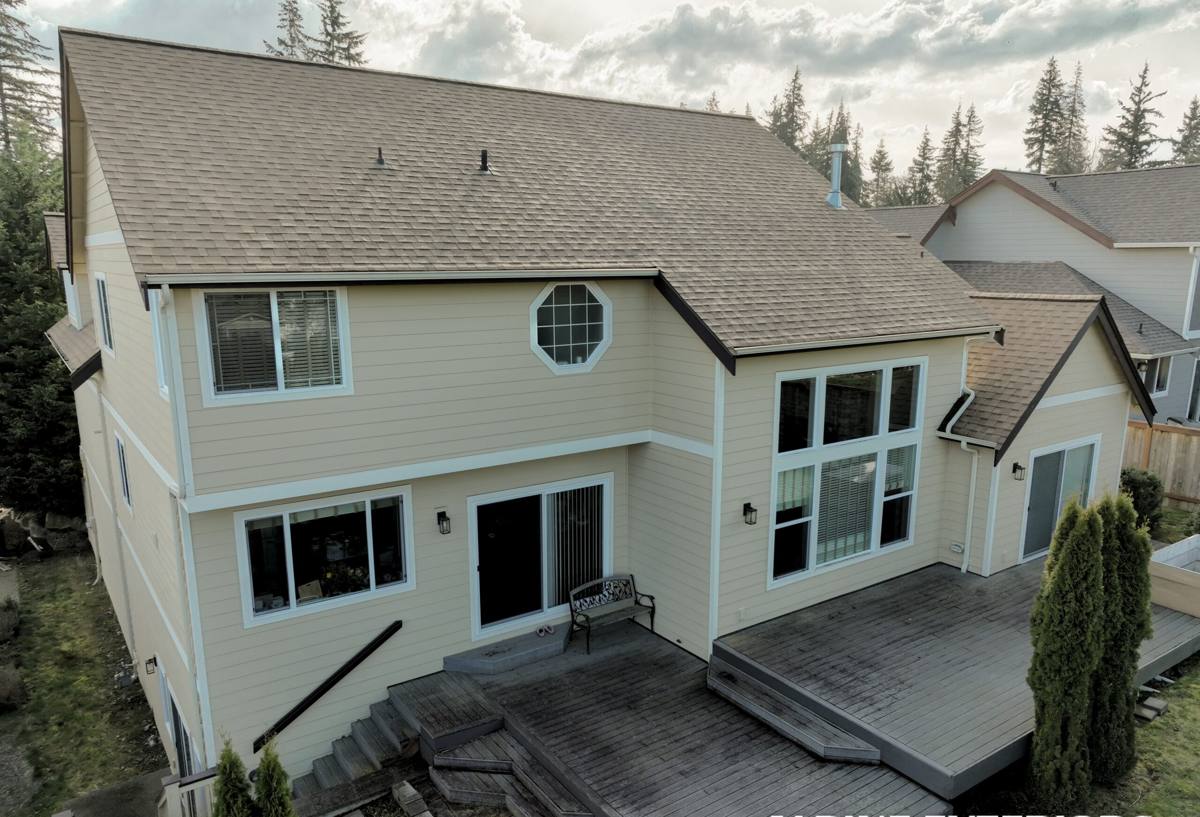
Fiber cement siding is a composite of cement, sand, and cellulose fibers, formed under pressure and cured into dense, dimensionally stable boards and panels. It doesn't absorb water the way wood does, it doesn't warp with temperature swings the way vinyl can, and it's non-combustible, which matters more every year as wildfire smoke and ember exposure become a regional concern even west of the Cascades.
We install James Hardie fiber cement exclusively. That's a deliberate standard, not a brand preference stated lightly. James Hardie engineers its products by climate zone, factory-finishes them with a baked-on ColorPlus finish instead of relying on field-applied paint alone, and backs the material with a transferable warranty that holds up when a home changes hands. For a coastal Whatcom County house, that combination — dimensional stability, a factory finish rated for UV and moisture, and a product line actually engineered for wet, humid, freeze-thaw climates — is what makes the difference between siding that lasts and siding that becomes a recurring repair line item.
Why HardieZone Matters Here
James Hardie makes different formulations for different climate zones, sold under the HardieZone system. Homes in the Pacific Northwest fall under HZ5, which is engineered for regions with significant moisture exposure and freeze-thaw cycling — a very different set of demands than the HZ10 formulation built for hot, humid southern climates. Installing the wrong zone product, or installing zone-correct product without following the zone-specific fastening and clearance requirements, undercuts the whole point of choosing an engineered material in the first place.
What a Correct Installation Involves in This Climate
Fiber cement siding is only as good as the installation behind it. In a climate like Ferndale's, a handful of details separate a job that lasts decades from one that fails at the seams within a few years.
- Weather-resistive barrier and flashing first. The siding is the visible layer, but the water-resistive barrier, window and door flashing, and drainage plane behind it do the actual work of keeping moisture out of the wall assembly.
- Correct clearances. James Hardie specifies minimum clearances from grade, roofing, decks, and horizontal surfaces. Skipping these is one of the most common causes of moisture intrusion and premature rot at the bottom of a wall, especially on homes with landscaping or grade that slopes toward the foundation.
- Proper fastening. Fasteners need to be corrosion-resistant and driven to the manufacturer's specified depth and spacing — overdriven or underdriven nails compromise both the water management and the finish.
- Factory-finished panels installed to preserve that finish. ColorPlus siding is pre-finished at the factory specifically so field touch-up is minimized. Cut edges and any field-touch areas need to be sealed with the matching Hardie touch-up product to keep raw cement from wicking moisture.
- Caulking and joint treatment appropriate for a wet climate. Every joint, seam, and penetration is a potential entry point for water. In a region with as much sustained rain as Whatcom County sees, sloppy caulk work shows up as staining and rot within a couple of seasons, not years.
Where Installations Go Wrong — and Why It Shows Up Fast Here
Most fiber cement siding problems we get called out to inspect trace back to the installation, not the material. Panels installed tight to grade with no clearance trap moisture against the bottom course. Butt joints without proper flashing let water track behind the siding during driving rain. Fasteners that aren't corrosion-resistant streak and stain under salt-air exposure. None of these mistakes are visible on day one — they show up eighteen months to three years later, usually as bubbling paint, dark staining at seams, or soft trim boards.
Because Ferndale's climate doesn't give a poorly installed exterior any grace period — the moisture and moss pressure is close to constant — installation errors compound faster here than they would in a drier region. That's the practical argument for hiring a crew that treats manufacturer specifications as non-negotiable rather than as suggestions to speed past.
How We Approach a Ferndale Job
Our process for a fiber cement siding project starts with a walk-around assessment of the home, not a generic quote. We look at grade clearance, existing trim and window flashing condition, moss and moisture staining patterns, and any areas where the current siding — whatever it is — has already failed. That tells us where extra flashing detail or repair work needs to happen before a single new panel goes up.
From there: removal of the old siding down to the sheathing, inspection and repair of any water-damaged framing or sheathing found underneath (a step that's not optional — covering rot with new siding just hides the problem), a correctly lapped weather-resistive barrier, manufacturer-spec flashing at every window, door, and penetration, and then the Hardie siding itself, fastened and clearanced to spec. We finish with sealed cut edges, touch-up paint matched to the ColorPlus finish, and a final walk-through.
Because we work this material regularly in this climate, we're not learning Whatcom County's moisture behavior on a customer's house — the clearance, flashing, and fastening details that matter here are built into how we bid and schedule every job from the start.
What Affects the Cost of a Fiber Cement Siding Job
Every home is different, and we don't quote sight unseen, but the factors that move the price on a Ferndale fiber cement project are fairly consistent:
| Factor | Why It Matters |
|---|---|
| Home size and wall complexity | More corners, gables, and dormers mean more cutting, flashing, and labor time |
| Condition of the sheathing underneath | Rot or moisture damage found during tear-off adds repair scope before new siding can go on |
| Siding profile and trim detail | Lap siding, board-and-batten, and shingle-style panels have different material and labor costs |
| Existing clearance and grading issues | Correcting grade or deck clearance to meet spec sometimes requires extra site work |
| Access and site conditions | Steep lots, mature landscaping, or tight setbacks affect staging and labor time |
We walk through these factors on-site so a quote reflects the actual home, not a per-square-foot guess.
Comparing How Materials Handle This Climate
Homeowners comparing siding options for a coastal Whatcom County home are usually weighing moisture behavior, moss resistance, and how long the finish will last before it needs attention. Here's how the common options compare on those points:
| Siding Material | Salt Air / Moisture Behavior | Moss & Mildew Resistance | Finish Longevity |
|---|---|---|---|
| James Hardie fiber cement | Dimensionally stable, won't swell or rot from moisture exposure | Dense cement composition resists organic growth better than wood | Factory-baked ColorPlus finish is engineered for UV and weather exposure |
| Cedar or wood siding | Absorbs moisture; prone to swelling, cupping, and rot in driving rain | Organic surface readily hosts moss and mildew in sustained damp conditions | Requires repainting or restaining on a regular cycle |
| Vinyl siding | Can warp with temperature swings; panel seams allow moisture behind the cladding | Sheds surface moss somewhat, but seams and J-channels trap organic debris | Color fades with UV exposure and cannot be repainted |
Keeping Fiber Cement Siding Performing Once It's Installed
Correctly installed James Hardie siding is low-maintenance, not no-maintenance. A little seasonal attention goes a long way in this climate:
- Rinse the siding down annually to clear salt residue and organic buildup before it takes hold
- Check caulking at trim, window, and door joints for cracking or separation each fall
- Watch ground-contact and low-clearance areas for moss creep or staining
- Keep gutters clear so overflow doesn't run down the wall face during heavy rain
- Trim back vegetation and landscaping that holds moisture against the siding
- Inspect the painted or factory finish periodically for chalking or wear, especially on south- and west-facing walls
Why Hiring a Crew That Already Works Ferndale Matters
Siding installation manuals cover the general specification, but the judgment calls — how much clearance to add on a low-grade lot, where to double up flashing on a wall that catches wind-driven rain, which details need extra attention because of how close the home sits to salt water — come from having actually installed and later inspected siding in this specific environment. A crew that works Whatcom County regularly has already seen what happens when those details get skipped, and builds around it as standard practice rather than an afterthought.
That local pattern recognition, paired with a single-manufacturer standard we hold every job to, is the reason we don't treat fiber cement installation as a generic trade skill that transfers identically from a dry inland climate to a coastal one. It doesn't.
If you're weighing a siding replacement or repair for a Ferndale home, we're happy to walk the property, look at what your current siding is telling us, and put together a straightforward, no-pressure estimate using the form below.