 Semiahmoo Siding
 Why Ferndale Decks Wear Out Faster Than the Brochure Says
Ferndale sits close enough to the water and to the open weather moving in off Semiahmoo Bay that decks here take a beating most inland homes never see. Salt-laden air corrodes fasteners and hardware faster than it would forty miles east. Driving rain off the Strait gets pushed sideways under railings and into ledger connections that were never fully sealed to begin with. And the long gray stretch from October through April gives moss, algae, and mildew months to establish themselves on any horizontal wood surface that doesn't dry out between storms.
None of that means a deck in Ferndale is doomed. It means the repair has to account for those three forces — salt, wind-driven rain, and prolonged damp — instead of treating the job like a generic patch-and-paint fix. A repair that works fine in a drier climate can fail here within a couple of seasons if it ignores how water actually moves through this environment.
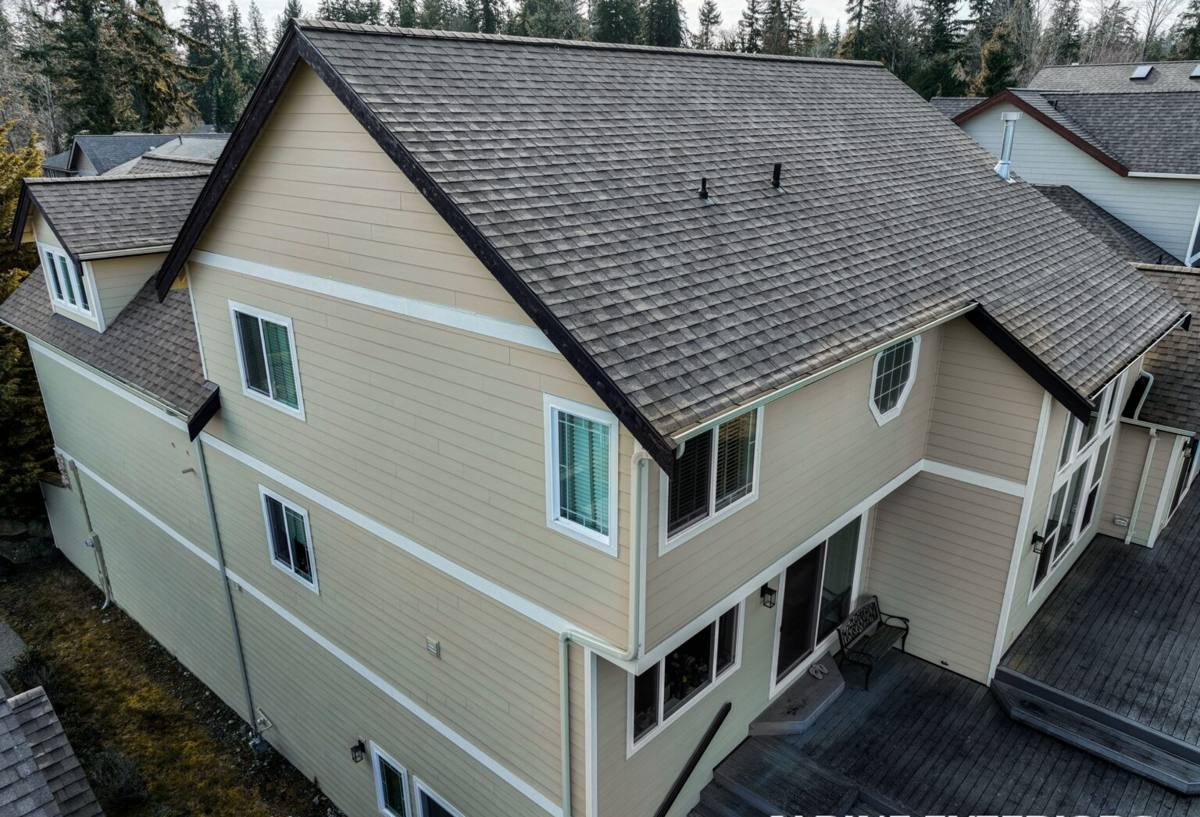
Signs a Ferndale Deck Needs Repair — Not Just Cleaning
A lot of deck problems in this area get missed because they look cosmetic at first. Moss and green staining are the visible symptom, but they're usually a sign that water is sitting somewhere it shouldn't. Before you assume a pressure wash will solve it, look for these warning signs:
- Soft or spongy spots underfoot, especially near the house or around post bases
- Rust streaking or corrosion around fasteners, joist hangers, or railing brackets
- Gaps opening up where the deck meets the house (ledger board separation)
- Boards that cup, crown, or have visibly separated from the joists below
- Persistent moss or black mildew that returns within weeks of cleaning
- Railings or stair stringers that feel loose or flex under weight
- Visible rot or a screwdriver that sinks into wood with light pressure
Any one of these on its own might be a minor fix. Several together, especially near the ledger board or support posts, usually mean the underlying structure has been absorbing moisture for a while and needs more than surface repair.
What a Correct Deck Repair Actually Involves
A deck is only as good as the parts nobody sees once it's finished. Ferndale's climate is hardest on the connections and hardware, so that's where we spend the most attention.
Ledger Board and Structural Connections
The ledger board — the piece that attaches the deck to the house — is the single most important structural connection on most decks, and it's also the one most exposed to trapped moisture. If flashing was installed poorly or is missing, water works its way behind the ledger and rots both the board and the rim joist behind it. Proper repair means removing enough decking to inspect the connection, replacing any compromised wood, and installing flashing that actually sheds water away from the house instead of channeling it into the framing.
Decking Boards, Rail, and Stairs
Individual board replacement only works if the joists underneath are sound. We check for soft or delaminated framing before replacing surface boards, because putting new decking over rotten joists just hides the problem for another season. Stair stringers and railing posts get the same scrutiny — they take direct weather exposure and repeated flexing, so a loose post base or a cracked stringer is a safety issue, not just a cosmetic one.
Fasteners and Hardware
This is where salt air does the most quiet damage. Standard fasteners can corrode from the inside of the wood outward, so a screw head that looks fine can be badly weakened where it's actually holding. We use corrosion-resistant, coated fasteners and stainless or hot-dip galvanized hardware rated for coastal exposure, not the general-purpose hardware that's fine sixty miles inland but underperforms here.
Repair or Replace: How We Help You Decide
Not every deck problem calls for a full rebuild, and not every deck is worth repairing piece by piece. The honest answer depends on where the damage is and how far it's spread.
| Factor | Repair Usually Makes Sense | Replacement Usually Makes Sense |
|---|---|---|
| Framing condition | Joists and beams are sound, damage is isolated | Multiple joists or the main beam show rot |
| Ledger board | Minor separation, flashing can be corrected | Ledger is rotted through or repeatedly failed |
| Age of structure | Under 15-20 years, built to a reasonable standard | Older deck near the end of its practical life |
| Extent of damage | Confined to a section (stairs, a few boards, one post) | Damage spread across the whole deck surface |
| Code and safety | Structure meets current safety expectations | Railing height, spacing, or footing don't meet code |
We'll walk the deck with you, explain what we're seeing, and give you a straight answer on which category yours falls into. If a repair is the honest recommendation, that's what we'll propose — we're not trying to sell a full rebuild when a targeted fix will hold up.
Our Deck Repair Process
- On-site inspection. We check the framing, ledger connection, fasteners, and surface boards, including probing any soft or discolored areas.
- Written scope and estimate. You get a clear breakdown of what needs to be repaired, replaced, or reinforced, and why — no vague line items.
- Demo of compromised material only. We remove what's actually damaged rather than tearing into sound wood, unless a wider rebuild is genuinely needed.
- Structural repair first. Framing, ledger flashing, and post connections get corrected before any cosmetic work happens.
- Board and hardware replacement. New decking, railing components, or stair parts go in with coastal-rated fasteners.
- Final check and cleanup. We confirm the repaired areas are solid underfoot and the site is left clean.
Materials: What We Recommend and Why
Homeowners in Ferndale usually ask us to weigh in on wood versus composite when boards need replacing, and the honest answer is that both work if they're installed and maintained correctly — the trade-offs are different, not one-sided.
Pressure-treated wood is more affordable up front and easy to spot-repair board by board, but it needs regular sealing or staining to resist this climate's moisture, and it's the material most likely to grow moss if it isn't kept clean and dry. Composite decking resists rot and doesn't need refinishing, but it costs more initially, individual boards can be harder to source and match later, and it still needs proper ventilation underneath — composite over poorly ventilated framing can trap moisture against the joists even though the boards themselves don't rot. We'll tell you honestly which option fits your budget, your existing structure, and how much upkeep you actually want to do, rather than pushing whichever material has a better margin.
Moss, Mildew, and Long-Term Deck Care in This Climate
Whatcom County's wet season is long, and a deck that isn't maintained between repairs will just develop the same problems again. A few habits make a real difference:
- Sweep debris off the deck regularly — trapped leaves and needles hold moisture against the boards
- Keep gutters and downspouts clear so runoff isn't dumping directly onto or under the deck
- Clean moss and algae early in the season before it spreads and stains the wood
- Check and re-seal or re-stain wood decking on a regular cycle, not just when it looks bad
- Make sure under-deck airflow isn't blocked by stored items, skirting, or overgrown landscaping
- Look at fastener heads and hardware once a year for early rust or corrosion
A deck that gets this kind of basic attention between repairs will need far less structural work down the road than one that only gets addressed after something fails.
Why a Crew That Already Works Ferndale Matters
Deck repair advice that comes from a general contractor's manual doesn't always account for what actually happens to wood and hardware this close to Semiahmoo Bay. A crew that regularly works Ferndale and the surrounding Whatcom County area has already seen which fastener grades hold up, which flashing details actually keep ledger boards dry through a wet winter, and which parts of a deck fail first in this specific combination of salt air and driving rain. That local pattern recognition is the difference between a repair that lasts one season and one that lasts fifteen.
It also means straightforward scheduling and follow-up — you're not waiting on a crew traveling in from outside the area, and if a question comes up after the work is done, you're dealing with people who already know your deck and your property.
Get a Straight Answer on Your Deck
If your deck in Ferndale is showing soft spots, rust, persistent moss, or just doesn't feel as solid as it used to, we're happy to take a look and give you an honest read on what it actually needs. Request a free, no-pressure estimate using the form below, and we'll walk you through the repair options in plain language.