 Semiahmoo Siding
 Siding Repair in Drayton Harbor Has to Account for the Bay
Drayton Harbor sits right where Semiahmoo's homes meet the water, and that location shapes almost every siding repair call we get in the area. Salt-laden air drifts in off the harbor and Semiahmoo Bay and settles on exterior walls year-round, not just during storms. Combine that with the driving rain that comes off the Strait of Georgia and a moss season that runs longer here than it does a few miles inland, and you get siding that fails in specific, predictable ways. A repair approach built for a dry-side Washington town or a generic national playbook does not hold up well against this combination.
That does not mean every home here needs constant repair. It means the homes that do need it usually show damage concentrated in the same places: low courses near grade, north- and west-facing walls that stay damp longest, and any spot where landscaping or fencing blocks airflow and traps moisture against the wall. Knowing where to look first is half the job.
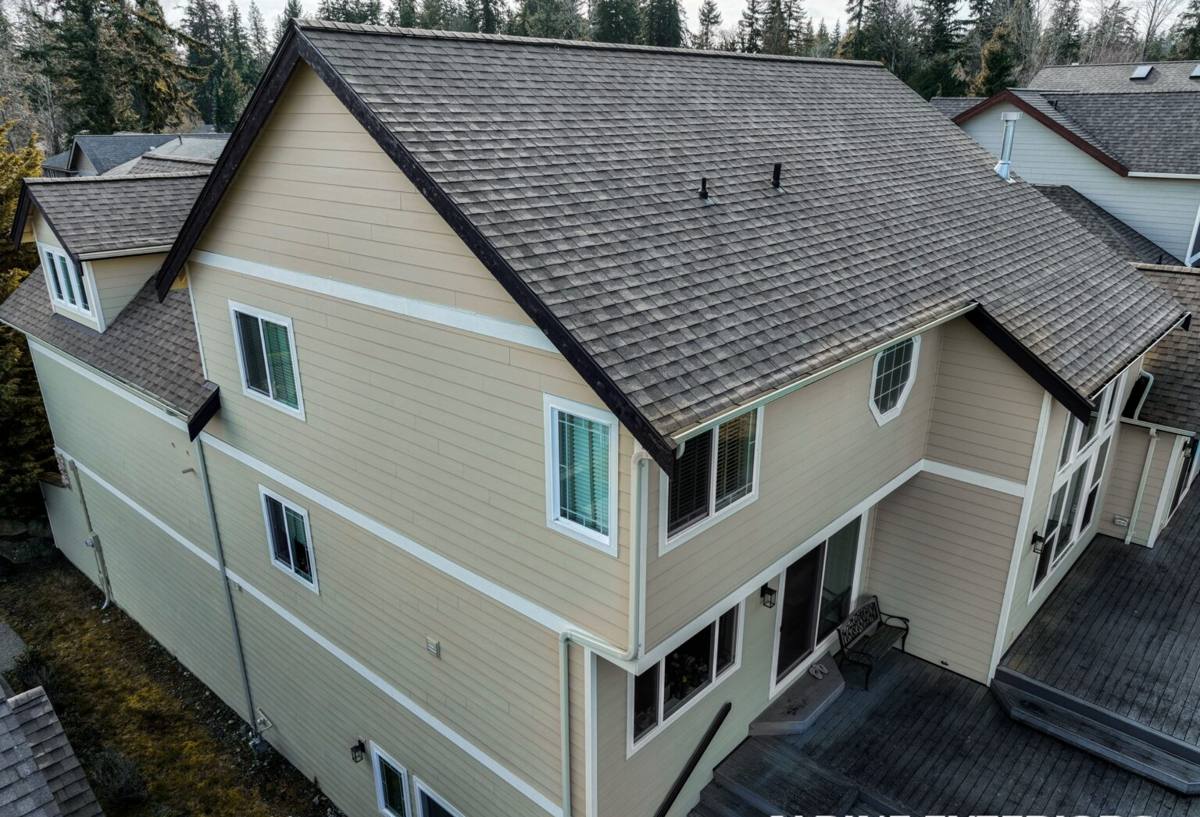
Signs Your Siding Needs Repair, Not Just Cleaning
Moss and algae staining alone is usually a cleaning and maintenance issue, not a repair issue. But moss and staining are often the visible symptom of moisture sitting on a wall longer than it should, and that same moisture is what causes the damage underneath. Homeowners in Drayton Harbor should treat the following as repair signals, not just cosmetic ones:
- Soft or spongy siding when pressed, especially near the bottom few courses
- Visible cracking, splitting, or bowing in individual boards or panels
- Paint or finish that is bubbling, peeling, or has gone chalky faster than the rest of the wall
- Rust streaks below nail heads or fasteners, common in salt-air exposure
- Gaps opening up at butt joints, corners, or trim where caulking has failed
- A persistent musty smell along an interior wall that backs up to an exterior wall showing exterior damage
- Moss regrowing within weeks of cleaning in the same spot, which usually points to trapped moisture rather than surface growth
Any one of these on its own might be minor. Several showing up in the same section of wall usually means water has been getting behind the siding for a while, and the visible damage is only part of the story.
What a Proper Repair Actually Involves
Inspection Before Anything Gets Replaced
A repair that starts with "just replace the bad-looking boards" often misses the actual problem. We start by identifying how water is reaching that section of wall in the first place — a failed piece of flashing, a caulking joint that opened up, siding installed too close to grade or a roofline, or a drainage plane that was never installed correctly behind the original siding. Replacing boards without fixing the water path just buys a few more years before the same repair call comes back.
Moisture Testing, Not Guessing
Where damage is suspected but not obvious, we use a moisture meter to check readings in the siding and sheathing rather than relying on a visual guess. This matters especially in Whatcom County's wetter months, when siding can look fine on the surface but read wet underneath. It tells us how far the damage actually extends before we cut into anything.
Matching the Repair to the Existing Wall
Once we know the extent of the damage, the repair itself needs to tie in cleanly — matching board profile, exposure, and reveal so the repaired section doesn't stand out, and re-flashing or re-caulking any joint that was part of the original failure. A repair that looks patched on is a sign the water path was never actually fixed.
Repair or Replace? How We Make the Call
Not every damaged section calls for a full re-side, and not every "repair" request is actually repairable in a way that will last. We walk homeowners through the same factors every time:
| Factor | Favors Repair | Favors Full Replacement |
|---|---|---|
| Extent of damage | Isolated to one or two wall sections | Spread across multiple elevations |
| Age of existing siding | Well within expected service life | Near or past the end of its practical life |
| Moisture readings | Elevated only at the damaged spot | Elevated broadly behind the wall |
| Material availability | Matching material or close equivalent exists | Discontinued profile, color, or product line |
| Underlying cause | Simple, fixable (flashing, caulk, one bad board) | Systemic (missing drainage plane, widespread rot) |
When a repair is the right call, we say so. When the honest answer is that a patch job will look mismatched or fail again in a couple of years because the underlying cause is bigger than one section of wall, we say that too.
Why We Repair With James Hardie, Not the Original Material
We install and repair with James Hardie fiber cement exclusively — we do not install vinyl, LP SmartSide, Cemplank, Allura, primed spruce, or cedar, and that includes repair work. If a home already has one of those products and needs a repair, we're upfront that patching in more of the same material has real limits here. Vinyl fades unevenly, so a new panel next to twenty-year-old panels rarely matches, and it can crack in cold snaps or warp near heat sources. Wood and primed spruce trim take on moisture readily in this climate and are exactly the kind of material we see rotting behind the paint line. LP SmartSide and similar engineered wood products are moisture-sensitive at cut edges and seams, which is often the very failure point that triggered the repair call.
Where it makes sense, we'll repair a section using James Hardie fiber cement tied into the existing wall, or we'll recommend re-siding that elevation so the whole wall performs consistently. Fiber cement is non-combustible, holds paint and factory ColorPlus finish far longer than wood or vinyl, and doesn't swell or rot at cut edges. For a property this close to salt water and shade, that durability difference shows up faster than it would somewhere drier and further inland.
Our Process for a Drayton Harbor Repair Call
1. On-Site Assessment
We look at the damaged area plus the surrounding wall, checking flashing, caulking, grade clearance, and any nearby landscaping or drainage issues that could be feeding the problem.
2. Moisture and Extent Check
Meter readings and, where needed, removing a board or two to see what's happening behind the surface, so the repair scope is based on what's actually there rather than what's visible.
3. Honest Scope and Estimate
We tell you plainly whether this is a contained repair, a larger repair, or a case where replacement is the more sensible long-term move — with the reasoning, not just a number.
4. The Repair Itself
Correct flashing and drainage detailing first, then siding installed to manufacturer specification — proper fastening, gapping, and caulking — so the repair holds up to the same driving rain and salt air that caused the original problem.
5. Walkthrough
We show you what was found, what was fixed, and what to keep an eye on going forward.
What Drives the Cost of a Siding Repair
Repair costs vary more than replacement costs, because so much depends on what's actually behind the wall once it's opened up. The broad factors:
| Cost Factor | Why It Matters |
|---|---|
| Hidden rot or sheathing damage | May require more than siding replacement — sheathing repair adds scope |
| Access and elevation | Second-story or hard-to-reach sections take more time and equipment |
| Material matching | Matching an existing product or color can require special ordering |
| Flashing and drainage corrections | Fixing the root cause properly is more labor than a cosmetic patch |
| Scope of the fix | One board versus a full wall section changes cost proportionally |
We don't quote a repair without seeing it in person, because the cost swings too much based on what's found once we're on-site.
Why Hiring a Crew That Already Works Drayton Harbor Matters
A siding repair here is a different job than the same repair inland. Crews unfamiliar with Semiahmoo's marine exposure sometimes underestimate how much moisture is behind a wall, or use fastener and flashing details that work fine in a drier climate but fail against sustained salt air and driving rain. Working this neighborhood regularly means recognizing damage patterns before they're fully visible — which wall orientations fail first, where moss regrowth signals a bigger issue, and how quickly a small gap in flashing turns into a real repair here versus somewhere less exposed. That local pattern recognition is often the difference between a repair that lasts and one that's back on the schedule in two years.
Keeping Repaired Siding in Good Shape Afterward
Once a repair is done right, a little seasonal attention keeps it that way — especially given how long the moss season runs in this part of Whatcom County:
- Rinse siding periodically to clear salt residue and organic buildup before it takes hold
- Trim back vegetation and keep at least a few inches of clearance along foundation plantings
- Check caulking at joints and trim annually, since it's usually the first thing to fail again
- Keep gutters and downspouts clear so runoff isn't sheeting down the wall face
- Address new moss growth early rather than letting it establish through another wet season
If you're seeing soft spots, cracking, staining, or moss that keeps coming back on your Drayton Harbor home, we're happy to take a look and give you a straight answer on what it needs. Estimates are free, there's no pressure, and you'll get our honest read on repair versus replacement — use the form below to get started.