 Semiahmoo Siding
 Why Birch Bay Decks Wear Out Faster Than the Catalog Says
Birch Bay sits right where Whatcom County's marine air meets a lot of exposed, west-facing outdoor living space. That combination is harder on a deck than most manufacturer literature accounts for. Salt-laden air off the water works into fastener heads and hardware year-round. Driving rain off the Strait doesn't just wet a deck surface — it drives moisture sideways under rail caps, into end-cuts, and down into framing connections that were never meant to stay damp for eight months of the year. And then there's moss. Whatcom County's long wet season, mild temperatures, and shade from mature trees give moss and algae a full season to establish on any surface that doesn't drain and dry quickly. Put those three factors together — salt, driving rain, and moss — and you get the three most common deck failures we see in Birch Bay: corroded fasteners, soft or delaminating boards at the ends, and a slick, green surface by the second winter.
A composite deck built correctly for this specific stretch of coastline should shrug off all three. A composite deck built to a generic spec sheet, or installed by a crew that normally works somewhere drier, often doesn't.
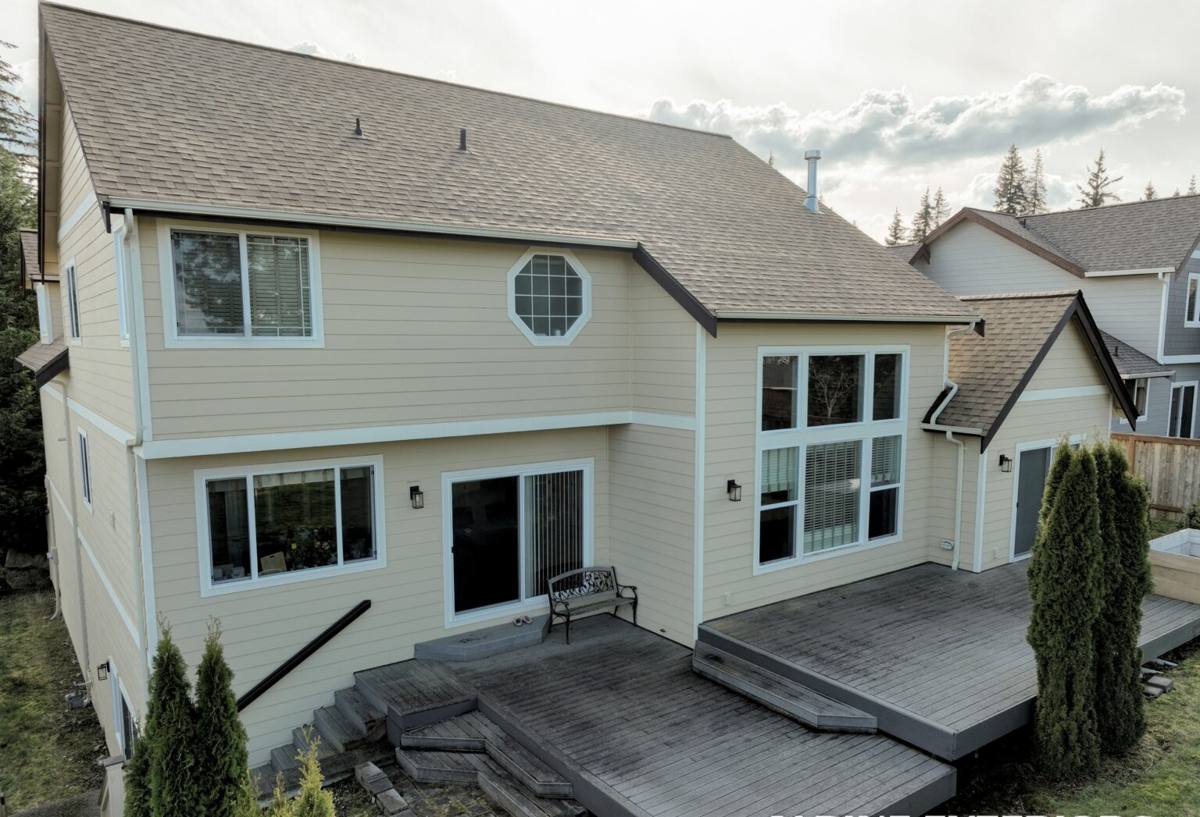
Why Composite Makes Sense for This Climate
We don't push composite decking because it's trendy — we push it in Birch Bay because it solves the specific problems this climate creates. Modern capped composite boards have a polymer shell that seals out moisture, which matters enormously here since untreated end-grain and exposed fastener holes are exactly where wood decking rots first in a wet marine climate. Composite doesn't need annual staining or sealing to hold up against driving rain, and its surface texture is engineered to shed water and resist the kind of moss and mildew growth that thrives in Whatcom County's shoulder seasons.
That said, composite isn't maintenance-free, and we tell every homeowner that up front. It still needs to be built on a substructure that drains and ventilates properly, it still needs periodic cleaning to keep pollen, salt film, and organic growth from building up, and not every composite product on the market handles this climate equally well. Board choice and installation detail matter more here than they would in a drier inland climate.
What Salt Air Specifically Attacks
- Uncoated or low-grade steel fasteners and joist hardware — they rust and stain the deck face from underneath
- Aluminum railing components without a marine-grade finish
- Any exposed cut edge on composite boards that isn't capped or sealed
- Ledger board connections at the house, where trapped moisture and salt film accelerate corrosion
What a Correctly Built Composite Deck Involves
The composite boards themselves get most of the attention, but in a Birch Bay install the substructure and hardware decisions matter just as much — arguably more, since that's what determines whether the deck is still solid in fifteen years.
Framing and Substructure
We frame with lumber rated for ground contact or exposed exterior use, and we pay close attention to ledger flashing at the house connection — that's the single most common source of hidden water damage on any coastal deck, composite decking or not. Joist spacing gets tightened up from typical wood-deck spans because composite boards behave differently under load and temperature than dimensional lumber, and manufacturers publish specific span tables that we follow rather than guess at.
Fasteners and Hardware
In a salt-air environment, hardware grade isn't a place to cut corners. We use stainless steel or coated fasteners rated for coastal/marine exposure, along with joist tape or a moisture barrier on top of the framing to keep water from wicking into the wood substructure through fastener penetrations.
Drainage and Airflow Underneath
A deck that can't breathe underneath is a deck that stays damp, and a damp substructure is where moss, mildew, and eventually rot take hold — even under composite boards that themselves resist moisture. We build in proper slope away from the house and enough clearance below the joists for air to move, which matters even more under a low deck close to grade, a common layout on Birch Bay lots.
Board Layout and Fastening
Hidden fastener clip systems are standard on most composite lines now, and they matter here for two reasons: they eliminate exposed screw heads that would otherwise corrode and streak the deck face, and they allow the boards to expand and contract with temperature swings without binding or buckling.
Composite vs. the Alternatives, for This Climate Specifically
| Decking Type | How It Handles Salt Air & Rain | Moss/Algae Resistance | Upkeep |
|---|---|---|---|
| Capped composite | Sealed polymer shell resists moisture intrusion; core doesn't absorb water like wood | Textured, low-porosity surface resists growth; still needs periodic cleaning | Occasional wash; no staining or sealing |
| Pressure-treated wood | Absorbs moisture at end-cuts and fastener holes; prone to swelling/checking | Porous surface holds moisture, feeds moss and mildew growth | Annual cleaning, sealing, and re-staining |
| PVC decking | Fully synthetic, excellent moisture resistance | Very low growth risk on most products | Low; can look and feel more plastic; higher material cost |
| Cedar/redwood | Naturally rot-resistant but still needs sealing in driving rain | Moderate; still needs regular treatment in a wet climate | Frequent sealing/staining to keep up appearance and protection |
None of these is universally "best" — it depends on budget, how the deck will be used, and how much upkeep a homeowner actually wants to do. For most Birch Bay homes, capped composite hits the practical middle: it handles the salt-and-rain-and-moss combination well without the ongoing sealing schedule that wood demands, and it costs less than full PVC systems.
Board Selection: What Actually Matters Here
Not every composite product performs the same in this climate. When we walk a homeowner through board options, we focus on a short list of factors that actually affect how the deck holds up on this coastline, not just color and grain pattern.
| Factor | Why It Matters in Birch Bay |
|---|---|
| Full cap vs. partial cap | Fully capped boards (top, bottom, and sides) resist moisture intrusion at cut ends better in a high-rain climate |
| Surface texture | A slip-resistant, textured finish matters on a surface that stays damp longer in a marine climate |
| Warranty structure | Look at what's covered — fade, staining, and structural warranties often differ, and coastal exposure can affect claims |
| Color | Darker boards absorb more heat and can show salt film/water spotting differently than lighter tones |
| Fastening system | Hidden clip systems reduce exposed metal that corrodes and streaks in salt air |
Our Process for a Birch Bay Composite Deck
- On-site assessment: We look at sun/rain exposure, existing structure (if replacing a deck), drainage slope, and how close the deck sits to grade — all of which affect the build spec.
- Design and board selection: We walk through composite lines, colors, and railing options with the climate factors above in mind, not just aesthetics.
- Permitting: Deck projects in Whatcom County typically require a permit depending on height, size, and attachment to the house — we handle that process rather than leaving it to the homeowner.
- Substructure build: Framing, flashing, and hardware go in to the standard described above — this is the part of the job that determines longevity, even though it's mostly invisible once finished.
- Decking and railing installation: Boards, fascia, and railing go in per manufacturer spec, including proper gapping for drainage and expansion.
- Final walk-through: We go over cleaning and care specific to the board you chose, and what to watch for in year one.
Living With a Composite Deck in a Moss-Prone Climate
Composite decking cuts maintenance dramatically compared to wood, but "low-maintenance" isn't "no-maintenance" — especially in a climate that grows moss on driveways and roofs, not just decks. A short seasonal routine keeps a Birch Bay composite deck looking and draining the way it should.
- Sweep off leaves, needles, and organic debris regularly, especially in fall — trapped organic matter is what feeds moss and mildew on any deck surface
- Rinse the deck periodically to clear salt film, pollen, and airborne grime before it builds up in the board texture
- Clean the gaps between boards where debris collects and can block drainage
- Check railing hardware and fasteners annually for any early corrosion, especially on homes closer to the water
- Keep gutters and downspouts near the deck clear so runoff isn't dumping extra water onto or under the deck
- Trim back overhanging branches where practical — shade that never dries out is what lets moss establish in the first place
Why a Crew That Already Works Birch Bay Matters
Composite decking installation isn't identical everywhere. A crew used to building in a dry inland climate can install a technically correct deck that still underperforms on this coastline, because the details that matter here — flashing at the ledger, hardware grade, drainage slope, board gapping for a wetter climate — aren't the details that matter most somewhere else. Working Birch Bay and the broader Semiahmoo area regularly means we've seen how decks actually age here, not just how they're supposed to perform on paper. We know which framing and fastener choices hold up against salt air over years, not just through one dry summer, and we build every deck to that standard rather than a generic one.
Local also means practical things: we understand Whatcom County's permitting process for deck projects, we're not guessing at typical lot layouts and grade conditions in this area, and we can get out to a Birch Bay property for an estimate or a warranty check without treating it as a special trip.
Questions Worth Asking Any Deck Contractor Here
- What fastener and hardware grade do you use, and is it rated for coastal/marine exposure?
- How do you flash and seal the ledger board connection at the house?
- What clearance and slope do you build in underneath the deck for drainage and airflow?
- Which composite lines have you actually installed in this area, and how have they held up?
- What does the manufacturer's warranty actually cover, and does coastal exposure affect it?
What This Typically Involves, Cost-Wise
Composite decking costs more up front than pressure-treated wood and less than full PVC systems, with the final number driven by deck size, board tier, railing choice, substructure condition, and site access. Rather than quote a number that won't reflect your specific property, we'd rather walk the site, understand what you're trying to get out of the space, and give you a real, itemized estimate based on what's actually there — including whether an existing deck's framing can be reused or needs to be rebuilt.
If you're in Birch Bay or elsewhere around Semiahmoo and thinking about a composite deck, we're happy to come take a look, walk you through board options suited to this climate, and put together a straightforward, no-pressure estimate using the form below.