 Semiahmoo Siding
 Why Cherry Point Decks Take a Different Kind of Beating
Cherry Point sits right on the water in Whatcom County, and that location shapes everything about how a deck ages here. Salt-laden air moves off the Salish Sea and settles on every exposed surface, working on metal fasteners and hardware year-round. Wind-driven rain doesn't fall straight down near the shoreline — it gets pushed sideways into ledger boards, railings, and any joint that isn't properly flashed. And our long stretch of grey, wet months from fall through spring gives moss and algae plenty of time to take hold on horizontal wood surfaces, especially in shaded spots near trees or on the north side of a house.
None of that means a deck can't last decades out here. It means the deck has to be built for this specific environment, not to a generic set of plans that would hold up fine somewhere drier and further inland. A lot of the deck problems we get called out to look at in this area trace back to a build that ignored one of these three factors — salt exposure, wind-driven moisture, or moss and standing water.
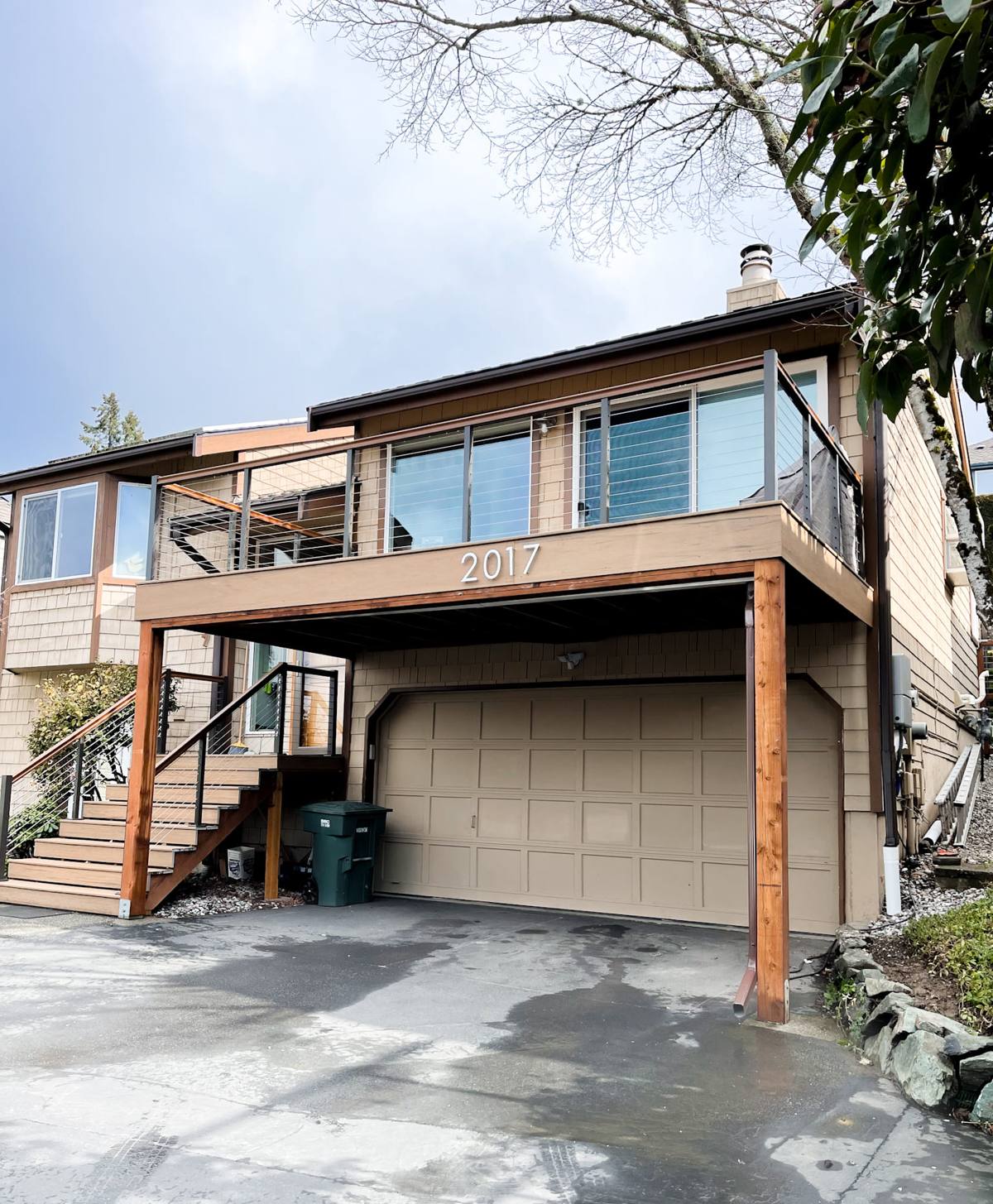
What a Correctly Built Deck Involves Here
Footings and Framing Below the Boards
Everything visible on a deck — the decking boards, the railing, the stair treads — depends on what's underneath it. Footings need to be sized and set to the proper depth for our soil and frost conditions, and framing needs to be spaced and sized for the actual loads the deck will see, not just what looks adequate. This is the part of the job nobody sees once it's done, which is exactly why it's the part that gets shortcut on a rushed build.
Ledger Attachment: The Single Biggest Point of Failure
Where a deck attaches to the house is the most common place decks fail in our climate, and it's almost always a flashing problem. Driving rain forces water up and behind a ledger board that isn't properly flashed and sealed, and that water doesn't just rot the ledger — it works its way into the band joist and wall framing behind it, often for years before anyone notices. A correct ledger installation uses proper flashing that sheds water outward, away from the house, with the housewrap or siding lapped correctly over the top. This is not an area to save time on.
Fasteners and Connectors
Standard electro-galvanized screws, nails, and joist hangers corrode noticeably faster this close to salt water. We use stainless steel or high-grade coated fasteners rated for coastal exposure, and hot-dip galvanized (or better) structural hardware at every connector. It costs more up front than hardware store basics, but replacing rusted-out joist hangers under a finished deck is a much more expensive and disruptive repair than paying for the right hardware the first time.
Choosing Decking Material for Salt Air and a Long Moss Season
There isn't one "right" decking material for every homeowner — it depends on budget, how much upkeep you want to do, and how much shade and moisture the deck sits in. Here's how the common options actually perform in a Cherry Point environment:
| Material | Salt Air / Moisture Behavior | Moss & Algae Resistance | Maintenance | Typical Lifespan |
|---|---|---|---|---|
| Pressure-treated lumber | Good if fasteners and flashing are correct; wood itself resists rot chemically | Low — needs regular cleaning to stay ahead of it | Annual cleaning, periodic sealing | 15-20+ years with upkeep |
| Cedar | Naturally rot- and insect-resistant, but softer surface can absorb moisture | Low to moderate — greys and can host moss without upkeep | Regular cleaning and re-oiling to hold color and resist moisture | 15-20 years with upkeep |
| Capped composite | Excellent — the polymer surface doesn't absorb salt or moisture like wood | Higher — smoother, sealed surface sheds algae more easily, though not immune in deep shade | Occasional washing, no staining or sealing | 25-30 year manufacturer warranties are common |
| Tropical hardwood (e.g. ipe) | Very good — dense, naturally weather-resistant wood | Low to moderate — dense surface still needs periodic cleaning | Periodic oiling if you want to maintain color, or leave to grey naturally | 25+ years |
We'll walk through these trade-offs honestly based on your specific site — how much sun and shade the deck gets, whether it's near trees, and what kind of maintenance schedule you're realistically going to keep up with. A low-maintenance composite in a shaded, moss-prone spot is often the more practical long-term choice, even if the upfront cost is higher than wood.
Drainage, Board Spacing, and Keeping Moss From Taking Over
Moss and algae need standing moisture and organic debris to get started, so the way a deck is built and framed either helps or hurts your odds. A few details matter more than people expect:
- Decking boards gapped correctly for drainage and airflow, not tight-fit for looks
- Framing sloped slightly away from the house so water actually runs off instead of pooling
- Enough clearance between the deck framing and the ground for air to circulate underneath
- Avoiding low spots or blocked drainage paths where leaves and needles collect
- Keeping nearby vegetation trimmed back so the deck surface gets some sun and airflow
A deck built with these details still needs occasional cleaning — nothing eliminates moss entirely in this climate — but a well-drained deck needs a fraction of the scrubbing that a poorly drained one does.
Railings, Stairs, and Code Requirements
Any deck above a certain height needs a code-compliant guard rail, and stairs have their own rules for rise, run, and handrail graspability. These requirements exist for safety, and they're non-negotiable on our jobs regardless of what a homeowner has seen on other decks. Just as important out here: railing posts and baluster hardware are just as exposed to salt air as the rest of the structure, so the same fastener and connector standards apply to railings as to framing. A beautiful railing held together with the wrong hardware is a maintenance headache within a few years.
Permits and Building Near the Shoreline
Cherry Point's location on the water means deck projects here can fall under shoreline-related permitting in addition to standard building permits through Whatcom County. Setback distances from the water, bluff or slope considerations, and standard structural permitting all need to be checked before design work goes very far — not after materials are ordered. We handle the permit submission as part of the job and will flag early on if your specific lot has shoreline considerations that affect deck size, placement, or footing type.
Our Process, From Estimate to Finished Deck
- Site visit and assessment — we look at sun/shade exposure, drainage, existing structure condition if this is a replacement, and how close the site is to the water
- Design and material selection — sized and laid out for your actual use of the space, with an honest conversation about material trade-offs for this environment
- Permitting — submitted and tracked through Whatcom County, including any shoreline review if applicable
- Footings and framing — built to proper depth and spec, with coastal-rated fasteners and connectors throughout
- Ledger flashing and waterproofing — done correctly the first time, since this is the hardest part to fix later
- Decking, railings, and stairs — installed with proper gapping and drainage in mind, not just visual fit
- Final walkthrough and cleanup — so you know what maintenance, if any, the specific materials you chose will need going forward
A Homeowner's Deck Longevity Checklist
Whether you're building new or evaluating an existing deck, these are worth checking:
- Is the ledger board flashed with material that sheds water away from the house, not just caulked?
- Are fasteners and joist hangers stainless or coated for coastal exposure, not standard hardware-store galvanized?
- Do decking boards have proper gaps for drainage and airflow underneath?
- Is there visible slope so water runs off rather than sitting on the frame?
- Are footings set to proper depth for our soil and frost conditions, not just poured shallow?
- Does the railing system meet current height and baluster spacing requirements?
- Was a building permit (and shoreline review, if applicable) actually pulled for the work?
Why Hiring a Crew That Already Works Cherry Point Matters
A deck contractor who mostly works inland doesn't always think about coastal-rated hardware or ledger flashing as a first priority, because in a drier climate those shortcuts take longer to show up as problems. Working this shoreline regularly means we've seen which details actually matter here — where moss builds up first, which fasteners hold up and which don't, and what the Whatcom County permitting process looks like for a property this close to the water. That's the difference between a deck that needs attention in five years and one that's still solid in twenty-five.
If you're planning a new deck or replacing one that's showing its age, we're happy to take a look and put together a free, no-pressure estimate. Fill out the form below and we'll get in touch to schedule a site visit.