 Semiahmoo Siding
 Why Decks Wear Out Faster in California Creek
California Creek sits close enough to the water that homes here deal with a different set of conditions than a deck built inland. Salt-laden air off Semiahmoo Bay and Drayton Harbor works on metal hardware year-round, wind-driven rain gets pushed sideways into joints and ledger connections that a calmer climate would never test, and the long, mild, wet stretch of the year most of us just call moss season keeps horizontal wood surfaces damp for months at a time. None of these things alone destroys a deck overnight. Together, over several years, they're the reason a deck in this part of Whatcom County can look and function very differently at year ten than one built on a dry inland lot.
Salt Air and Hardware
Ordinary fasteners, screws, and connector hardware corrode faster near the coast than manufacturers' general lifespan estimates assume. Once a nail or screw starts rusting, the wood around it loosens, water gets a path in, and the fastener loses grip. This is a hardware selection issue as much as a wood issue -- it's one of the first things we look at when we're deciding whether a deck can be repaired or needs a full rebuild.
Driving Rain and Water Intrusion
Rain that comes in mostly straight down is fairly easy for a deck to shed. Rain that gets pushed sideways by wind off the water is a different problem -- it finds its way under ledger boards, into end grain, and behind railing posts that weren't flashed correctly. Most of the rot we find in older decks in this area didn't start on the surface where you'd notice it. It started at a hidden connection point that stayed wet long after a storm passed.
Moss Season
Whatcom County's stretch of cool, damp, low-sun weather can run for the better part of the year, and it's long enough that moss and algae get a real foothold on any deck surface that doesn't drain and dry quickly. Beyond looking bad, a mossy deck surface holds moisture against the wood underneath it and gets slick underfoot -- a genuine safety issue on stairs and near door thresholds.
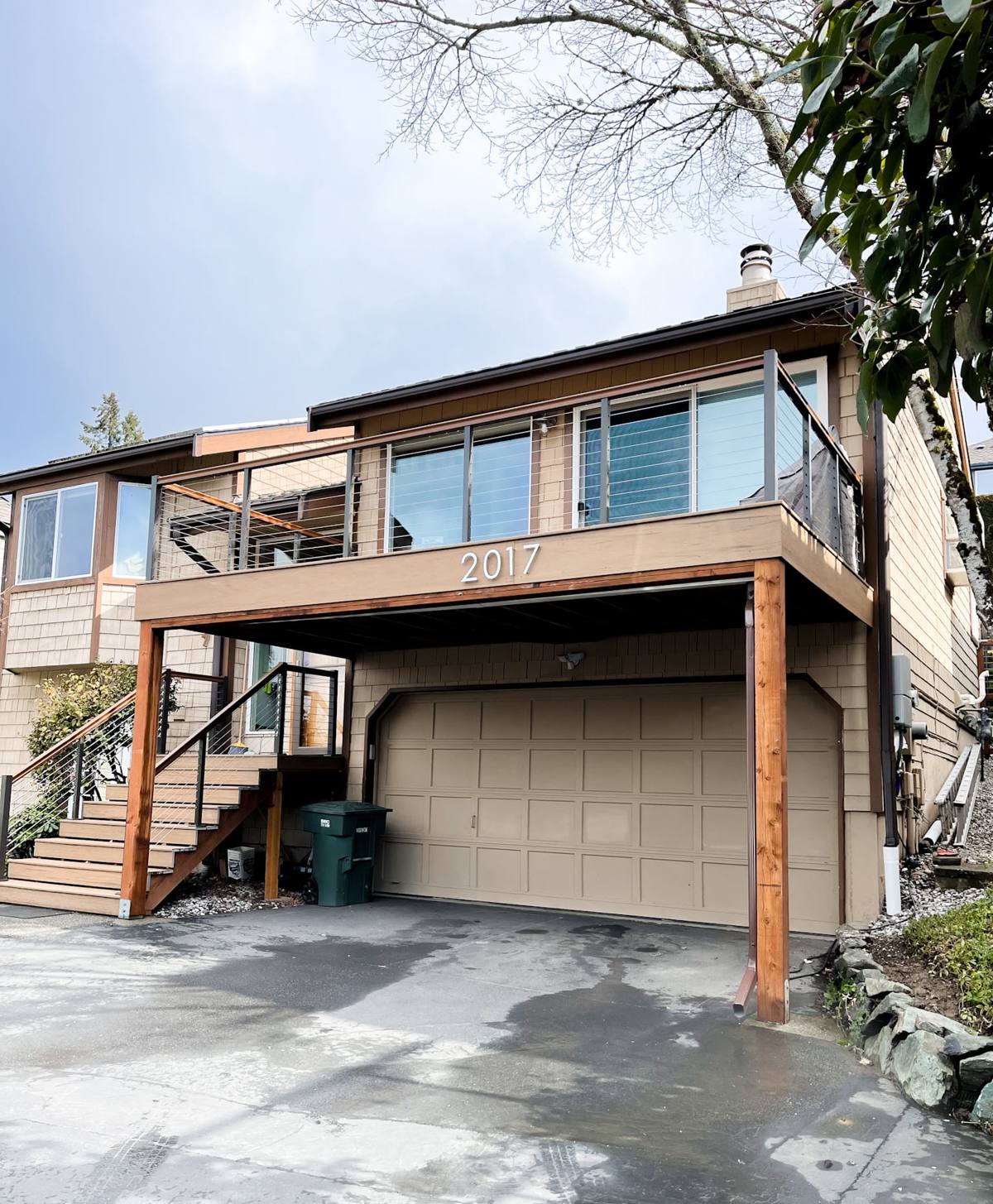
Signs Your Deck Has Reached the End of Its Life
Not every problem deck needs a full replacement, but there's a point where patching individual boards stops making sense and starts costing more than it's worth. Here's what tells us a deck is past the repair stage:
- Board surfaces that feel soft, spongy, or spring back when you walk on them
- Rust streaks bleeding out from screws, nails, or metal connectors
- A ledger board that's visibly pulling away from the house or has a gap you can see daylight through
- Moss or algae that comes back within weeks of cleaning, no matter how well it was scrubbed
- Railings or posts that wobble or flex when you lean on them
- Framing members that a screwdriver can be pushed into without much resistance
- A deck old enough for its material type that several of the above are showing up at once, rather than one isolated spot
What a Correct Replacement Actually Involves
A proper deck replacement is not just pulling up old boards and screwing down new ones. The structure underneath is what determines whether the new deck lasts, and in a climate like this, the details that don't show matter more than the ones that do.
Ledger Flashing Done Right
The ledger board -- where the deck attaches to the house -- is the single most common failure point we find on older decks in this area. It needs flashing that actually sheds water away from the house framing, not just caulk over a gap. Given how often driving rain hits this connection point directly, we treat ledger flashing as non-negotiable, not an upgrade.
Framing and Fasteners
Joist hangers, structural screws, and connector hardware all need to be rated for exterior, corrosion-prone conditions -- stainless steel or a comparable coated hardware, not standard interior-grade fasteners. This costs a little more up front and is one of the easiest places for a corner to get cut where you'd never see it until years later.
Footings and Structure
We check footing depth and condition against current code requirements rather than assuming the old footings are adequate just because the old deck stood on them. Ground conditions and drainage around a footing affect how well it holds up over time, and it's far cheaper to address that during a full replacement than to dig it up again later.
Choosing Decking Material for This Climate
There's no single right material for every home -- it depends on budget, how much upkeep you want to do, and how the deck sits relative to shade and moisture. Here's how the common options actually compare once salt air and moss season are part of the equation:
| Material | Moisture / Moss Resistance | Maintenance | Typical Lifespan |
|---|---|---|---|
| Pressure-treated wood | Decent if sealed regularly; moss takes hold if neglected | Annual cleaning and periodic re-sealing | 15-20 years with upkeep |
| Cedar | Naturally more rot-resistant than PT pine but still needs finish maintenance | Regular cleaning and refinishing to hold color and resist moisture | 15-20 years with upkeep |
| Composite (capped) | Strong resistance to moisture and staining; still needs cleaning to prevent surface moss | Occasional washing, no sealing or staining | 25-30 years, manufacturer-dependent |
| PVC decking | Fully synthetic, does not absorb water; least prone to hidden rot | Low -- periodic washing only | 25-30+ years, manufacturer-dependent |
Wood costs less to install but asks more of you every year in maintenance -- and if that maintenance slips for a season or two during a wet stretch, moss and moisture damage catch up quickly. Composite and PVC cost more up front but hold up with far less attention, which matters on a shaded lot that stays damp longer than average. We'll walk through the real trade-offs for your specific deck rather than pushing one product across the board.
Our Deck Replacement Process
- On-site assessment. We look at the existing deck, the framing underneath, the ledger connection, and how sun and drainage hit that particular spot on your property.
- Honest material discussion. We go over the trade-offs between wood and composite/PVC options for your budget and maintenance preference -- no upselling toward whatever has the best margin.
- Permitting. If the project requires a permit, we handle that process rather than leaving it on you.
- Tear-off and structural rebuild. Old decking, framing, and hardware come out; footings, ledger flashing, and framing get rebuilt to current standards.
- Decking and railing installation. Boards, fasteners, and railings go in with attention to drainage gaps and airflow that help resist moss buildup going forward.
- Final walkthrough. We go over the finished deck with you and explain what maintenance, if any, it needs.
Permits and Whatcom County Considerations
Many deck projects in unincorporated Whatcom County and the surrounding jurisdictions require a permit, particularly for decks attached to the home, elevated decks, or new footings. Guardrail height, stair rise and run, and footing depth all have to meet current code -- this isn't optional paperwork, it's what keeps the structure safe and keeps you from running into problems if you ever sell the house. We handle the permit process as part of the job rather than treating it as an add-on.
Keeping a New Deck Ahead of Moss Season
Even the best-built deck benefits from a little seasonal attention in this climate. A few habits go a long way:
- Sweep leaves and debris off the deck surface regularly, especially in fall
- Rinse or lightly scrub surfaces before moss gets a chance to establish, particularly in shaded corners
- Keep gutters and downspouts near the deck clear so runoff isn't draining directly onto it
- Check railing posts and stair connections once a year for movement or early rust
- Re-seal wood decking on the manufacturer's recommended schedule rather than waiting until it looks dry
Why Hiring a Crew That Already Works California Creek Matters
A contractor who only occasionally works this close to the water can still build a deck -- but they're guessing at things a crew familiar with California Creek already knows firsthand: how far wind-driven rain actually reaches under a covered deck, which spots on a typical lot stay shaded long enough to grow moss even in summer, and how fast standard hardware corrodes when it's this close to Semiahmoo Bay. That local pattern recognition shows up in small decisions -- flashing details, fastener choice, board spacing -- that add years to a deck's life without adding much to the cost.
If your deck is showing its age or you're planning a replacement before it fails, we're happy to take a look and give you a straight assessment -- repair, replace, or somewhere in between. Reach out for a free, no-pressure estimate using the form below.