 Semiahmoo Siding
 What Semiahmoo's Marine Climate Does to a Deck
Blaine sits right at the water — Drayton Harbor and Semiahmoo Bay on one side, the open Strait on the other — and that location shapes what a deck has to survive here. It isn't just "Pacific Northwest rain," it's salt-laden air moving off the bay almost daily, driving rain that comes in sideways during winter storms, and a moss season that can run from October clear through April. None of that is dramatic on its own. The problem is what it does over years, quietly, to fasteners, framing, and finishes that weren't specified for it.
Salt air accelerates corrosion on anything metal that isn't rated for coastal exposure — screws, joist hangers, post bases, railing hardware. Driving rain finds every gap in flashing and works its way behind ledger boards and under decking, where it doesn't dry out for days. And the near-constant damp during moss season feeds algae and moss on any horizontal wood surface that doesn't get direct sun, turning boards slick and, over time, holding moisture against the wood itself. A deck built to a generic spec sheet from a dry-climate market will show all three problems within a few winters. One built for Whatcom County's actual conditions won't.
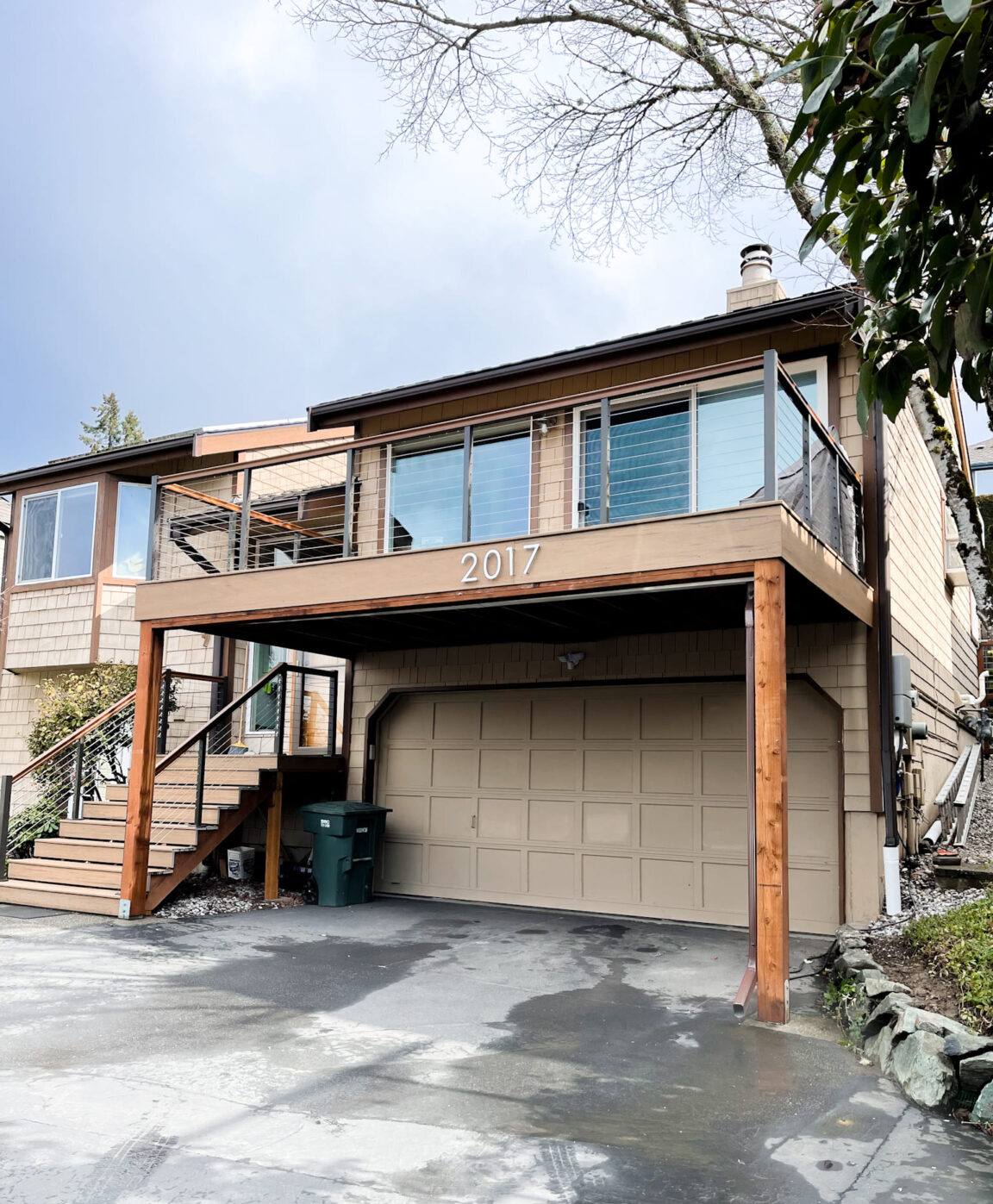
Decking Material Choices That Actually Hold Up Here
There's no single "best" decking material — there's a best material for a given budget, sun exposure, and how much upkeep you're willing to do. In a salt-air, high-moisture environment like Semiahmoo, the tradeoffs matter more than they would inland.
Pressure-Treated Lumber
Still the most common choice for framing and often for decking itself, because it's affordable and the treatment resists rot. It's not maintenance-free, though — it needs to be sealed or stained on a regular cycle, and it will check and gray without that upkeep. In our climate, the biggest risk isn't the treated lumber failing outright, it's homeowners skipping the reseal schedule because the deck "looks fine" for a couple years.
Cedar
Cedar has natural rot and insect resistance and it looks the part, which is why it's popular on homes near the water. It's also more sensitive to installation quality than people expect — end grain that isn't sealed, or boards installed too tight without expansion gaps, will cup and split faster here than in a drier climate. Cedar wants a real maintenance commitment: cleaning and refinishing every year or two if you want it to keep its color and stay tight.
Composite and PVC Decking
Capped composite and PVC boards cost more upfront but they don't absorb moisture the way wood does, they resist mold and moss better on the surface, and they don't need annual sealing. They're a strong fit for a shaded, damp deck that would otherwise need constant attention. The tradeoff is heat sensitivity on south-facing decks in summer and a different repair process if a board is ever damaged — you're replacing a board, not sanding and refinishing it.
| Material | Moisture Resistance | Typical Maintenance | Realistic Lifespan |
|---|---|---|---|
| Pressure-treated lumber | Good, if sealed regularly | Reseal/stain every 1-2 years | 15-20 years |
| Cedar | Naturally decent, sensitive to detailing | Clean and refinish yearly | 15-20 years |
| Capped composite/PVC | Excellent on the surface | Periodic wash, no sealing | 25-30+ years |
The Structural Details Salt Air Punishes First
The parts of a deck that fail first around here are almost never the decking boards themselves — they're the connections and hardware behind the scenes. This is where a deck either holds up through Whatcom County winters or starts causing problems by year five.
- Ledger board flashing: where the deck attaches to the house is the single most common source of hidden rot. Proper flashing — installed correctly, in the right order relative to the house's water-resistive barrier — is non-negotiable in a climate with this much driving rain.
- Fasteners and hardware: screws, joist hangers, and post bases need to be rated for coastal/salt-air exposure — stainless steel or genuinely hot-dip galvanized, not the cheaper coated fasteners that streak and corrode within a few seasons this close to the bay.
- Joist protection: tape or a comparable barrier over the tops of joists keeps screw penetrations from becoming entry points for water that sits and rots the joist from the inside out.
- Footing depth: footings need to go below the local frost line and bear on undisturbed, properly compacted soil — skipping this is invisible on day one and shows up as a wobbly or settling deck later.
- Post-to-concrete separation: posts should sit on bases that keep the wood off the concrete and off standing water, not buried in or resting directly on it.
Permits and Local Requirements
Most attached decks, and many freestanding ones above a certain height, need a building permit and, depending on span and height, an engineered plan for the framing. Guardrails are required above a certain deck height, with minimum height and maximum baluster spacing set by code so a small child can't slip through or climb over. Stair geometry, ledger attachment, and footing depth are all things an inspector will check before final sign-off.
Exact thresholds and code cycles are set by the local building department and do get updated, so we don't guess on them — we pull the current requirements for your specific property before we design anything, handle the permit application, and coordinate the inspections. If your property is inside a community with its own architectural or design covenants, we also confirm what that adds on top of the base code before work starts.
How We Build a Deck in Blaine
- Site visit and design: we look at sun exposure, drainage, soil, and how the deck will actually get used, then design footprint, framing, and material to match.
- Permit and engineering: we handle the paperwork and any required engineering so the plan is approved before we cut a single board.
- Demo, if needed: removal of an old or failing deck, checking the ledger and rim joist behind it for hidden rot before anything new goes up.
- Footings and framing: footings poured to proper depth, framing built with corrosion-rated hardware and correctly flashed at the ledger.
- Decking and railings: boards and railings installed per the manufacturer's spec (fastener type and spacing matter more than people assume for warranty coverage).
- Final walkthrough and inspection: we walk the finished deck with you, and it goes through final building inspection before we call the job done.
Keeping Moss, Mold, and Salt Residue From Taking Over
Even a well-built deck needs some seasonal attention in this climate — the goal is to make that upkeep small and routine instead of a periodic emergency.
- Sweep debris (needles, leaves, seed pods) off the deck regularly — trapped organic matter is what moss actually feeds on.
- Rinse salt residue off metal hardware and railings a few times a year, especially after winter storms.
- Keep board gaps clear so water can drain through instead of pooling on the surface.
- Maintain clearance and airflow underneath the deck — a skirted, sealed-off underside stays damper longer.
- Reseal or restain wood decking on the schedule appropriate to the product — don't wait until it's visibly gray and worn.
- Use a wood- or composite-safe cleaner for moss and algae rather than a pressure washer alone, which can drive water into seams and joints.
Why a Crew That Already Works Blaine Matters
A lot of deck problems in this area trace back to a design or material choice that would have been fine somewhere drier and inland, but wasn't specified for a bay-facing property. A crew that regularly builds in Blaine and the wider Semiahmoo area already knows which fastener grade holds up here, what the local building department actually wants to see on a permit set, and how differently a deck facing open water behaves compared to one tucked a few miles inland in Whatcom County. That familiarity shows up in fewer surprises during inspection and a deck that's still solid well past the point a generic build would need major repair.
What Drives the Cost of a Blaine Deck
We don't quote a project without seeing the site, but these are the factors that move the number up or down on any deck build here:
- Total square footage and shape — simple rectangles cost less per square foot than multi-level or curved designs.
- Material choice — pressure-treated, cedar, and composite land at very different price points, as reflected in the comparison above.
- Height above grade and whether stairs are involved.
- Railing style — basic wood balusters versus cable, glass, or metal panel systems.
- Number and depth of footings required, which depends on soil conditions and deck size.
- Demo and disposal of an existing structure, if one needs to come out first.
- Permit and engineering complexity for the specific property.
If you're planning a new deck or replacing one that's showing its age, we're happy to take a look and give you a straightforward, no-pressure estimate — just fill out the form below and we'll set up a time to walk the site with you.