 Semiahmoo Siding
 Bellingham's Climate Is Hard on Siding — Here's Why
Bellingham sits right on Bellingham Bay, which means homes here deal with a combination of stresses that inland Whatcom County properties don't face nearly as often: salt-laden air moving off the water, long stretches of driving rain through fall and winter, and shaded, damp lots where moss and algae take hold and never fully let go. Any one of these on its own is manageable. Together, over years, they wear down siding that wasn't built or installed with this specific climate in mind.
We install fiber cement siding on homes throughout the Bellingham area, and the jobs we get called back to fix are almost always the same story: a product or an installation that worked fine somewhere drier, or somewhere without salt air, but wasn't right for here. This page is about what Bellingham homes actually need from their siding, what a correct fiber cement installation involves in this climate, and why we've standardized on one product system instead of offering a menu of options.
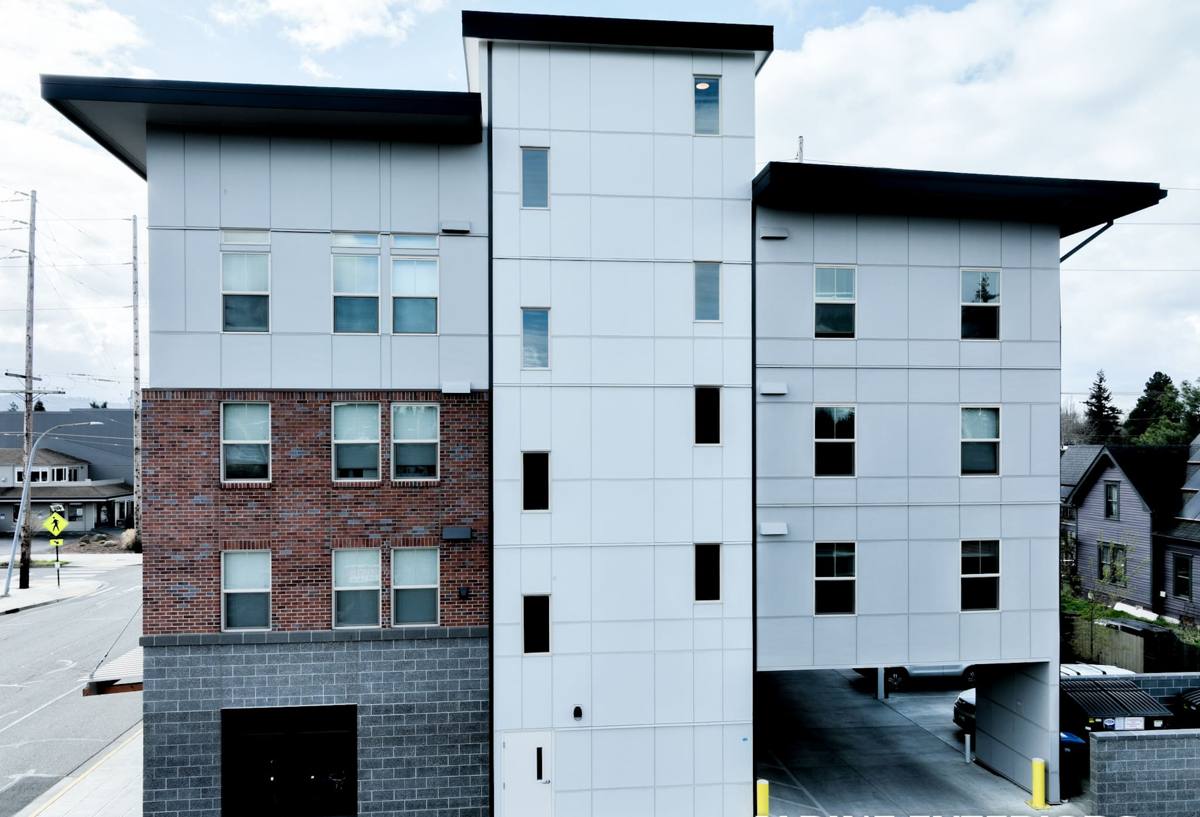
What Salt Air, Rain, and Moss Actually Do to a Home's Exterior
Salt air
Airborne salt from Bellingham Bay settles on exterior surfaces and accelerates corrosion of exposed metal — fasteners, flashing, trim edges — and it also holds moisture against the wall longer than dry air would. Siding materials that rely on paint film integrity or that swell and contract with moisture are more vulnerable to this than a dense, stable material.
Driving rain
Pacific Northwest storms in this part of Washington don't just fall straight down — wind off the water pushes rain sideways into wall assemblies, wall penetrations, and butt joints. A siding system is only as good as its weakest seam, and driving rain finds every seam that wasn't detailed correctly.
Moss and prolonged dampness
Many Bellingham lots have significant tree cover, which means shaded, slow-drying wall sections. Moss and algae thrive in exactly those conditions, and once established they hold moisture against the siding surface almost continuously. Over time that constant dampness is harder on a wall than an occasional heavy storm — it's the slow, steady exposure that breaks down materials that can't tolerate it.
Why We Install Only James Hardie Fiber Cement
We don't offer vinyl siding, LP SmartSide, Cemplank, Allura, or primed wood species like spruce or cedar. That's a deliberate standard, not a lack of options, and it's worth explaining honestly rather than just asserting it.
- Vinyl is inexpensive and low-maintenance in the right climate, but it's a thin plastic product that expands and contracts with temperature and can become brittle over time — it isn't the material we'd choose for a coastal, storm-exposed wall.
- LP SmartSide is an engineered wood product. Engineered wood, by its nature, is more sensitive to sustained moisture exposure than fiber cement — and sustained moisture is exactly what a shaded, damp Bellingham lot delivers.
- Cedar and primed spruce are attractive, traditional choices, but real wood siding demands ongoing maintenance — recoating, caulking, and monitoring for rot — that most homeowners underestimate until the bills start arriving.
- Cemplank and Allura are also fiber cement products and share some of Hardie's core advantages, but we've built our installation process, our fastening details, and our warranty relationship entirely around one manufacturer's engineering specs, and we think that specialization produces a better result than switching systems from job to job.
James Hardie fiber cement is non-combustible, dimensionally stable across our temperature swings, and factory-finished with ColorPlus technology so the color coat is baked on and warrantied rather than applied on-site and left to weather unevenly. Hardie also engineers region-specific product lines (their HZ5 line is built for climates like ours), which matters more than it sounds like it should — a siding product engineered for the Southwest and a siding product engineered for the Pacific Northwest are not interchangeable.
What a Correct Installation Involves Here
Fiber cement siding's real-world performance depends far more on installation quality than most homeowners realize. The material itself is durable; the failures we get called to repair almost always trace back to installation shortcuts, not the product. In a climate with driving rain and salt air, a few details matter more than they would elsewhere:
| Detail | Why it matters in Bellingham |
|---|---|
| Weather-resistive barrier and proper lap | Rain driven sideways by coastal wind needs a continuous drainage plane behind the siding, not just a barrier that's "close enough" |
| Flashing at windows, doors, and penetrations | These are the points where driving rain intrudes first; correct flashing sequencing keeps water moving out, not in |
| Fastener selection and placement | Salt air corrodes the wrong fasteners over time; correct placement also prevents the cracking that leads to moisture entry |
| Clearance and gaps at grade, decks, and roof lines | Bellingham's damp, shaded lots need siding held clear of standing moisture and debris that traps water against the bottom edge |
| Caulking and joint treatment | Manufacturer-spec sealants and joint gaps stop water intrusion without trapping moisture inside the wall assembly |
Every one of those details is spelled out in James Hardie's published installation instructions, and following them precisely is also what keeps the manufacturer's warranty intact. Skipping steps to save time on a job doesn't just risk premature siding failure — it can void the coverage a homeowner is counting on.
Our Process for Bellingham Fiber Cement Siding Projects
We run every project the same disciplined way, whether it's a full re-side or a section replacement:
- On-site assessment — we look at the home's exposure (how much direct storm and salt-air exposure it gets, how shaded and slow-drying the walls are) before recommending anything.
- Removal and inspection — old siding comes off and we inspect the sheathing and framing underneath for moisture damage before covering it back up. This step catches problems that would otherwise get sealed inside the wall.
- Weather barrier and flashing installation — done to manufacturer spec, with particular attention to window, door, and penetration details given how much driving rain this area sees.
- Hardie siding installation — installed with correct fastener type, spacing, and clearances for our climate zone.
- Final detailing — caulking, trim, and touch-up finish work, followed by a walk-through so the homeowner understands what was done and what maintenance, if any, is expected going forward.
Fiber Cement vs. Other Siding Options for This Climate
| Factor | James Hardie Fiber Cement | Vinyl | Wood / Engineered Wood |
|---|---|---|---|
| Salt air resistance | Strong — dense, non-organic material | Moderate — can become brittle over time | Weaker — organic material, moisture-sensitive |
| Driving rain / moisture tolerance | Strong when correctly installed and sealed | Moderate — relies on lap seams staying intact | Weaker — prone to swelling, rot if moisture gets in |
| Moss and algae resistance | Good — dense surface, factory finish | Fair — can host growth in shaded, damp spots | Poor without regular treatment and recoating |
| Fire resistance | Non-combustible | Combustible | Combustible |
| Maintenance burden | Low — factory finish, occasional wash | Low, but limited repair options if damaged | High — recoating, caulking, rot monitoring |
| Typical lifespan when installed correctly | Multiple decades | Multiple decades, shorter in harsh coastal exposure | Varies widely with maintenance discipline |
Ongoing Care for Fiber Cement Siding in a Moss-Prone Climate
Fiber cement is low-maintenance compared to wood, but "low-maintenance" doesn't mean "no maintenance," especially on a shaded Bellingham lot where moss pressure is constant. A short annual routine keeps siding performing the way it's supposed to:
- Rinse the siding surface (a garden hose is usually enough) once or twice a year, more often on heavily shaded walls
- Trim back vegetation and tree limbs that keep a wall section shaded and slow to dry
- Check gutters and downspouts before the fall rains — misdirected water is one of the most common causes of localized siding staining and moss growth
- Inspect caulking at trim, windows, and joints annually and have gaps re-sealed before they let water in
- Walk the exterior after major storms and note any impact damage, loose trim, or areas holding water against the wall
Why Hiring a Crew That Already Works Bellingham Matters
Fiber cement installation manuals are the same everywhere Hardie sells the product. What isn't the same is judgment — knowing which walls on a given lot need extra flashing attention because they take the brunt of storm-driven rain, which shaded sections are going to fight moss no matter what, and which grade and drainage conditions around a Bellingham home need special handling before the first course of siding ever goes up. That judgment comes from doing this work repeatedly in this specific climate, not from a general contractor's résumé or a one-size-fits-all install crew passing through.
We also stand behind the work with a manufacturer relationship built on following Hardie's installation specs to the letter, which is what keeps the product warranty valid and keeps callbacks rare in the first place.
If you're weighing a full re-side or dealing with aging, damaged, or high-maintenance siding on a Bellingham home, we're glad to take a look and talk through what your home's specific exposure calls for. Reach out for a free, no-pressure estimate — there's a form right below to get started.