 Semiahmoo Siding
 Why California Creek Siding Wears Out Faster Than the Manufacturer's Brochure Suggests
Every siding product sold in the Pacific Northwest gets tested against "normal" weather exposure. Homes along California Creek don't get normal weather exposure. This is a low-lying pocket of Whatcom County close to Semiahmoo Bay, where salt-laden air moves in off the water, rain arrives sideways more often than straight down, and shaded, moisture-holding microclimates along the creek corridor keep siding damp for days after a storm has already passed everywhere else in town. That combination is hard on every exterior material, but it's especially hard on the ones that weren't built to handle it.
Salt air accelerates corrosion on fasteners, flashing, and any exposed metal trim. Driving rain finds the seams, laps, and butt joints that a calmer climate would never stress-test. And the long moss season here — often running from early fall through late spring — means algae and moss spores land on siding surfaces and get the sustained dampness they need to take hold, especially on north- and east-facing walls shaded by trees along the creek. A siding product that's marginal on moisture resistance somewhere drier will show its weaknesses here first, and it will show them sooner than most homeowners expect.
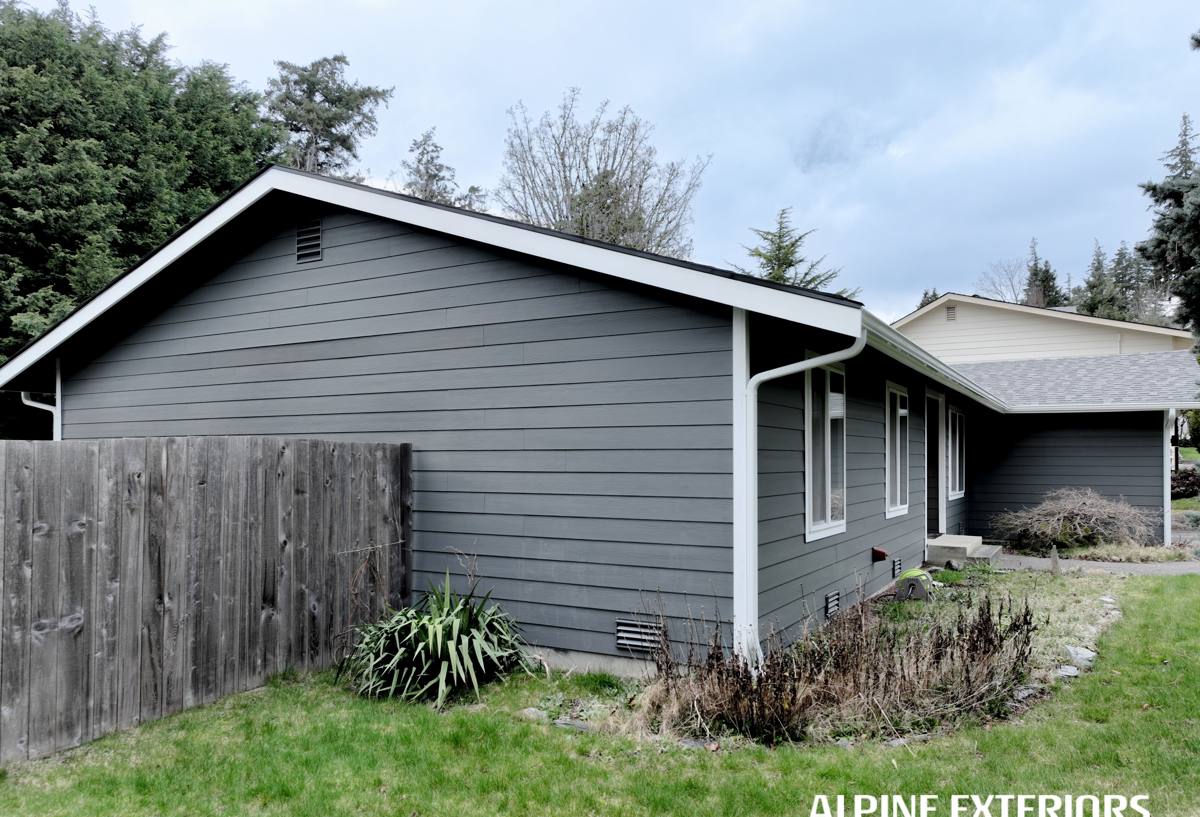
What a Correct Siding Replacement Actually Involves
Siding replacement isn't just stripping old panels off and nailing new ones on. Done right, it's a full envelope job, and skipping any part of it is exactly how a brand-new siding job ends up with rot problems five years later.
Full Tear-Off and Sheathing Inspection
We remove the existing siding down to the sheathing on every wall, not just the sections that look obviously damaged. This is the only point in the entire project where anyone can actually see the condition of the wall behind the cladding. In a climate like this one, it's common to find soft or delaminated sheathing around old window flashing, penetrations, or anywhere the original water-resistive barrier failed. Any compromised sheathing gets replaced before a single new panel goes up — covering it over just locks the problem inside the wall.
Water-Resistive Barrier and Flashing
A new weather-resistive barrier goes on over the sheathing, lapped correctly from bottom to top so water sheds outward at every seam. Flashing gets installed at every window, door, and penetration, and it gets integrated with the barrier in the correct shingle-lap order — flashing first, barrier lapped over it, never the reverse. This detail matters more here than in drier climates, because driving rain will find any shortcut in the flashing sequence and push water behind it instead of over it.
Fastening, Clearances, and Ventilation
Correct fastener type and placement, proper clearance from grade, decks, and roof lines, and enough of an air gap for the wall assembly to dry if it does take on moisture — these details don't show up in a driveway photo, but they're the difference between siding that lasts three decades and siding that starts failing at year eight. We follow manufacturer installation specifications exactly, because that's also what keeps a warranty valid if something ever does go wrong.
Why We Install Only James Hardie Fiber Cement
We get asked fairly often why we don't offer vinyl, LP SmartSide, or cedar as options. The honest answer is that we looked at what actually holds up in this specific climate — salt air, sustained damp, heavy moss pressure — and standardized on one product system rather than selling whatever a homeowner might prefer on price alone.
| Material | How It Handles This Climate | Why It's Not What We Install |
|---|---|---|
| Vinyl siding | Doesn't rot, but expands/contracts with temperature swings and can warp or crack in wind-driven storms | Seams and laps are more prone to moisture intrusion behind the panel over time |
| LP SmartSide (engineered wood) | Treated wood strand product; performs reasonably when maintained perfectly | Any coating breach lets moisture into the wood substrate, and constant dampness here shortens that margin for error |
| Cedar / primed spruce | Attractive natural look, but wood is wood | Requires ongoing sealing and repainting to resist rot and moss in a climate that stays damp much of the year |
| James Hardie fiber cement | Non-combustible, dimensionally stable, engineered specifically for high-moisture regions | This is what we install — no trade-offs to explain away |
None of these other products are bad in every setting — cedar looks great, vinyl is inexpensive, LP has its fans. But we're not installing siding for an average climate. We're installing it for a stretch of Whatcom County that sits close to the water and stays wet for a large part of the year, and fiber cement is the material that handles that reality with the least long-term maintenance burden.
Picking the Right Hardie Product Line for a Coastal Microclimate
James Hardie makes climate-specific formulations, and this isn't marketing — it's a real engineering difference. Their HZ5 product line is formulated for regions with freeze-thaw cycling and sustained moisture exposure, which fits this part of Washington better than the HZ10 formulation built for hot, humid climates. For a California Creek property, that means we're not just installing "Hardie siding" — we're specifying the version of it that was engineered for conditions close to what's actually happening outside the house.
ColorPlus factory-applied finish is the other piece worth understanding. It's baked on and cured before the panels ever arrive on site, which gives it more consistent color retention and resistance to fading from UV and salt exposure than field-applied paint. It also comes with its own finish warranty, separate from the substrate warranty, which matters in a climate where standard paint jobs on other materials tend to need attention well before their advertised lifespan.
Our Replacement Process, Start to Finish
- On-site assessment — we walk the exterior, check for moisture damage, and look at drainage, grade, and shading conditions specific to the property.
- Written scope and product selection — panel profile, HZ formulation, and ColorPlus color are specified in writing before any work begins.
- Full tear-off — old siding and trim removed down to the sheathing on all affected walls.
- Sheathing repair — any soft, delaminated, or rotted sheathing is replaced, not patched over.
- Water-resistive barrier and flashing installation — installed in correct shingle-lap sequence at every seam and penetration.
- Hardie panel installation — fastened, spaced, and clearanced to manufacturer specification.
- Trim, caulking, and finish detailing — corners, window and door trim, and butt joints sealed correctly.
- Final walkthrough — we review the finished work with the homeowner before calling the job complete.
Signs a California Creek Home Needs Replacement Now, Not Later
Not every siding problem means full replacement — sometimes a section repair or better maintenance schedule is genuinely the right call. But certain signs mean waiting will cost more than acting does.
- Soft or spongy spots when you press on the siding, especially near the bottom courses or below windows
- Persistent moss or dark staining that returns within weeks of cleaning, particularly on shaded or creek-facing walls
- Visible gaps, warping, or buckling panels, especially after a windy storm
- Peeling or bubbling paint that keeps recurring in the same spots year after year
- A musty smell in an interior room that shares a wall with a problem area outside
- Siding installed more than 20-25 years ago with no major update since, especially on the water-facing side of the house
If more than one of these applies, it's worth getting a professional look before another wet season adds to the damage.
What Drives the Cost of a Siding Replacement Project
| Cost Factor | Why It Matters Here |
|---|---|
| Sheathing condition | Hidden rot found during tear-off adds material and labor that can't be quoted until the wall is opened up |
| Home size and wall complexity | More corners, dormers, and trim detail means more cutting, fitting, and labor time |
| Panel profile and finish | Lap, shingle, and panel styles carry different material costs; ColorPlus colors are priced by finish, not just profile |
| Site access | Properties near the creek with limited driveway or yard access can add scaffolding or staging time |
| Existing moisture damage | Extensive rot from a long-neglected wall assembly is the single biggest swing factor in final project cost |
We don't quote a number without seeing the house first — anyone who does is guessing, and guesses on a job like this tend to be wrong in the homeowner's disfavor once tear-off starts.
Why It Matters to Hire a Crew That Already Works This Area
Installation quality is what actually determines whether James Hardie siding performs the way it's engineered to. A crew that treats every job the same regardless of location will follow the same generic install pattern whether the house is in a dry inland valley or three blocks from Semiahmoo Bay. That's how you end up with technically-correct-on-paper installations that still develop moisture problems, because the generic approach didn't account for the specific exposure a California Creek wall actually faces — the wind direction storms tend to come from, the walls that stay shaded and damp longest, the fastener corrosion risk from sustained salt exposure.
A crew that already works this stretch of Whatcom County has seen where these houses actually fail, which means the flashing details, clearances, and product choices get adjusted for reality instead of copied from a generic spec sheet. That local pattern recognition doesn't show up as a line item on a quote, but it's a large part of why some siding jobs last thirty years and others start showing problems in eight.
Caring for New Siding Through the Moss Season
James Hardie siding needs far less maintenance than wood or engineered wood alternatives, but "low-maintenance" isn't "no-maintenance," especially with a moss season this long. A yearly rinse-down before the wet months set in, keeping nearby vegetation trimmed back so walls get some airflow and sun exposure, and checking caulking at trim joints every couple of years will keep a correctly installed Hardie exterior looking and performing the way it's supposed to for decades. None of this is heavy work — it's a fraction of what cedar or engineered wood siding demands in the same conditions.
If you're weighing whether your California Creek home's siding needs a repair, a partial replacement, or a full tear-off, we're happy to take a look and give you a straight answer either way. Reach out for a free, no-pressure estimate using the form below.