 Semiahmoo Siding
 Birch Bay Sits in a Tougher Climate Than Most People Realize
Birch Bay looks calm on a summer afternoon, but the siding on a Birch Bay home works harder than siding almost anywhere else in Whatcom County. The water is right there, which means salt-laden air moving onto every exposed wall, day after day, year after year. Add in driving rain off the Strait of Georgia, wind that doesn't let up in the winter months, and a moss season that can stretch from October through April, and you have a set of conditions that will find every weakness in a siding product or an installation shortcut.
We install fiber cement siding on homes throughout the Semiahmoo area, and Birch Bay properties consistently show more weathering stress on their exteriors than homes even a few miles inland. Waterfront and near-waterfront lots take the brunt of it. This page is about what fiber cement siding needs to do in this specific environment, what a correct installation actually involves, and why we only install James Hardie products to get there.
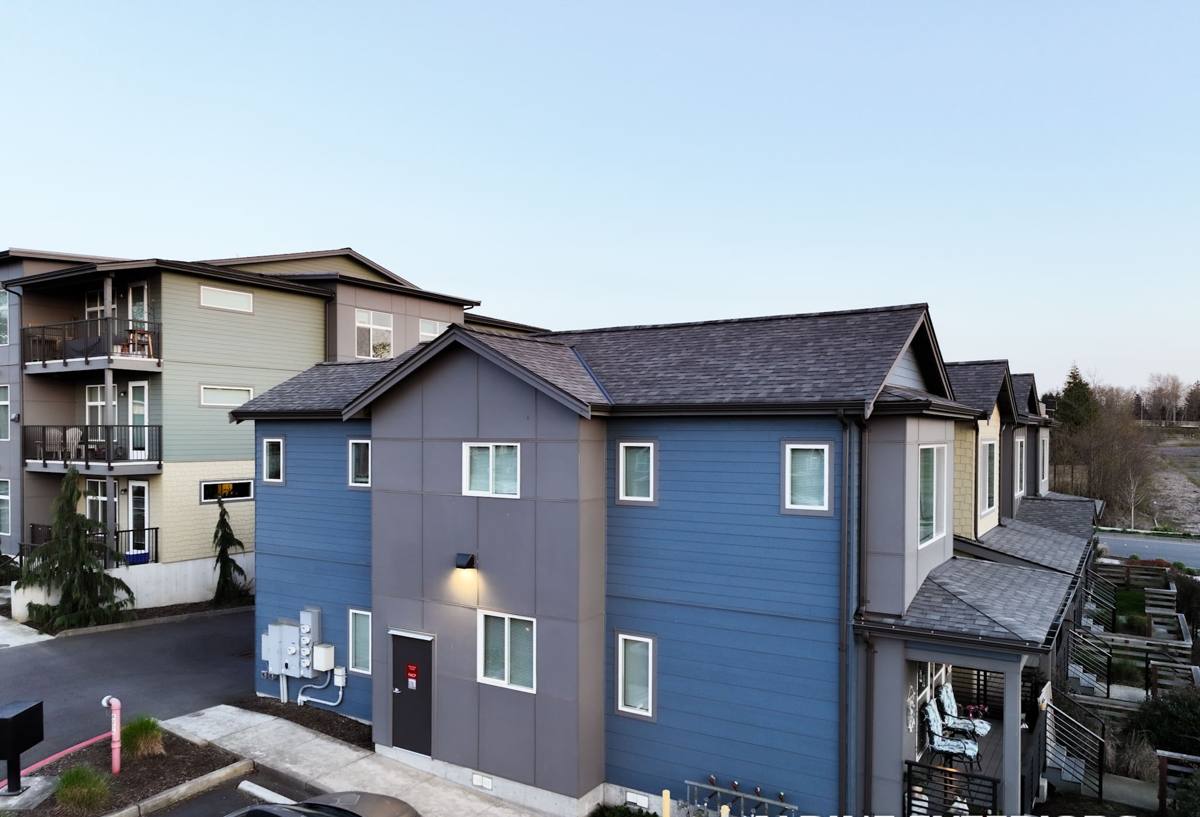
What Birch Bay's Climate Actually Does to Siding
Salt Air
Airborne salt is corrosive to metal fasteners, trim flashing, and any siding component that isn't rated to handle it. Over time it also accelerates the breakdown of lower-grade paint finishes, leading to chalking, fading, and premature repainting. A siding system exposed to salt air needs a finish that's engineered to resist that breakdown, not a standard exterior paint job applied on site.
Driving Rain
Wind-driven rain doesn't just wet a wall — it pushes water sideways and upward, testing every seam, joint, and piece of flashing on the house. This is where installation quality matters as much as the product itself. A siding material can be excellent and still fail if the water-management details behind it (house wrap, flashing, joint treatment) aren't done correctly.
Extended Moss and Mildew Season
Whatcom County's damp, mild winters create long stretches of moisture sitting on north-facing and shaded walls. Organic materials and porous surfaces are more vulnerable to moss, algae, and mildew growth in these conditions. Siding that holds moisture at the surface, or that has seams and gaps where debris and moisture collect, gives moss more places to take hold.
Temperature Swings and Wind
Birch Bay gets real wind events, especially in fall and winter. Siding and trim need to be fastened and sealed to hold up under repeated wind loading, not just look good on a calm day during installation.
Why We Install Only James Hardie Fiber Cement Here
Fiber cement as a category is a strong choice for a coastal, wet climate because it's non-combustible, dimensionally stable, and doesn't swell, rot, or attract insects the way wood-based products can. But not all fiber cement is manufactured or finished the same way, and in a climate like Birch Bay's, those differences show up faster than they would somewhere drier.
We standardized on James Hardie for a few concrete reasons that matter directly to this location:
- HZ5 engineered product line: Hardie manufactures siding formulated for specific climate zones, including harsher, wetter regions. That climate-specific engineering matters on a site that's dealing with salt air and constant moisture exposure.
- ColorPlus factory finish: The color is baked on at the factory under controlled conditions, rather than field-painted after installation. That finish is formulated to resist fading and hold up to UV and moisture exposure better than a standard field-applied coat, which matters when salt air is already working against the finish.
- Non-combustible core: Fiber cement doesn't provide fuel the way wood siding products do, which is a meaningful consideration anywhere in the Pacific Northwest.
- Track record and warranty structure: Hardie backs its products with a strong, transferable warranty, which matters to homeowners planning to sell in the years ahead and to us as the installer standing behind the work.
We don't install vinyl, LP SmartSide, Cemplank, Allura, or primed wood siding. That's not a knock on every homeowner who has one of those products — it's a professional standard we hold for the work we put our name on, based on how those materials perform over time in exactly this kind of coastal, wet, moss-prone environment.
What a Correct Fiber Cement Install Involves
The siding board itself is only part of the system. In a location like Birch Bay, the installation details are what determine whether the siding performs for 30+ years or starts showing problems in five.
| Step | Why It Matters in Birch Bay |
|---|---|
| Water-resistive barrier (house wrap) installed correctly, lapped shingle-style | Stops wind-driven rain from reaching the sheathing even if water gets past the siding surface |
| Proper flashing at windows, doors, and roof-to-wall intersections | These are the highest-risk leak points under driving rain conditions |
| Correct fastener type, spacing, and depth per Hardie's installation specs | Salt air accelerates corrosion on the wrong fastener type; improper fastening also voids warranty coverage |
| Proper clearance between siding and grade, decks, and roof lines | Keeps the bottom edge of the siding from sitting in standing moisture, a common moss and rot starting point |
| Correctly caulked and sealed joints, or engineered gapped joints per Hardie spec | Prevents water intrusion at seams during sustained wind-driven rain |
| Adequate ventilation behind the siding (rainscreen where appropriate) | Lets moisture that does get in dry out instead of sitting against the wall assembly, reducing moss and mildew risk |
Every one of these steps is spelled out in Hardie's published installation instructions, and following them precisely is what keeps the manufacturer's warranty valid. It's also, frankly, just the difference between siding that performs and siding that doesn't in this climate.
Signs a Birch Bay Home's Siding Needs Attention
- Moss or dark streaking concentrated on north- or west-facing walls
- Visible gaps, cracking, or separation at seams and corner boards
- Paint that's chalking, peeling, or fading unevenly, especially on walls facing the water
- Soft spots, staining, or discoloration near the bottom courses of siding close to grade
- Rust streaking from fasteners or trim hardware
- Visible warping or bowing in existing wood-based or composite siding
Any of these can be an early sign that moisture is getting past the siding surface, which is worth addressing before it reaches the sheathing or framing behind it.
Our Process for a Birch Bay Siding Job
1. On-Site Assessment
We walk the exterior, check current siding condition, identify problem areas (especially water-facing and shaded walls), and look at existing flashing, trim, and moisture damage before quoting anything.
2. Product and Color Planning
We help homeowners select the right Hardie product line and ColorPlus finish for their home, factoring in sun and wind exposure specific to their lot.
3. Tear-Off and Substrate Check
Old siding comes off, and we inspect the sheathing underneath for existing moisture damage before installing new house wrap. This step matters more in Birch Bay than in drier inland areas, since long-term moisture exposure is more likely to have already affected the wall assembly.
4. Installation to Manufacturer Spec
House wrap, flashing, fastening, joint treatment, and clearances are all installed to Hardie's published specifications — not shortcuts, not "close enough."
5. Final Walkthrough
We review the finished work with the homeowner, including care and maintenance guidance specific to a coastal, moss-prone property.
Why Hiring a Crew That Already Works Birch Bay Matters
Fiber cement installation isn't complicated in theory, but getting it right in a demanding coastal environment takes attention to details that a crew unfamiliar with this specific climate might not prioritize. A contractor who mostly works drier, inland jobs may not default to rainscreen detailing, may not think twice about fastener corrosion resistance, and may not flag moss-prone wall orientations during the walkthrough. None of that shows up as a problem on day one — it shows up in year three or four.
We work in Semiahmoo, Birch Bay, and the surrounding Whatcom County waterfront communities regularly, so these considerations are part of our default process, not an afterthought. That's also why we stand behind our installation work in addition to the manufacturer's product warranty — the two are only as good as each other.
What to Expect Cost-Wise
Fiber cement siding costs more upfront than vinyl and is comparable to or somewhat more than engineered wood products, depending on the specific Hardie line, trim package, and the condition of the substrate underneath the old siding. Homes closer to the water with more wind and salt exposure sometimes call for additional flashing and rainscreen detailing, which affects the scope of the job. We provide a specific, itemized estimate after seeing the property in person — broad ballpark numbers without an on-site look aren't useful in a climate this variable from lot to lot.
Ready for an Honest Look at Your Siding?
If you're in Birch Bay and dealing with moss, fading, soft spots, or siding that's simply aged out, we're happy to come take a look and give you a straight assessment — no pressure, no obligation. Use the form below to request a free estimate, and we'll walk your property with the specific conditions of your lot in mind.