 Semiahmoo Siding
 Why Siding Fails Faster Near California Creek
Homes around California Creek sit close to Semiahmoo Bay and the low, wooded drainage that feeds it, which means three things are working against the siding on your walls almost every day of the year: salt-laden air off the water, wind-driven rain that hits siding sideways instead of straight down, and shade from surrounding trees that keeps north and west walls damp long after a storm has passed. None of that is unusual for Whatcom County, but the combination is harder on a home's exterior than most homeowners realize until they're already dealing with soft trim, peeling paint, or siding that's swelling at the seams.
Salt air accelerates corrosion on fasteners, flashing, and any exposed metal. Driving rain finds the smallest gap in a lap joint or a butt seam and pushes water behind the siding rather than letting it run off the face. And moss doesn't just sit on a roof — given enough shade and moisture, it colonizes siding surfaces, trim, and the caulk lines between them, holding water against the material for weeks at a stretch. Siding that isn't built and installed to handle that cycle doesn't fail all at once. It fails slowly, at the seams and fastener points, in the exact way water travels.
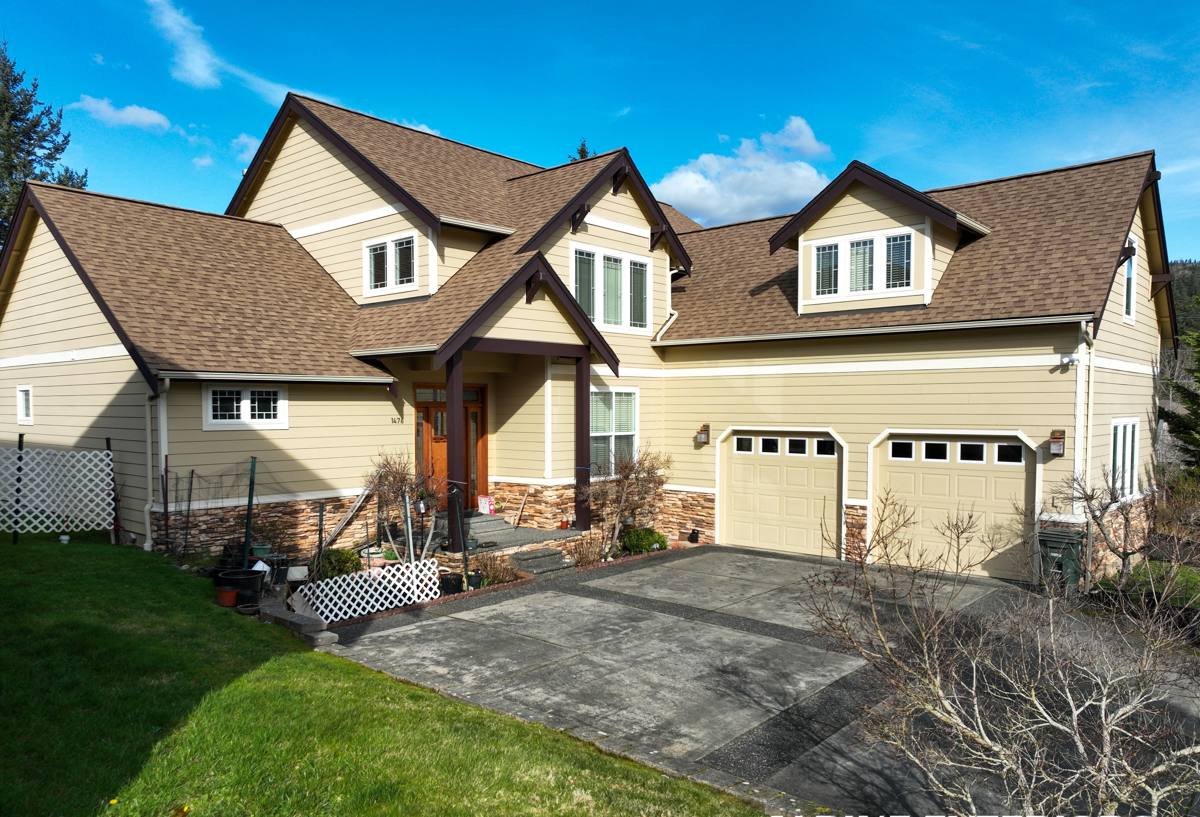
What a Correct Siding Installation Involves
A siding installation that holds up in this environment isn't really about the siding material alone — it's about everything behind it. The parts homeowners never see are usually what decide whether a wall stays dry for thirty years or starts showing rot in five.
The Water-Management System Behind the Siding
Correct installation starts with a drainage plane — a weather-resistant barrier applied over the sheathing — and a rainscreen gap or approved drainage mat that lets any water that gets behind the siding drain out and air-dry instead of sitting against the wall. Every window, door, and penetration needs proper flashing integrated with that barrier in the right shingle-lap order, so water is always directed outward and down, never trapped. On a site this close to the water, we treat this layer as non-negotiable, not an upgrade.
Fastening and Field Cuts
Fiber cement siding has to be fastened at the manufacturer's specified pattern and depth — over-driven or under-driven nails both create failure points, and in salt air, the wrong fastener material corrodes and streaks the siding within a few years. Field-cut edges need to be sealed and primed before installation, because an unsealed cut edge is the fastest way for a fiber cement board to absorb moisture and start delaminating at that spot.
Signs Your Current Siding Is Already Losing the Fight
Because failure happens gradually, most homeowners don't notice until it's visible from the street. Walk your exterior — especially the north and west-facing walls and anything shaded by trees — and look for:
- Soft or spongy spots when you press on siding or trim near the bottom courses
- Paint that's peeling, bubbling, or chalking heavily in one area but not others
- Visible gaps opening up at butt joints or where boards meet trim
- Persistent green or black staining that returns within weeks of cleaning
- Warping, cupping, or boards that no longer sit flat against the wall
- Rust streaks below fasteners or flashing
- A musty smell near exterior walls inside the home, which can mean moisture is already past the siding
Any one of these on its own might just need a repair. Several together, especially on the same wall, usually mean the water-management layer behind the siding has already been compromised.
Our Installation Process, Step by Step
We run the same disciplined process on every California Creek project, because skipping a step is exactly how the problems above start.
- Walk-through and assessment — we look at existing siding, trim condition, and any signs of moisture intrusion before quoting anything, so the estimate reflects what your walls actually need.
- Removal and sheathing check — old siding comes off and we inspect the sheathing underneath for soft spots or hidden rot before anything new goes on. Problems found here get addressed, not covered up.
- Weather-resistant barrier and drainage plane — installed to manufacturer spec with correct overlaps and integrated flashing at every window, door, and penetration.
- Rainscreen gap — creates the air space that lets incidental moisture drain and dry rather than sit against the wall.
- Siding installation — James Hardie boards or panels installed at the specified fastener pattern, with all field cuts sealed before they go up.
- Trim, caulking, and touch-up — factory-finished ColorPlus trim and touch-up paint matched to the product, so seams and fastener heads blend rather than becoming the next weak point.
- Final walk-through — we go over the finished exterior with you before calling the job done.
Why We Install Only James Hardie Fiber Cement Here
We've made a deliberate choice not to install vinyl, LP SmartSide, or other fiber cement brands, even though all of them have a place in the market. For this climate specifically, James Hardie's product line addresses the failure points we see most often on Whatcom County exteriors.
Built for Wet, Coastal Climates
James Hardie engineers its HZ product lines by climate zone, and the HZ5 formulation used in the Pacific Northwest is built for exactly this combination of rain, humidity, and temperature swings. Fiber cement itself doesn't rot, warp, or feed moss and mold the way wood-based products can — it's cement, sand, and cellulose fiber, so it doesn't give organic growth anything to root into.
A Factory Finish That Doesn't Depend on Field Conditions
ColorPlus finish is baked on at the factory under controlled conditions, not brushed or sprayed on-site in whatever weather shows up that week. That matters here — a field-applied finish is only as good as the drying conditions it gets, and drying conditions near the water are inconsistent. A factory finish also comes with a longer, more consistent warranty against fading and peeling than most site-applied paint jobs.
Non-Combustible
Fiber cement doesn't burn, which isn't the primary reason homeowners choose it in this part of the state, but it's a real, tangible advantage over wood-based siding products with no real trade-off attached.
What Siding Installation Costs — and What Drives the Price
Every home is different, but the main variables that move a siding quote up or down are consistent. This isn't a price list — it's what to expect a contractor to walk you through before you sign anything.
| Cost Factor | Why It Matters |
|---|---|
| Condition of existing sheathing | Hidden rot found during removal adds repair scope before new siding can go on |
| Home size and wall complexity | More corners, gables, and dormers mean more cutting, flashing, and labor time |
| Siding profile chosen | Lap siding, board-and-batten, and panel systems differ in material and install time |
| Trim and accent work | Detailed trim packages add material and finish labor beyond the field siding |
| Access and site conditions | Tree cover, slope, and tight setbacks near the creek can affect staging and scaffolding |
| Removal and disposal | Tear-off and haul-away of old siding is separate from the new install labor |
Ask any contractor quoting your project to break the estimate down by these categories. A number with no explanation behind it makes it hard to compare bids fairly.
Why a Crew That Already Works This Area Matters
Detailing a wall correctly on paper and detailing it correctly in the field are two different skills, and the difference shows up most on sites where wind direction, shade, and moisture don't behave the way a textbook assumes. A crew that's worked repeatedly around Semiahmoo and the Whatcom County coastline already knows which walls on a given lot orientation take the worst of the driving rain, where moss tends to establish first, and how much drainage capacity a rainscreen needs on a shaded, water-adjacent lot versus an open one further inland. That's not something you can fully spec from a manufacturer's install manual — it comes from having done the work here, repeatedly, and seen which details hold up over years and which ones don't.
It also means faster, more accurate estimates, because we're not guessing at local conditions — we're applying what we've already confirmed works on homes like yours.
Caring for New Siding After Installation
Correctly installed James Hardie siding is genuinely low-maintenance, but "low-maintenance" doesn't mean "no maintenance" in a salt-air, high-moss environment. A yearly rinse-down to clear salt residue and organic buildup, prompt attention to any caulking that starts to crack or separate, and keeping tree branches trimmed back from siding surfaces to reduce shade and debris will keep a new installation performing the way it's designed to for decades.
If you're seeing any of the warning signs above, or you're simply ready to stop maintaining siding that was never built for this coastline, we're glad to take a look. Reach out for a free, no-pressure estimate — we'll walk your home, tell you honestly what we find, and give you a clear, itemized quote using the form below.