 Semiahmoo Siding
 Why Blaine Roofs Wear Differently Than Roofs Inland
Blaine sits close enough to the water that the air itself works against a roof. Salt-laden marine air moves in off Semiahmoo Bay and Drayton Harbor, settles into fasteners, flashing seams, and exposed metal, and speeds up corrosion that a roof thirty miles inland wouldn't see for another decade. Add driving, wind-pushed rain off the Strait of Georgia, and you get water finding its way sideways under shingles and around vents in ways a straight-down rainstorm never would. Then there's the moss. Whatcom County's mild, wet stretch from fall through spring gives moss and algae a long runway to take hold on north-facing slopes and shaded valleys, and once established it holds moisture against the roofing material year-round.
None of this means a Blaine roof is doomed to constant repair. It means the repairs that do come up have specific causes, and fixing them well means understanding those causes rather than just patching the visible symptom.
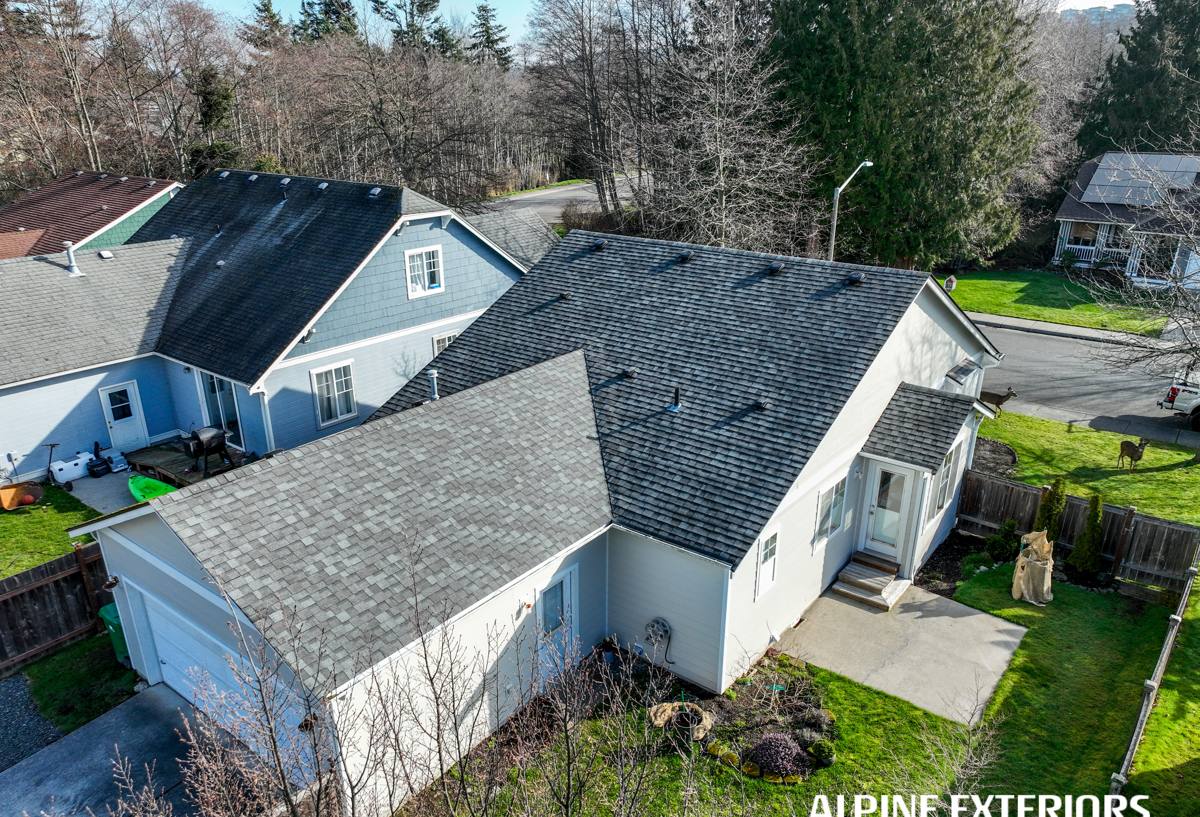
Signs a Blaine Roof Needs Attention
Most roof problems here don't show up as a dramatic leak on day one. They show up as small, easy-to-dismiss signs that build for a season or two before water actually gets inside. Homeowners who catch these early save real money.
- Dark streaking or green-black growth on shingles, especially on north or shaded slopes
- Granules collecting in gutters or at downspout outlets
- Soft or spongy spots when walking the roof (should only be checked by a professional)
- Rust staining below metal flashing, vents, or fasteners
- Daylight visible through the attic roof deck, or damp insulation near the eaves
- Shingles curling, lifting at the edges, or missing after a windy front off the water
- Water stains on interior ceilings near chimneys, skylights, or where two roof planes meet
Any one of these on its own might not mean a failing roof. Several together, or any sign paired with an interior stain, is worth a proper inspection before the next wet stretch.
The Repair Calls We See Most in Blaine
Coastal Whatcom County homes tend to develop the same handful of problems, largely because the same climate factors are at work on every roof in the area. Understanding the cause changes how the repair should be done.
| Problem | Typical Cause Here | What a Correct Repair Involves |
|---|---|---|
| Moss colonization | Long damp season, shaded north slopes, low airflow | Careful removal (not aggressive scraping), treatment, and addressing the shade or debris source |
| Flashing leaks at chimneys/valleys | Wind-driven rain forced sideways and upward under laps | Re-flashing with proper step and counter-flashing, not just caulk over the old metal |
| Corroded fasteners or vent boots | Salt air accelerating rust on exposed metal | Replacement with corrosion-resistant fasteners and boots rated for coastal exposure |
| Gutter overflow and fascia rot | Moss and needle debris blocking flow during heavy rain events | Clearing, resloping if needed, and repairing any wood already softened |
| Granule loss / bald patches | Age combined with constant moisture cycling | Spot shingle replacement if isolated, full-slope evaluation if widespread |
Salt Air and Metal Components
The parts of a roof most people never think about — nail heads, flashing edges, vent boot collars — are usually the first to show wear near the water. We look at these closely on every Blaine inspection because a single corroded flashing point is a common source of a leak that otherwise looks mysterious from inside the attic.
Moss Isn't Just Cosmetic
Moss holds water against the roofing surface long after the rest of the roof has dried out. Over a full moss season that constant dampness works into shingle mat, lifts edges, and can work its way under laps at ridges and valleys. Treating moss as a maintenance item rather than waiting until it's visible from the street is one of the more effective things a Blaine homeowner can do for roof longevity.
What a Correct Roof Repair Actually Involves
A roof repair done right is more than swapping out the shingles that look bad. It starts with figuring out why that section failed in the first place, because replacing material without addressing the cause just buys a year or two before the same spot fails again.
- Diagnose the water path. Water rarely enters where it shows up inside. We trace the actual entry point, which is often several feet from the interior stain.
- Check the deck, not just the surface. If the roof sheathing underneath has softened from sustained moisture, that gets addressed before any new material goes on.
- Match flashing to the actual roof geometry. Valleys, chimneys, and dormers each need flashing details specific to that intersection — a generic patch doesn't hold up to wind-driven rain.
- Use fasteners and boots rated for coastal exposure. Standard hardware corrodes faster this close to the water; we account for that in what we install.
- Address the underlying cause — shade, debris, poor airflow, or an aging component — so the repair isn't undone by the same conditions that caused it.
How Our Process Works
We keep the repair process straightforward because homeowners deserve to know exactly what's happening on their roof and why.
1. On-Site Inspection
We walk the roof (weather permitting) and the attic, looking for both the visible damage and the underlying cause. We take photos so you can see what we're seeing, even from the ground.
2. Honest Diagnosis
We tell you plainly whether this is a contained repair, a sign of a larger issue developing, or something that's reasonably fine to monitor for now. We don't manufacture urgency where there isn't any.
3. Written Estimate
You get a clear scope of work and price before anything happens — what's being repaired, what materials are used, and why.
4. The Repair
Work is done to match your existing roofing system as closely as possible, with attention to how the repaired section will perform against the same wind and rain that caused the original problem.
5. Follow-Up
We stand behind the work and are reachable if anything about the repair needs a second look.
Repair or Replace? How to Think About It
Not every roof problem in Blaine calls for a full replacement, but sometimes patch repairs stop making financial sense. Here's a general way to think through it — every roof is different, so treat this as a starting framework, not a verdict.
| Factor | Leans Toward Repair | Leans Toward Replacement |
|---|---|---|
| Roof age | Under two-thirds of expected lifespan | At or beyond expected lifespan for the material |
| Extent of damage | Isolated to one section or flashing point | Spread across multiple slopes |
| Deck condition | Solid, no soft spots found | Sheathing damage found in more than one area |
| Repair history | First or second repair on this roof | Repeated repairs to the same or nearby areas |
| Granule loss | Localized | Widespread and thinning |
When a roof is genuinely in the repair range, we say so and repair it. We don't push replacement on a roof that has good years left in it.
A Practical Maintenance Checklist for Blaine Homeowners
Between professional inspections, a few habits go a long way toward keeping small issues from becoming big ones in this climate:
- Clear gutters and downspouts before the fall rains set in, and again mid-winter if trees are nearby
- Have moss treated at the first sign of growth rather than waiting for full coverage
- Watch for granules building up in gutters after storms — an early aging signal
- Check the attic after major wind events for any new light, damp insulation, or staining
- Keep tree branches trimmed back from the roofline to reduce shade and debris buildup
- Have flashing points (chimney, skylights, valleys) inspected every couple of years, since these fail before the shingle field usually does
Why Hiring a Crew That Already Works Blaine Matters
Roofing crews unfamiliar with this stretch of the Washington coast sometimes treat a Blaine roof like any other Pacific Northwest roof, and miss the details that actually matter here — the accelerated corrosion from salt air, the specific wind direction that drives rain up under laps rather than straight down, and how long the moss season really runs compared to areas even a short drive inland. We work siding and roofing throughout Semiahmoo and the surrounding Whatcom County area regularly, so when we're on a roof in Blaine we're not guessing at what the coastal conditions will do to a repair over the following winter — we've already seen it play out on homes nearby.
That local familiarity also means faster, more accurate estimates. We're not learning the area's climate quirks on your roof; we bring that knowledge with us to every inspection.
Get a Straight Answer About Your Roof
If you're dealing with a leak, moss buildup, or just want a second opinion on a roof that's starting to show its age, we're glad to take a look. We offer free, no-pressure estimates for Blaine homeowners — you'll get an honest read on what your roof actually needs, not a sales pitch. Use the form below to get started.