 Semiahmoo Siding
 Building Decks for Peace Arch Homes Near the Border
Peace Arch sits close enough to Semiahmoo Bay and the Strait that its homes take a different kind of weather than decks built further inland. Salt-laden air off the water, long stretches of driving rain through fall and winter, and a moss season that can run half the year all work on wood, fasteners, and footings in ways that a generic deck build doesn't account for. When we build or replace a deck in this part of Whatcom County, the material choices, fastener grade, and drainage details are picked with that specific exposure in mind, not just to meet code minimums.
A deck here isn't just a weekend backyard project. It's an exterior structure that has to survive years of coastal moisture cycling — wet, dry, wet again — without the frame rotting quietly underneath a deck board that still looks fine on top.
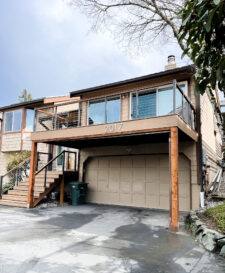
What Peace Arch's Climate Actually Does to a Deck
Salt Air and Metal Fatigue
Being close to Semiahmoo Bay means airborne salt reaches further inland than most homeowners expect, especially with onshore wind. Salt air accelerates corrosion on exposed fasteners, joist hangers, and railing hardware. A deck built with standard interior-grade or even basic exterior screws can show rust bleed and weakening connections years before an identical deck built further from the water. This is one of the most common reasons we see older decks in this area develop loose railings or squeaky, shifting boards long before the wood itself is actually failing.
Driving Rain and Water Intrusion
Rain here doesn't just fall straight down — wind-driven rain gets pushed sideways and up under ledger boards, around post bases, and into any gap where flashing was skipped or done poorly. The ledger board connection (where the deck attaches to the house) is the single most important waterproofing detail on the entire structure. Get it wrong and water tracks behind the siding and into the house framing, which is a much more expensive problem than anything happening on the deck surface.
Moss, Algae, and a Long Wet Season
Whatcom County's wet season stretches long, and shaded or north-facing decks in Peace Arch can stay damp for weeks at a time. That moisture supports moss and algae growth on deck boards, stair treads, and anywhere debris collects against a rail or post. Beyond looking bad, moss holds moisture against the wood surface and turns stair treads and ramps slick — a real slip hazard on a deck that sees regular foot traffic.
What a Correctly Built Deck Looks Like Here
A deck built to hold up in this environment isn't dramatically more expensive than a generic build, but it does require different decisions at almost every stage:
- Stainless steel or heavy hot-dip galvanized fasteners and hardware, not standard coated exterior screws, especially anywhere close to the bay-facing side of a property
- Proper ledger flashing with a drip cap and water-resistant barrier behind it, installed before the ledger board goes up, not caulked on as an afterthought
- Footings sized and set below frost depth per local code, on undisturbed or properly compacted soil
- Joist spacing and beam sizing matched to actual span tables for the decking material chosen, not just "what we did last time"
- Gaps between boards sized to allow drainage and airflow underneath, reducing the standing moisture that feeds moss and rot
- Post bases that keep wood off standing water, with a capillary break where the post meets concrete
- Railing systems rated for the required load, with connections that won't loosen under the freeze-thaw and wet-dry cycling common here
Choosing Decking Material for This Environment
There's no single "best" decking material — each option trades off cost, maintenance, and how it handles this specific climate differently. We walk through the honest trade-offs rather than pushing whichever product has the best margin.
| Material | How It Handles Salt Air & Moisture | Maintenance | Typical Lifespan |
|---|---|---|---|
| Pressure-treated wood | Good if properly sealed and re-sealed on schedule; end grain and fastener holes are the weak points | Annual cleaning, re-staining/sealing every 2-3 years | 15-20 years with upkeep |
| Cedar | Naturally rot- and insect-resistant, but still needs sealing near salt air to prevent graying and surface checking | Regular cleaning, periodic oil or sealant | 15-25 years with upkeep |
| Composite decking | Very stable in wet/dry cycling and doesn't rot, but hidden framing underneath still needs to be treated wood, properly fastened and flashed | Occasional washing; no staining or sealing | 25-30+ years, manufacturer-dependent |
| PVC/cellular decking | Fully resists moisture and salt exposure at the board level; performance still depends entirely on the substructure underneath | Lowest maintenance of the group | 25-30+ years, manufacturer-dependent |
Whatever board material a homeowner chooses, the framing underneath it is where most long-term failures actually start. A composite deck built on undersized, poorly flashed, or corrosion-prone framing will still fail early — the surface material only solves half the problem.
Our Process for a Peace Arch Deck Build
1. On-Site Assessment
We look at sun and shade exposure, prevailing wind direction relative to the water, drainage on the lot, and how the deck will tie into the house — including what's currently happening at the ledger location if this is a replacement.
2. Design and Material Selection
We size the structure to the actual load and span requirements, not a rule of thumb, and walk through decking, railing, and hardware options with real trade-offs explained rather than upsold.
3. Permitting
Most deck builds in this area require a permit, particularly for anything attached to the house or elevated above a certain height. We handle the permit process and make sure footings, ledger attachment, and railing height meet current code before inspection, not after.
4. Demolition (Replacements Only)
When we're replacing an existing deck, we check the ledger and rim joist area for hidden water damage once the old boards come off — this is often where the real story of a deck's condition is, regardless of how the top surface looked.
5. Build
Footings, framing, ledger flashing, decking, and railing go in in that order, with each stage checked before the next starts. Fastener and hardware grade is matched to the exposure level we assessed on-site, not a single default spec used everywhere.
6. Final Walkthrough
We go over the finished deck together, including basic care guidance specific to the material installed and this climate — cleaning frequency, what to watch for with moss, and any sealing schedule if applicable.
Why It Matters to Hire a Crew That Already Works Peace Arch
A contractor who mostly builds decks in a dry inland climate will make different — and sometimes wrong — assumptions when they show up in Peace Arch. They may spec standard hardware instead of corrosion-resistant fasteners, skip the extra flashing detail at the ledger, or space boards for a climate that doesn't deal with sustained wet seasons and moss growth the way Whatcom County does. None of that shows up as a problem on day one. It shows up two, five, or ten years later as rust-stained hardware, a soft spot at the ledger, or a deck surface that's slick half the year.
A crew that already works this area knows which details aren't optional here, and prices and builds accordingly from the start — rather than the homeowner finding out the hard way after the first few wet seasons.
Maintenance That Actually Extends a Deck's Life Here
- Sweep debris (leaves, needles, seed pods) off the deck regularly — trapped debris holds moisture against boards and feeds moss growth
- Rinse or lightly scrub visible moss and algae before it builds up, especially on shaded or north-facing sections and stair treads
- Check railing and stair connections annually for looseness or rust bleed around fasteners
- Keep gutters and downspouts near the deck clear so roof runoff isn't dumping extra water onto or under the structure
- Re-seal or re-stain wood decking on the schedule appropriate to the product — don't wait until graying and checking are already advanced
- Watch the ledger board area at the house wall for any staining, soft spots, or paint bubbling, which can signal water getting behind the flashing
Repair vs. Replace
Not every aging deck in Peace Arch needs a full rebuild. If the framing, footings, and ledger connection are still sound, replacing decking boards, railings, or fasteners can extend the life of a structurally solid deck for a fraction of full replacement cost. But if there's rot at the ledger, undersized or corroded framing connections, or footings that were never properly set, patching the surface just hides the real problem for a while. Part of our assessment is being straight about which situation a given deck is actually in before recommending a repair or a rebuild.
If you're planning a new deck or need an honest look at one that's showing its age, we'd be glad to walk the property with you. Use the form below to request a free, no-pressure estimate for your Peace Arch deck project.